


Grade 3 measurement lesson
Area and Perimeter: Meaning, Formulas, Calculations, Examples, and Quiz
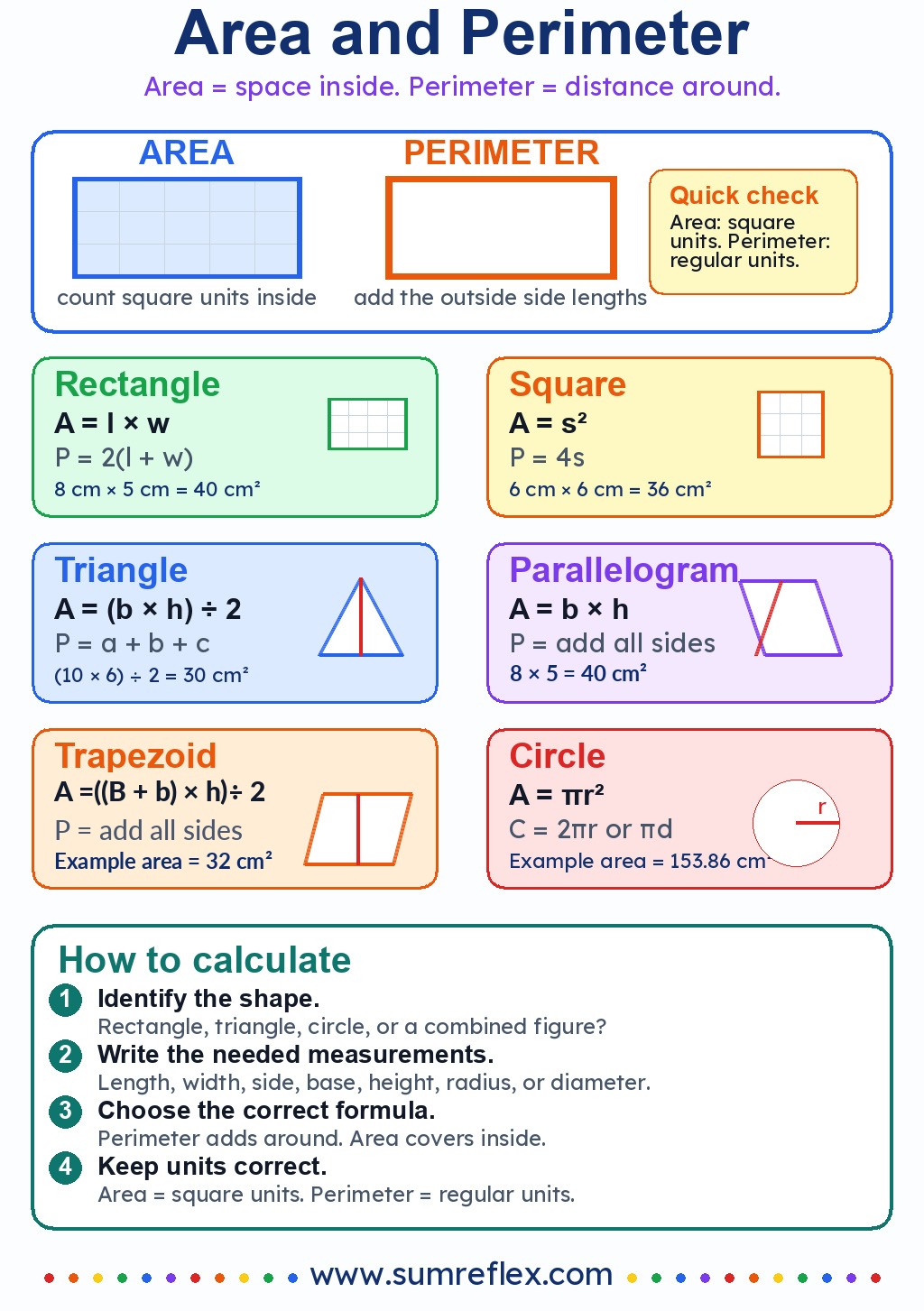
Area measures the space inside a shape. Perimeter measures the distance around a shape. The trick is knowing which one the problem is asking for.
What are area and perimeter?
Area and perimeter both describe a shape, but they do two very different jobs.
Area tells how much flat space is inside a shape. If you are covering a floor with tiles, painting a wall, or finding how much grass is inside a garden, you are thinking about area.
Perimeter tells the distance around the outside edge of a shape. If you are putting a fence around a yard, ribbon around a poster, or trim around a picture frame, you are thinking about perimeter.
A simple way to remember it is this: area covers and perimeter goes around.
Printable area and perimeter formula chart
Use this SumReflex chart when students need a quick reminder of the difference, the formulas, and the unit rules.
The same chart is also available on its Area and Perimeter Chart printable page and in the broader Printable Geometry Charts section.
Area calculation table chart
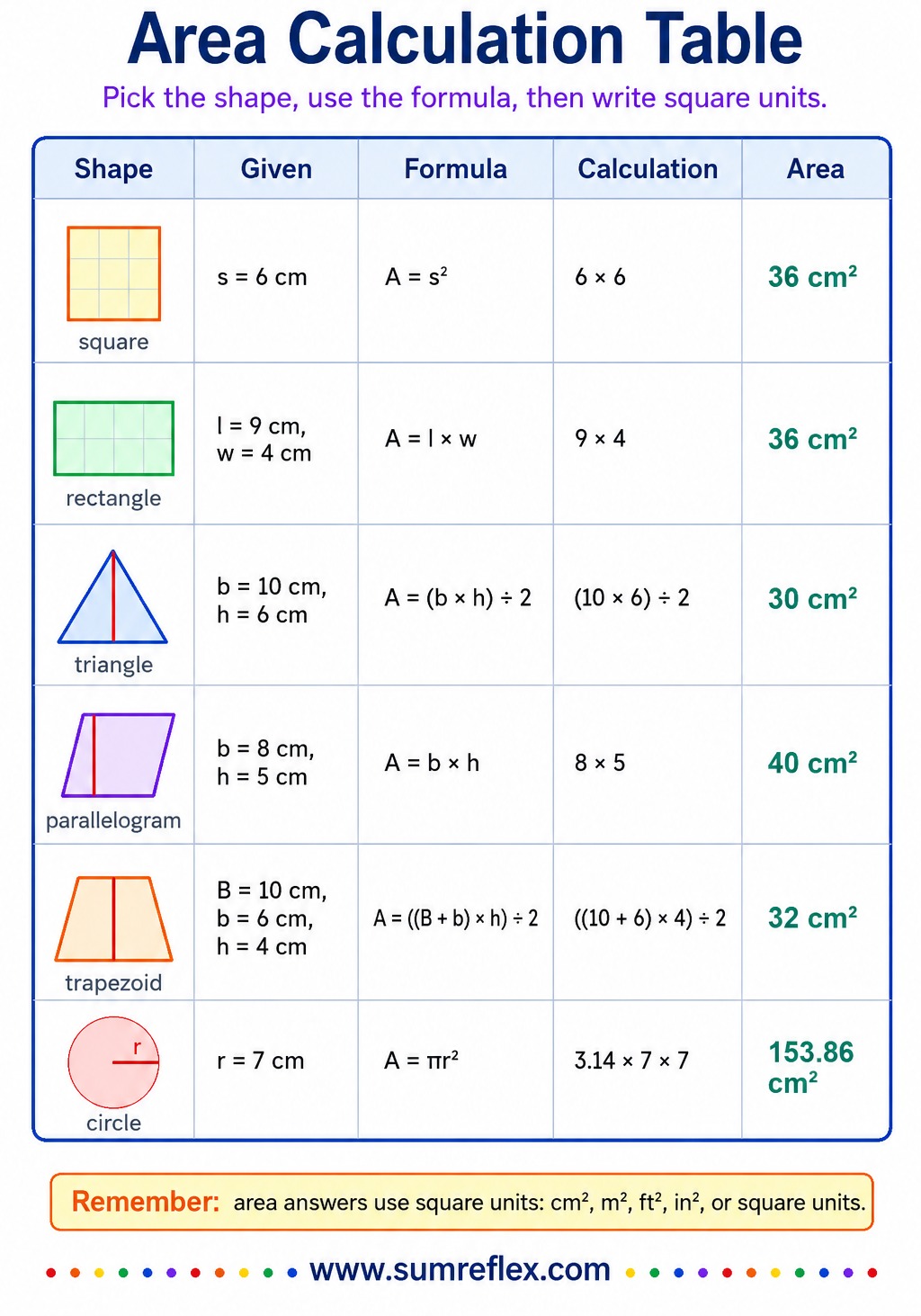
This second chart shows worked area calculations in a table. It is helpful when students understand the formula but still need to see how numbers are substituted into it.
It includes a square, rectangle, triangle, parallelogram, trapezoid, and circle, with the formula and final square-unit answer shown for each one. The chart also has its own Area Calculation Table printable page.
The big difference students must know
Area is about the inside. Perimeter is about the border.
Imagine a rectangular garden. If you want to plant grass over the whole garden, you need the area. If you want to put a fence around the garden, you need the perimeter.
The same shape can have both an area and a perimeter. The question tells you which one to calculate.
Units for area and perimeter
Perimeter uses normal length units because it measures a distance. Examples: 24 cm, 18 m, 40 ft, or 12 in.
Area uses square units because it measures how many little squares cover the inside. Examples: 24 cm2, 18 m2, 40 ft2, or 12 square units.
If the answer is area and you forget the square unit, the answer is incomplete. If the answer is perimeter and you write square units, the unit is wrong.
Rectangle formulas
For a rectangle, the area formula is Area = length × width.
The perimeter formula is Perimeter = 2 × (length + width), or you can add all four sides.
Example: a rectangle is 12 cm long and 7 cm wide. Area = 12 × 7 = 84 cm2. Perimeter = 12 + 7 + 12 + 7 = 38 cm.
Notice the units: area is cm2, but perimeter is cm.
For more step-by-step rectangle perimeter practice, use the Perimeter of a Rectangle lesson.
Square formulas
A square has four equal sides, so the formulas become shorter.
The area formula is Area = side × side, also written as A = s2.
The perimeter formula is Perimeter = 4 × side.
Example: a square has side length 9 m. Area = 9 × 9 = 81 m2. Perimeter = 4 × 9 = 36 m.
Triangle formulas
For a triangle, the area formula is Area = (base × height) ÷ 2.
The perimeter is found by adding the three side lengths: Perimeter = side + side + side.
Example: a triangle has base 14 cm and height 6 cm. Area = (14 × 6) ÷ 2 = 84 ÷ 2 = 42 cm2.
If the side lengths are 10 cm, 10 cm, and 14 cm, then perimeter = 10 + 10 + 14 = 34 cm.
A common mistake is using a slanted side as the height. The height must be straight up and down from the base, making a right angle with the base.
Parallelogram formulas
A parallelogram looks like a pushed-over rectangle. Its area still uses base and height.
The area formula is Area = base × height.
The perimeter is found by adding the four sides. If opposite sides are equal, you can use Perimeter = 2 × (base side + slanted side).
Example: a parallelogram has base 13 cm and height 5 cm. Area = 13 × 5 = 65 cm2.
If the base side is 13 cm and the slanted side is 9 cm, perimeter = 13 + 9 + 13 + 9 = 44 cm.
Trapezoid formulas
A trapezoid has two parallel bases. The bases may have different lengths.
The area formula is Area = ((base 1 + base 2) × height) ÷ 2.
The perimeter is found by adding all four side lengths.
Example: a trapezoid has bases 18 cm and 10 cm, and height 7 cm. Area = ((18 + 10) × 7) ÷ 2 = (28 × 7) ÷ 2 = 196 ÷ 2 = 98 cm2.
If the four side lengths are 18 cm, 8 cm, 10 cm, and 9 cm, then perimeter = 18 + 8 + 10 + 9 = 45 cm.
Circle formulas
For a circle, the distance around the outside is called circumference. It is the circle version of perimeter.
The area formula is Area = πr2, where r means radius.
The circumference formulas are C = 2πr or C = πd, where d means diameter.
Example: a circle has radius 5 cm. Area = 3.14 × 5 × 5 = 78.5 cm2. Circumference = 2 × 3.14 × 5 = 31.4 cm.
Circle formulas are usually introduced after students are comfortable with simpler shapes, but they follow the same idea: area is inside and circumference is around.
Use the area calculator when numbers get messy
For checking bigger or decimal-based problems, use the SumReflex area calculator.
The calculator is helpful after students understand the formula. It should not replace the thinking step. First decide the shape and formula, then use the calculator to check the arithmetic.
Example: finding the area of a tiled floor
A floor is 8 m long and 6 m wide. Since the floor is a rectangle, use Area = length × width.
Area = 8 × 6 = 48 m2.
This means the inside of the floor covers 48 square meters. If each square tile covered 1 m2, it would take 48 tiles to cover the whole floor.
Example: finding the perimeter of a garden
A rectangular garden is 15 ft long and 9 ft wide. A fence goes around the outside.
Because fencing goes around the garden, calculate perimeter, not area.
Perimeter = 15 + 9 + 15 + 9 = 48 ft.
The garden needs 48 feet of fencing, not 135 square feet of fencing. The 135 ft2 answer would describe the inside space.
Missing side example using perimeter
A rectangle has perimeter 50 cm. Its width is 9 cm. What is its length?
A rectangle has two lengths and two widths. So 50 = length + width + length + width.
Another way is to divide the perimeter by 2 first: 50 ÷ 2 = 25. That means length + width = 25.
Since width = 9, length = 25 - 9 = 16 cm.
Check: 16 + 9 + 16 + 9 = 50 cm.
Missing measurement example using area
A rectangle has area 72 cm2. Its length is 12 cm. What is its width?
Use Area = length × width.
72 = 12 × width. So width = 72 ÷ 12 = 6 cm.
Check: 12 × 6 = 72 cm2.
Tough example: L-shaped area
An L-shaped floor can be split into two rectangles.
Suppose the bottom rectangle is 8 m by 3 m. Its area is 8 × 3 = 24 m2.
The tall left rectangle above it is 4 m by 6 m. Its area is 4 × 6 = 24 m2.
Total area = 24 + 24 = 48 m2.
For composite shapes, do not guess one big formula. Split the shape into rectangles, triangles, or other familiar shapes.
Tough example: L-shaped perimeter
Using the same L-shape, perimeter means walking around the outside edge.
The outside side lengths are 8 m, 3 m, 4 m, 6 m, 4 m, and 9 m.
Perimeter = 8 + 3 + 4 + 6 + 4 + 9 = 34 m.
This is tougher than area because you must include only the outer boundary. Do not add inside split lines used for area.
Confusing example: same perimeter, different area
A square with side 6 has perimeter 6 + 6 + 6 + 6 = 24 units. Its area is 6 × 6 = 36 square units.
A rectangle that is 8 by 4 also has perimeter 8 + 4 + 8 + 4 = 24 units. Its area is 8 × 4 = 32 square units.
Both shapes have the same perimeter, but they do not have the same area.
This is why perimeter and area are related to the shape, but they are not the same measurement.
Confusing example: same area, different perimeter
A 12 by 3 rectangle has area 12 × 3 = 36 square units and perimeter 12 + 3 + 12 + 3 = 30 units.
A 9 by 4 rectangle also has area 9 × 4 = 36 square units, but its perimeter is 9 + 4 + 9 + 4 = 26 units.
A 6 by 6 square also has area 36 square units, but its perimeter is 24 units.
Same area does not always mean same perimeter.
Confusing example: triangle height is not always a side
A triangle has base 12 cm and height 8 cm. Two slanted sides are each 10 cm.
Area uses the base and height: (12 × 8) ÷ 2 = 48 cm2.
Perimeter uses the side lengths: 12 + 10 + 10 = 32 cm.
The height helped with area, but it was not added to the perimeter because it is inside the triangle, not around the outside.
Common mistakes to avoid
Do not use square units for perimeter. Perimeter is a length, so it uses cm, m, ft, or another length unit.
Do not use normal units for area. Area needs square units such as cm2 or square units.
Do not multiply all side lengths to find area. Choose the correct formula for the shape.
Do not add inside cut lines when finding perimeter of a composite shape.
Do not use a slanted side as a triangle height unless it is perpendicular to the base.
Mini quiz
1. A rectangle is 10 cm by 4 cm. What is the area? Answer: 40 cm2.
2. The same rectangle is 10 cm by 4 cm. What is the perimeter? Answer: 28 cm.
3. A square has side length 7 m. What is the area? Answer: 49 m2.
4. A square has side length 7 m. What is the perimeter? Answer: 28 m.
5. A triangle has base 9 in and height 6 in. What is the area? Answer: 27 in2.
6. A rectangle has area 45 ft2 and width 5 ft. What is the length? Answer: 9 ft.
7. Which measurement goes around the outside edge? Answer: perimeter.
8. Which measurement tells how much space is inside? Answer: area.
The big idea
Area and perimeter become much easier when students slow down and ask what the problem is really measuring.
If the problem is about covering, painting, tiling, or space inside, find area.
If the problem is about fencing, framing, edging, or distance around, find perimeter.
Once that choice is clear, the formula and unit usually become much easier to pick.