


Grade 3 measurement lesson
Perimeter of a Rectangle: Formula, Examples, and Step-by-Step Solutions
The perimeter of a rectangle is the total distance around its outside edge. Add all four sides, or use P = 2(length + width).
What is the perimeter of a rectangle?
The perimeter of a rectangle is the total distance around the outside edge of the rectangle.
Think of walking around a rectangular playground, putting ribbon around a poster, or building a fence around a garden. In all of those situations, you need the distance around the border.
A rectangle has two long sides and two short sides. The opposite sides are equal, so the two lengths match and the two widths match.
That is why rectangle perimeter is easier than it may look. You do not need four different numbers. You only need the length and the width.
Printable perimeter of a rectangle chart
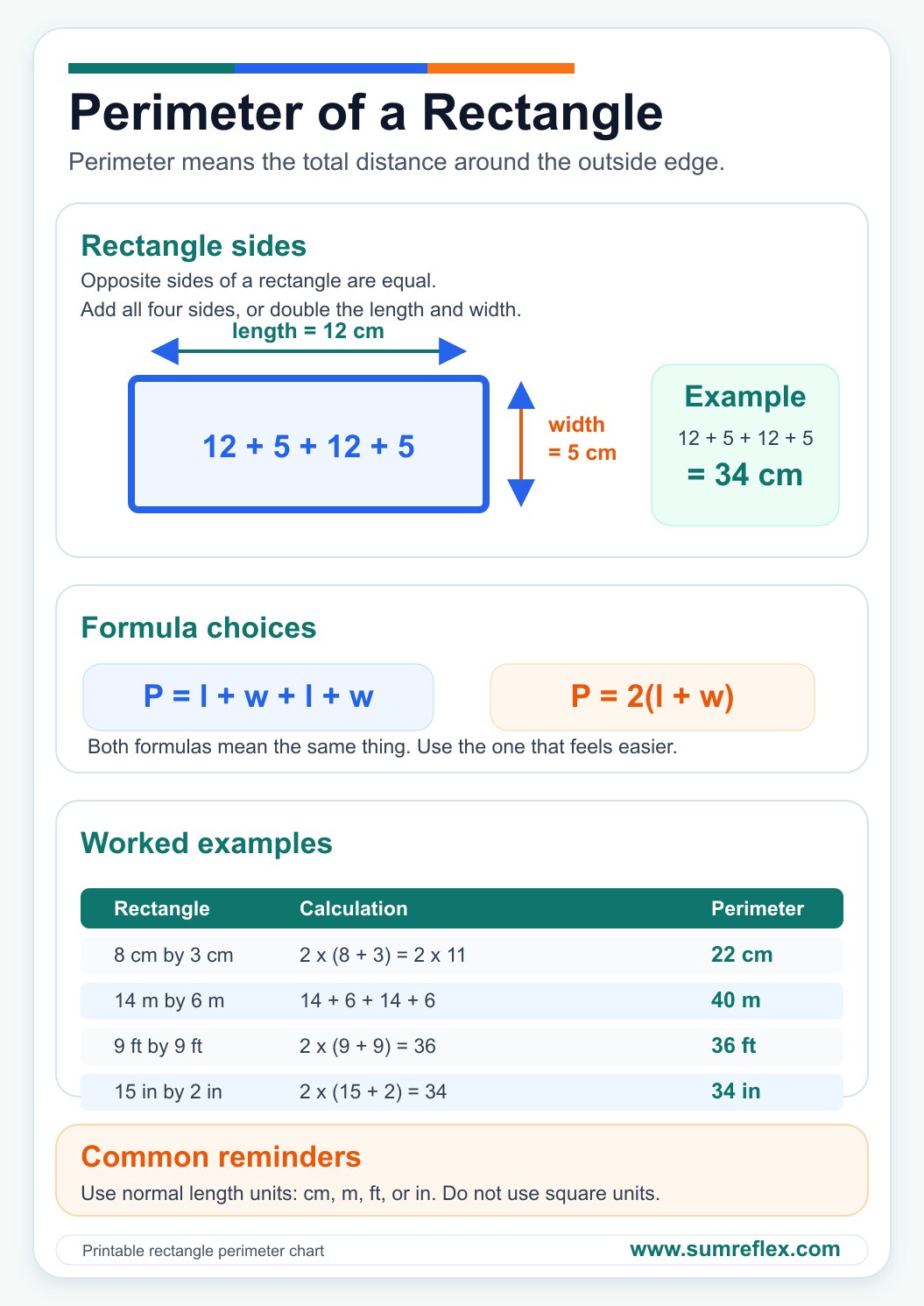
Use this SumReflex chart as a quick reminder of what perimeter means, how opposite sides match, and how the two rectangle perimeter formulas work.
The same chart is also available in the Printable Geometry Charts section with print and download options.
Rectangle perimeter formulas
There are two common formulas for rectangle perimeter.
Formula 1: Perimeter = length + width + length + width.
Formula 2: Perimeter = 2 × (length + width). This is often written as P = 2(l + w).
Both formulas mean the same thing. The first formula adds all four sides one by one. The second formula uses the fact that a rectangle has two lengths and two widths.
Example: if the length is 12 cm and the width is 5 cm, then perimeter = 12 + 5 + 12 + 5 = 34 cm. The same answer comes from 2 × (12 + 5) = 2 × 17 = 34 cm.
Step-by-step method
Step 1: Read the length and width.
Step 2: Decide which formula to use.
Step 3: Substitute the numbers into the formula.
Step 4: Add or multiply carefully.
Step 5: Write the answer with a normal length unit, such as cm, m, ft, or in.
Do not use square units for perimeter. Square units are for area, not distance around the outside.
Example 1: basic centimeter problem
A rectangle is 8 cm long and 3 cm wide. Find the perimeter.
Use the formula P = 2(l + w).
P = 2 × (8 + 3).
P = 2 × 11.
P = 22 cm.
The answer is 22 cm because the distance around the rectangle is 22 centimeters.
Example 2: add all four sides
A rectangle is 14 m long and 6 m wide. Find the perimeter.
Add all four sides: 14 + 6 + 14 + 6.
14 + 6 = 20, and another 14 + 6 = 20.
20 + 20 = 40 m.
So the perimeter is 40 meters.
Example 3: square as a special rectangle
A square is also a rectangle because it has four right angles and opposite sides are equal. But all four sides of a square are the same length.
A square has side length 9 ft. Find the perimeter.
You can use the rectangle formula: P = 2 × (9 + 9).
P = 2 × 18 = 36 ft.
You could also use the square shortcut: 4 × 9 = 36 ft.
Example 4: thin rectangle
A name tag is 15 in long and 2 in wide. Find the perimeter.
P = 2 × (15 + 2).
P = 2 × 17.
P = 34 in.
Even though the rectangle is thin, it still has two long sides and two short sides.
Example 5: decimal measurements
A small picture frame is 7.5 cm long and 4 cm wide. Find the perimeter.
P = 2 × (7.5 + 4).
7.5 + 4 = 11.5.
P = 2 × 11.5 = 23 cm.
Decimal lengths work the same way. The formula does not change.
Example 6: word problem with fencing
A rectangular vegetable garden is 18 ft long and 10 ft wide. A fence goes around the garden. How much fencing is needed?
Fencing goes around the outside, so this is a perimeter problem.
P = 2 × (18 + 10).
P = 2 × 28.
P = 56 ft.
The garden needs 56 feet of fencing.
Example 7: word problem with ribbon
A poster is 24 in long and 18 in wide. Maya wants to put ribbon around the edge. How many inches of ribbon does she need?
Ribbon around the edge means perimeter.
P = 24 + 18 + 24 + 18.
24 + 18 = 42, and 42 + 42 = 84.
Maya needs 84 in of ribbon.
Example 8: missing length
A rectangle has a perimeter of 46 cm. Its width is 8 cm. What is its length?
Use the idea that length + width is half of the perimeter.
46 ÷ 2 = 23. So length + width = 23.
The width is 8 cm, so length = 23 - 8.
Length = 15 cm.
Check: 15 + 8 + 15 + 8 = 46 cm.
Example 9: missing width
A rectangle has a perimeter of 70 m. Its length is 22 m. What is its width?
Half of the perimeter is 70 ÷ 2 = 35.
That means length + width = 35.
The length is 22 m, so width = 35 - 22.
Width = 13 m.
Check: 22 + 13 + 22 + 13 = 70 m.
Example 10: compare two rectangles
Rectangle A is 10 cm by 4 cm. Rectangle B is 8 cm by 6 cm. Which rectangle has the greater perimeter?
Rectangle A: P = 2 × (10 + 4) = 2 × 14 = 28 cm.
Rectangle B: P = 2 × (8 + 6) = 2 × 14 = 28 cm.
Both rectangles have the same perimeter.
This is a good reminder: different-looking rectangles can have the same distance around.
Perimeter is not area
Perimeter and area are easy to mix up because both can use length and width.
For a rectangle, area = length × width. Area measures the space inside.
For a rectangle, perimeter = 2 × (length + width). Perimeter measures the distance around.
Example: a rectangle is 6 cm by 4 cm. Its area is 6 × 4 = 24 cm2. Its perimeter is 6 + 4 + 6 + 4 = 20 cm.
Notice the units: area uses square centimeters, but perimeter uses centimeters.
For more comparison practice, use the Area and Perimeter lesson.
Common mistakes to avoid
Mistake 1: Adding only length + width. That gives half the perimeter, not the full perimeter.
Mistake 2: Multiplying length × width. That finds area, not perimeter.
Mistake 3: Using square units. Perimeter uses normal length units.
Mistake 4: Forgetting that a rectangle has two lengths and two widths.
Mistake 5: Mixing units. If one side is in feet and another is in inches, convert first before adding.
Practice problems
1. A rectangle is 6 cm long and 2 cm wide. Find the perimeter.
2. A rectangle is 11 m long and 5 m wide. Find the perimeter.
3. A rectangle is 20 ft long and 8 ft wide. Find the perimeter.
4. A rectangle is 9 in long and 9 in wide. Find the perimeter.
5. A rectangle has perimeter 36 cm and width 7 cm. Find the length.
6. A rectangle has perimeter 64 m and length 18 m. Find the width.
7. A poster is 30 in long and 12 in wide. How much border tape is needed around it?
8. A garden is 25 ft long and 16 ft wide. How much fencing is needed?
Practice answers
1. P = 2 × (6 + 2) = 16 cm.
2. P = 2 × (11 + 5) = 32 m.
3. P = 2 × (20 + 8) = 56 ft.
4. P = 2 × (9 + 9) = 36 in.
5. Half of 36 is 18. Length = 18 - 7 = 11 cm.
6. Half of 64 is 32. Width = 32 - 18 = 14 m.
7. Border tape needed = 2 × (30 + 12) = 84 in.
8. Fencing needed = 2 × (25 + 16) = 82 ft.
The big idea
The perimeter of a rectangle is the distance around its outside edge.
You can add all four sides, or use P = 2(l + w).
The answer uses normal length units because perimeter is a distance.
If the problem talks about fencing, framing, ribbon, border tape, trim, or walking around a rectangle, it is probably asking for perimeter.