



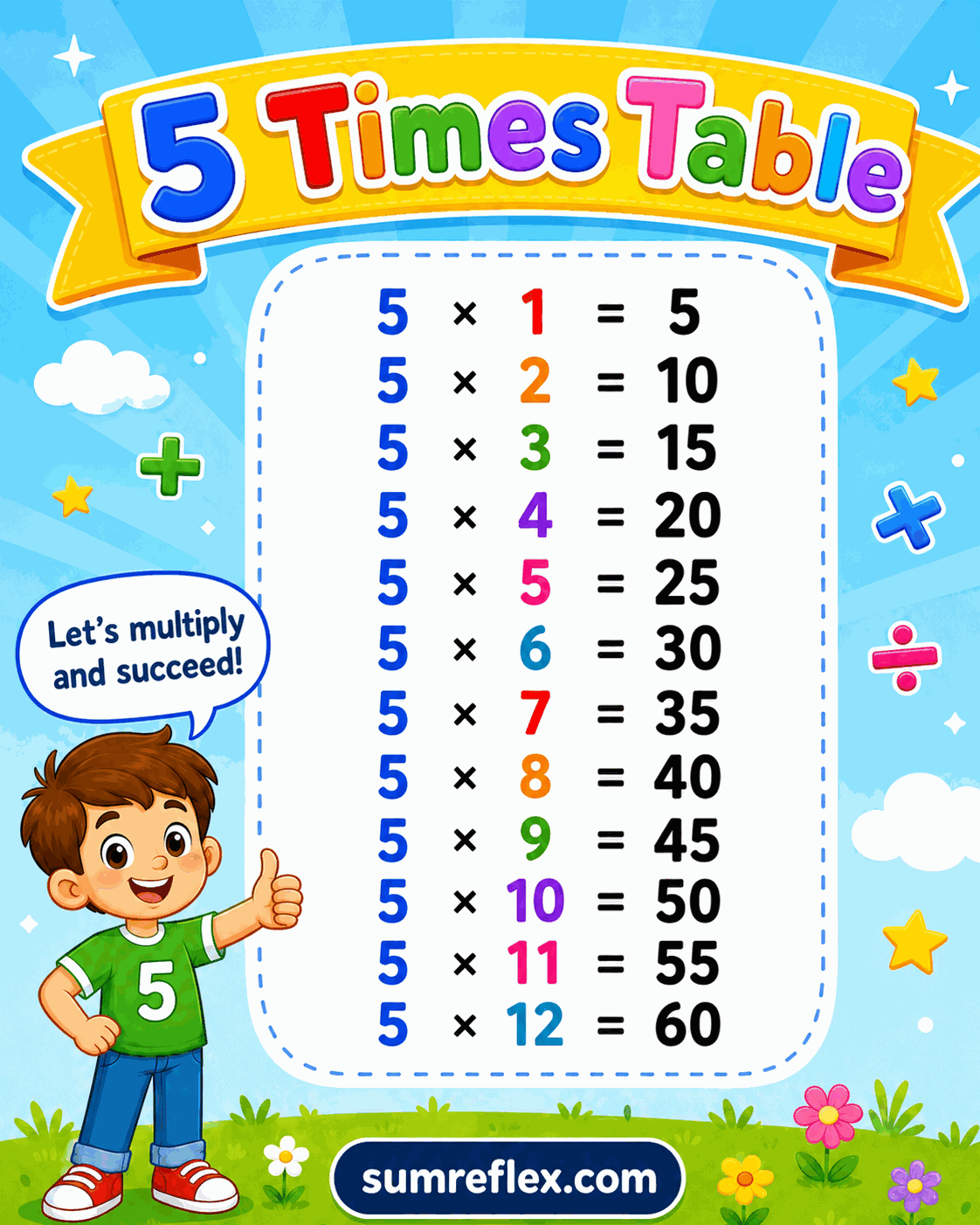
Five table practical guide
Learning the 5 table through clocks, coins, and clear endings
The ending pattern gives quick confidence
Every product in the 5 row ends in 0 or 5. That visible pattern gives students a fast way to check their work. Five times 7 is 35, five times 8 is 40, and five times 9 is 45. The ending changes, but the product always stays in the same 0-or-5 family.
This pattern should be treated as a helpful clue, not the whole lesson. Students still need to connect each product to the correct factor. The chart keeps the factor-product pair visible so learners do not only chant 5, 10, 15, 20 without knowing which fact they are saying.
Clock minutes make the row useful
A clock face gives the 5 table a strong real-world anchor. One number marker on an analog clock represents five minutes, two markers represent ten minutes, and twelve markers represent sixty minutes. Students who know the 5 row have an easier time reading many minute positions.
For time notation work, pair this page with the 24-hour clock chart. The 5 table supports minute counting, while the clock chart supports reading and writing times.
Nickels and tally marks add hands-on practice
Money practice gives another natural use. If one nickel is 5 cents, then 6 nickels are 30 cents and 9 nickels are 45 cents. Tally marks work similarly because the fifth mark closes a group. These examples let students count real or drawn objects before they read the product from the chart.
Ask learners to build a fact with coins or tally groups, then write the multiplication sentence. This keeps the row tied to meaning instead of turning it into a lookup page.
The divisibility rule is already visible
The products in the 5 table are all divisible by 5. Older students can connect this row to the divisible by 5 chart, which explains why whole numbers ending in 0 or 5 pass the test.
The times-table chart builds the multiples through repeated groups. The divisibility page checks whether a number belongs to that same set. Using both pages helps students see the relationship between multiplication and factor tests.
Practice facts away from the chant
Students often recite the 5 row easily in order but hesitate when a fact appears alone. Ask for 5 x 9, 5 x 4, 5 x 11, and 5 x 6 in a mixed order. Then ask how the answer was checked: by a nearby fact, by the ending pattern, or by counting groups.
This kind of practice is short, but it builds individual fact recall. The chart remains available for correction after the student attempts the answer.
Where to go after the 5 row
The skip count by 5 chart is useful if the counting pattern needs more work. For mixed multiplication, the 1 to 10 times table chart can come later. Use this single-table chart while students are still building confident 5 facts.
For a stronger check, ask students to give the product and a context. Five times 8 can be 40 minutes, 40 cents in nickels, or 40 tally marks in groups of five. Switching the label while keeping the product helps students see the row as a reusable structure.
If a learner misses a fact, move to a nearby anchor. Five times 10 is 50, so five times 9 is 45 and five times 11 is 55. Anchors make the row easier to navigate out of order.