



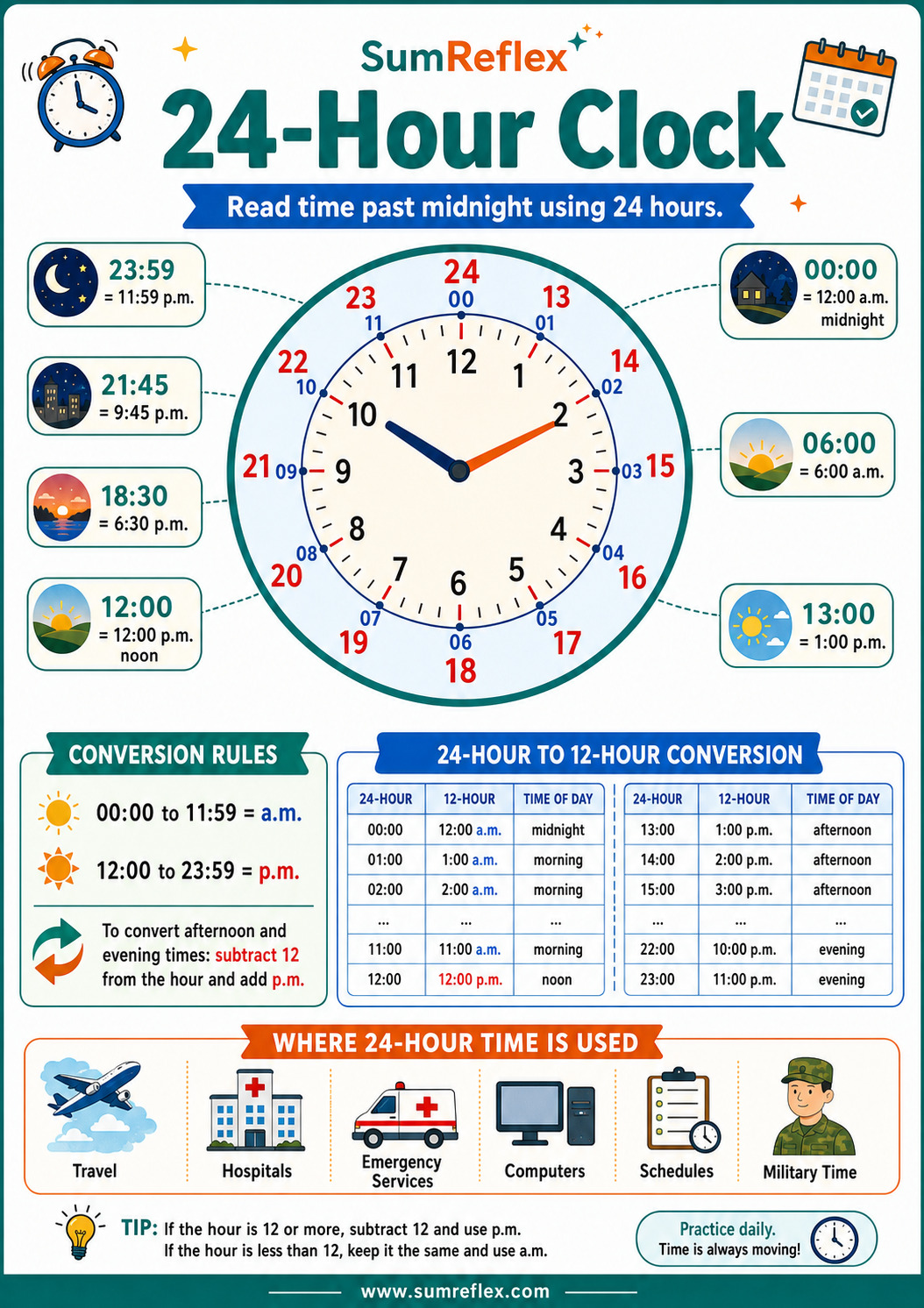
Time conversion guide
Reading 24-hour time without losing the meaning of the day
The hour changes, the minutes stay steady
The most useful habit for 24-hour conversion is to look at the hour first and leave the minutes alone. In 18:30, the 30 minutes remain 30 minutes. Only the hour needs translation. Since 18 is greater than 12, subtract 12 from the hour and label the time p.m. That makes 18:30 equal to 6:30 p.m. The chart keeps that process visible so students do not rewrite the entire time unnecessarily.
Morning times are usually easier. Hours from 01 to 11 keep the same hour number and use a.m. The hour 00 is special because it means midnight, so 00:15 becomes 12:15 a.m. The hour 12 is noon, so 12:45 stays 12:45 p.m. These two boundary cases deserve extra practice because they are where many conversion mistakes happen.
Why the format avoids morning and evening confusion
The 24-hour clock names every hour of the day with a different hour number. That means 07:00 and 19:00 cannot be confused. One is morning, and the other is evening. This is why the format appears in hospitals, transportation, emergency services, computer settings, international schedules, and work rosters. The time carries its own day position without needing a.m. or p.m.
Students can understand the reason by comparing two schedules. A bus that leaves at 8:10 needs extra information if the time is written in 12-hour form. Is it morning or evening? A bus listed at 20:10 is clearly in the evening. The chart helps students see that 24-hour time is not harder for its own sake; it removes ambiguity.
A conversion routine for notebooks
For written work, have students draw three small columns: 24-hour time, hour decision, and 12-hour time. If the hour is 00, they write midnight and change the hour to 12 a.m. If the hour is 01 through 11, they keep it and write a.m. If the hour is 12, they keep it and write p.m. If the hour is 13 through 23, they subtract 12 and write p.m. The minute pair is copied exactly.
That routine works well beside elapsed-time lessons too. Students can first convert a 24-hour time into a familiar 12-hour phrase, then solve the time question. For direct checking after a written solution, the Time Calculator can support time arithmetic, but the chart is better for learning what each written time means.
Use real schedules instead of isolated examples
The chart becomes more useful when students read authentic-looking schedules. Give them a clinic appointment at 14:20, a train time at 06:45, a movie start at 21:10, and a deadline at 23:59. Ask for each time in 12-hour language and then ask whether the event happens in the morning, afternoon, evening, or near midnight. This extra context checks comprehension, not just subtraction.
Calendar work can also connect here. When students discuss weekdays, weekends, dates, and time of day together, the days of the week chart gives the day-order reference while this clock chart handles the time notation.
What to keep visible during practice
Keep the chart near the clock face or digital-time examples until students no longer need to count around the clock. The extra 13 to 24 hour ring helps visual learners connect 13 with 1 p.m., 14 with 2 p.m., and so on. Over time, the subtraction by 12 becomes automatic, but the visual ring is useful while the habit is forming.