



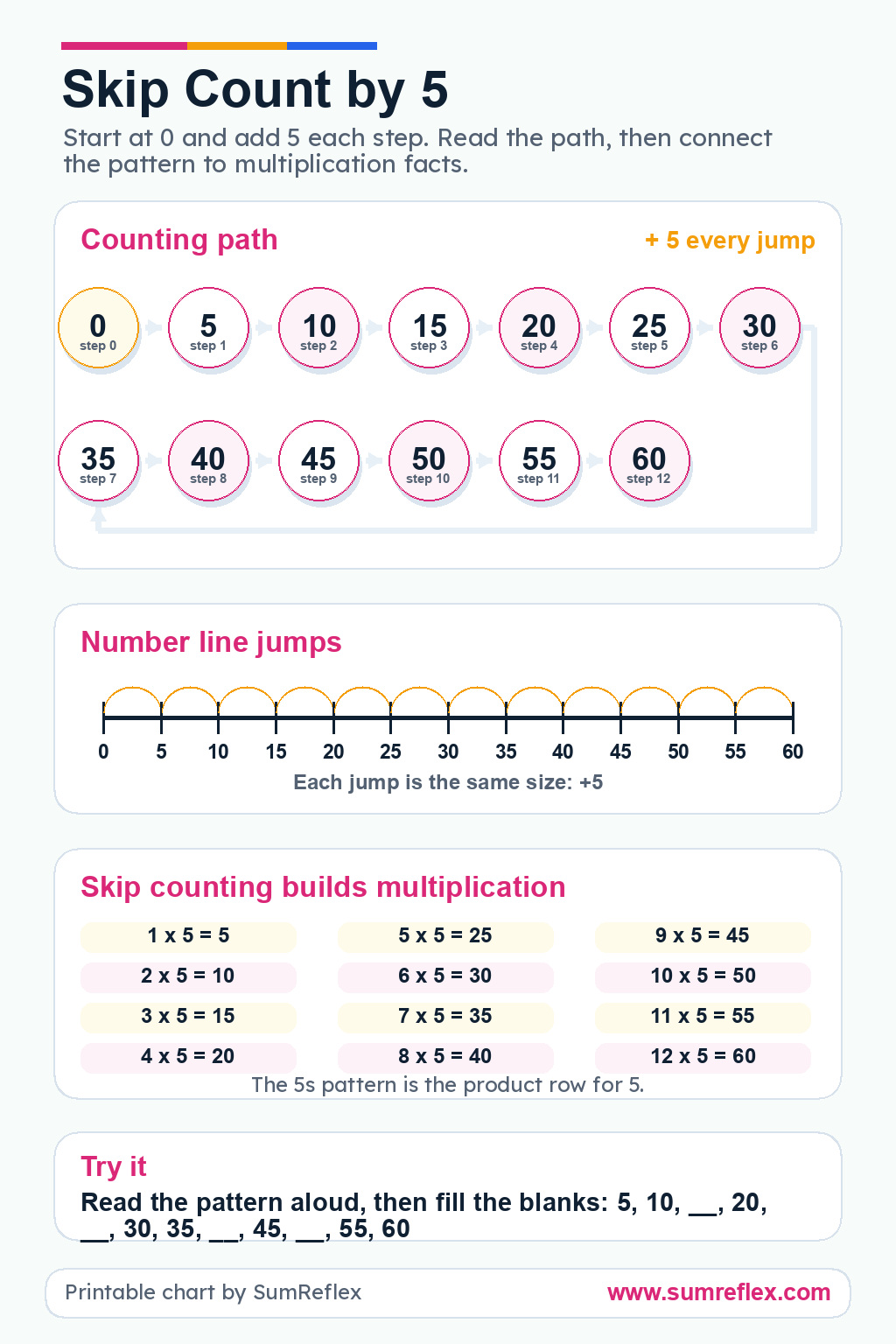
Fives pattern guide
Counting by fives through clocks, coins, and grouped marks
The endings carry a clear signal
The fives pattern is friendly because the ones digit alternates between 5 and 0. Students can see that 5, 15, 25, 35, and 45 share one ending, while 10, 20, 30, 40, and 50 share the other. The chart gives that alternating pattern a simple visual path.
The ending pattern should be treated as a clue, not the entire lesson. Each step still means one more group of five. When students understand both ideas, they can use the ending digits for speed while keeping the grouped meaning underneath.
Clock minutes make the sequence practical
A clock face is one of the best real examples for counting by 5. The minute labels move 5, 10, 15, 20, 25, and continue around the circle. Students who know the fives pattern can read many analog clock positions more confidently because each number marker represents another five minutes.
When schedule reading appears, this chart can sit near the 24-hour clock chart. The fives page supports minute counting; the clock page supports time notation and reading times across the day.
Nickels and tally bundles give fast practice
Counting nickels is another natural use. One nickel is 5 cents, two nickels are 10 cents, and eight nickels are 40 cents. Tally marks work the same way because the fifth mark closes a bundle. These examples let students use the chart while counting things they can touch or draw.
Ask learners to build five-mark groups, cover the chart, count the bundles aloud, and then check the sequence. That back-and-forth keeps the printable from replacing thinking. It becomes the check, not the whole activity.
The divisibility connection is visible
Numbers in the fives sequence are divisible by 5. The divisible by 5 chart later names the shortcut: whole numbers ending in 0 or 5 pass the test. Students usually understand that rule better when they first build a long fives sequence and notice the endings themselves.
This is also a good place to compare fives and tens. Every multiple of 10 is also in the fives pattern, but values such as 15, 25, and 35 are not multiples of 10. That distinction helps students avoid overgeneralizing from ending digits.
Moving toward fact recall
The 5 times table chart is useful once students are ready to match each count with a multiplication fact. Until then, the skip-count chart gives a path they can travel: count groups, say totals, and then attach the fact notation when the meaning is secure.
For review, ask students to start at 25, count three more fives, and explain how they know the values without returning to 0. That kind of middle-start work shows whether the fives sequence is usable, not merely familiar.
You can also mix contexts on the same page. Write 6 nickels, 6 groups of tally marks, and 6 x 5, then ask students why all three answers are 30. That comparison helps them see the fives sequence as a reusable structure across money, recording marks, and multiplication facts.
Keep a few blank spaces available after 60 for students who are ready to extend the pattern. Continuing to 65, 70, and 75 shows that the same ending pattern keeps working beyond the printed facts.
That extension is simple, but it proves that the chart is teaching a repeatable counting rule.