



Divisibility by 5 practice notes
Using the divisible by 5 chart to connect endings, nickels, and factor thinking
The 0-or-5 ending as a fast sorting tool
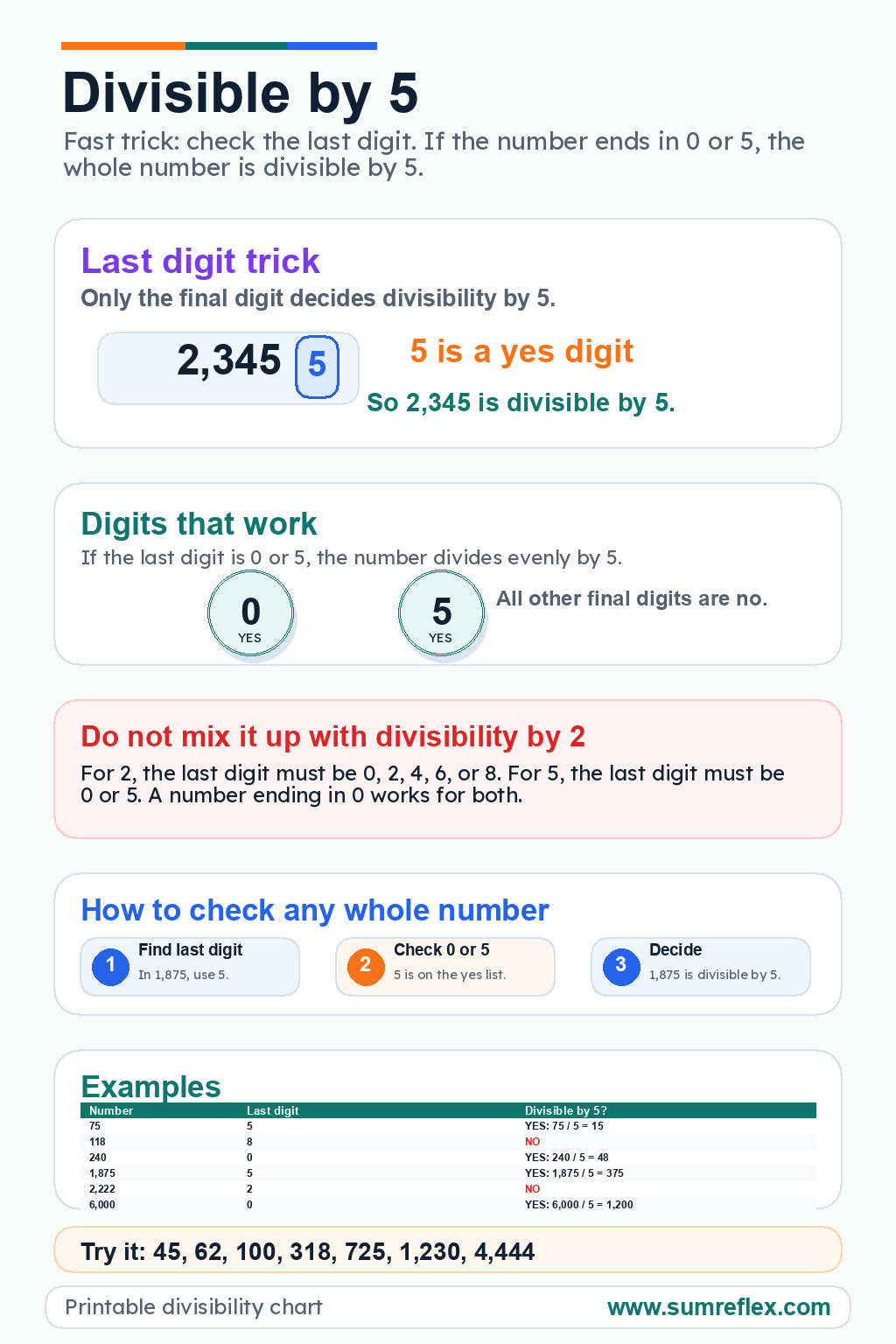
The divisible by 5 chart gives students one of the cleanest whole-number tests: only numbers ending in 0 or 5 pass. That simplicity makes the page useful for quick sorting, but it still deserves explanation. A number ending in 0 is a whole group of tens, and each ten contains two groups of five. A number ending in 5 adds one more group of five to those complete tens. Any other ending leaves a remainder when the number is shared into fives.
Because the rule is easy to memorize, the teacher can use the chart to slow students down just enough to name their evidence. Instead of saying yes for 235 by habit, they should point to the ending 5 and explain that it matches the chart. That small evidence step keeps the printable connected to reasoning and not just recognition.
Moving from counting nickels to divisibility
Many students first meet the 5 pattern through money. Counting nickels produces 5, 10, 15, 20, 25, and so on, so the ending pattern becomes familiar before the word divisibility appears. This chart can use that background without turning into a money lesson. Ask students to imagine whether a number of cents could be made with only nickels. If the amount ends in 0 or 5, it can. If it ends in 2, 4, 7, or 9, it cannot be made from exact groups of five.
The printable also pairs naturally with the divisible by 5 lesson. The lesson can introduce the language of factor and multiple, while the chart stays visible during practice. Students who need more pattern support can compare it with the skip count by 5 chart and see the same sequence from a counting viewpoint.
Common confusions around even numbers
A frequent error appears when students mix this rule with divisibility by 2. Since 10, 20, 30, and 40 pass both rules, some learners begin to treat even numbers as if they should always pass the 5 test. The chart gives a clear correction: 12, 26, 48, and 64 are even, but none end in 0 or 5. Divisibility by 5 is about groups of five, not about pairs.
The comparison becomes stronger when the page sits beside the divisible by 10 chart. Every number divisible by 10 is divisible by 5, but numbers ending in 5 are not divisible by 10. That relationship is a useful first step toward understanding how factor rules overlap. Students can mark three categories: passes only 5, passes both 5 and 10, and passes neither.
Best links for finishing the practice
After the ending rule feels secure, the chart can support larger factor questions. Students can test whether 5 belongs in the factor list before completing a table, simplifying a fraction, or checking a product. The Factor Calculator is useful for confirming the full result after students try the mental check, especially when the number has several factors and the 5 test is only one part of the work.
For a short review routine, give students a row of numbers that includes endings 0, 5, and several close misses. Ask them to circle the final digit first, write pass or fail, and then choose one passing number to divide by 5. That last division step matters because it shows that the chart is not only a label. It points to an actual equal-group calculation that can be checked.