



Two table starter guide
Learning the 2 table through doubles and paired groups
Pairs make multiplication visible
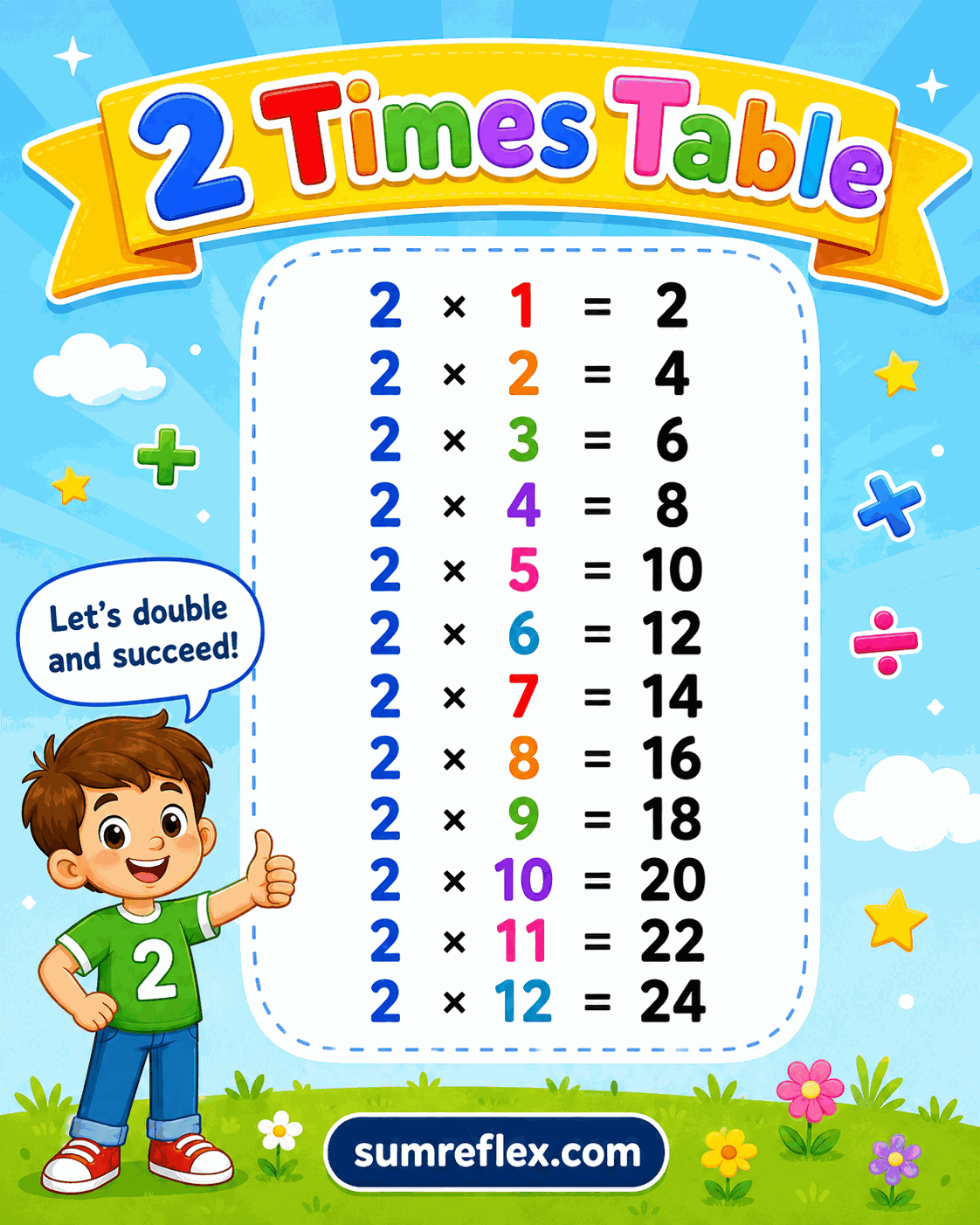
The 2 table is easiest to teach through things that naturally come in pairs: shoes, socks, eyes, gloves, bicycle wheels, or partners. When students count one pair, then another pair, the totals become 2, 4, 6, 8, and 10. The chart gives those totals a clean multiplication form.
This matters because multiplication should not begin as a list of answers. It begins as equal groups. Two times 5 means 5 groups of two or two groups of five, depending on the story. Either way, the product can be built from paired counting before it is recalled from memory.
Doubles are the main mental path
Many students already know doubles from addition. Double 4 is 8, double 7 is 14, and double 10 is 20. The 2 table turns that addition habit into multiplication language. Instead of only saying double 7, students can also say 2 x 7 = 14.
Use the chart by asking for the double first and the multiplication fact second. That order gives learners a familiar way into the row. Over time, the fact notation becomes just as comfortable as the double language.
Every product lands in the even family
All products in the 2 row are even. Students can use that observation to catch errors. If a learner writes 2 x 9 = 19, the final digit tells them something is wrong before they even check the chart. A product from this row must end in 0, 2, 4, 6, or 8.
For number-category support, the even and odd numbers chart gives the sorting language. This times-table page shows the multiplication row that creates many of those even examples.
Skip counting is the bridge, not the finish line
Counting by twos helps students move through the row, but the goal is to connect each landing to a fact. When the count reaches 16, ask which fact it belongs to. The answer might be 2 x 8 or 8 x 2. That question turns a counting sequence into multiplication knowledge.
The skip count by 2 chart is helpful when the count itself needs more practice. This 2 times table chart is better when students are ready to attach factors to the products.
A focused practice routine
Start with object pairs, then move to doubles, then read the chart. After that, cover the products and ask for facts out of order: 2 x 6, 2 x 11, 2 x 4. Out-of-order practice prevents students from depending only on the chant.
For a written task, ask students to choose three facts and draw a pair-based picture for each. The picture does not need to be artistic. Two rows, paired dots, or simple grouped marks are enough to show that the product comes from equal groups.
Where the row leads next
Once the 2 table feels steady, the 4 times table chart becomes easier because fours can be built by doubling again. The 2 row also supports divisibility work later, especially with the divisible by 2 chart.
For a final review prompt, show a product such as 18 and ask students to name the factor pair, draw the pairs, and explain why the product is even. That small three-part task checks recall, representation, and number sense at the same time.
It also keeps the row useful after the first facts feel easy.