



Even and odd number guide
Teaching even and odd numbers from pairs to ending digits
Pairing explains the rule
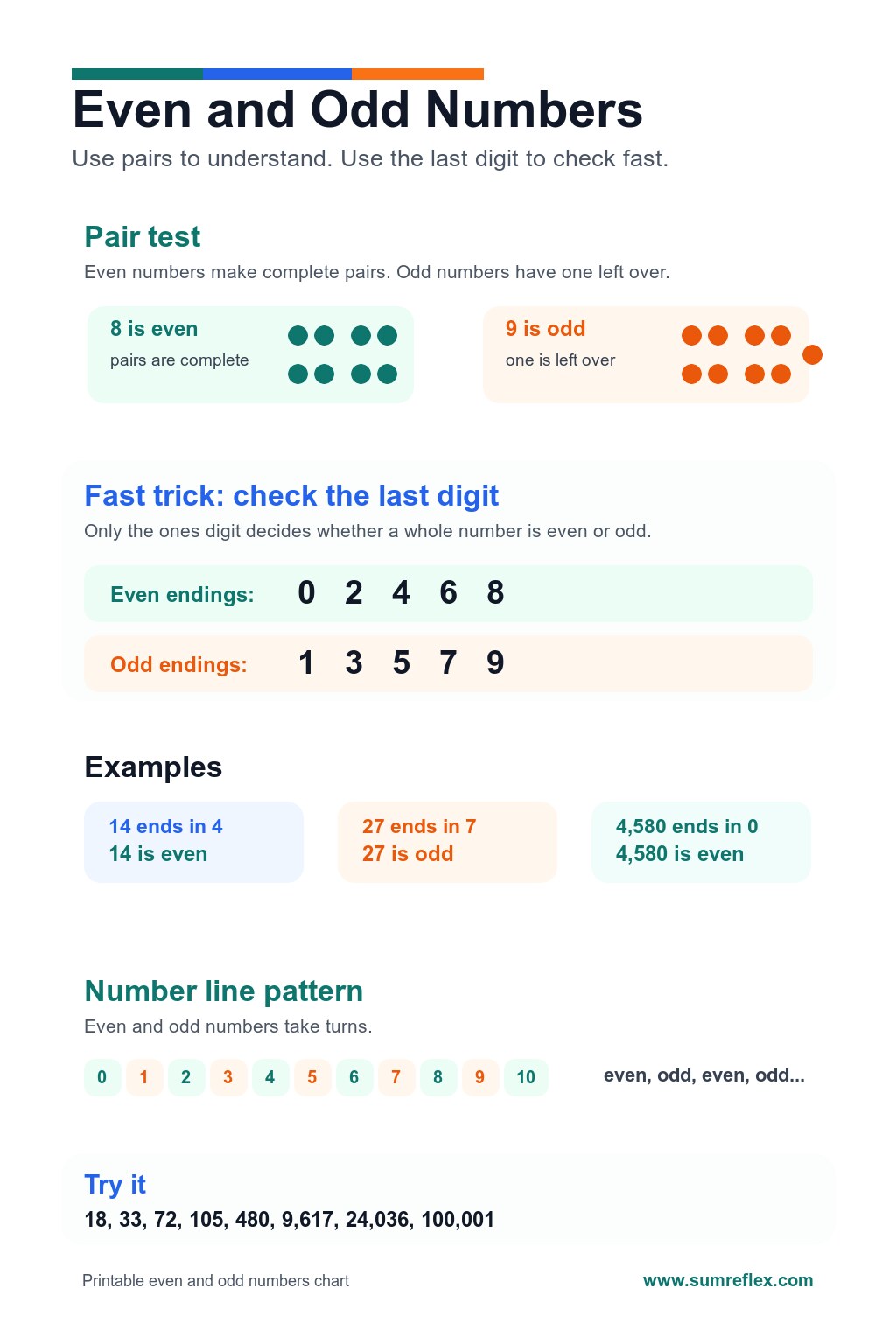
Even and odd numbers make the most sense when students can see objects being paired. If every object has a partner, the number is even. If one object is left without a partner, the number is odd. This chart keeps that concrete meaning visible so the lesson does not begin and end with memorized ending digits.
Use counters, cubes, or quick dot drawings before moving to large numbers. Eight objects can be arranged into four pairs, so 8 is even. Nine objects make four pairs with one leftover, so 9 is odd. Once that image is clear, the ending-digit shortcut feels like a faster version of the same idea rather than a separate trick.
The last digit takes over for large numbers
For bigger whole numbers, students do not need to build every item in pairs. They can look only at the ones digit. A number ending in 0, 2, 4, 6, or 8 is even. A number ending in 1, 3, 5, 7, or 9 is odd. The rest of the number is made of complete tens, and every ten can be split into pairs, so the ones digit decides whether anything is left over.
This explanation helps students avoid a common mistake: checking whether the number contains an even digit somewhere. In 237, the digit 2 appears, but the final digit is 7, so the number is odd. The chart should train learners to say, "The last digit is..." before they answer.
Number lines show the alternating pattern
A number line gives another way to see the idea. Starting at 0, even and odd numbers alternate: even, odd, even, odd. Moving one step changes the type. Moving two steps lands on the same type. This pattern becomes useful later for skip counting by 2 and for checking whether sums and differences make sense.
Pair this page with the number line chart when students need a visual path from one number to the next. The line helps them see why every other number shares the same even-or-odd category.
How even and odd leads into divisibility
Even numbers are exactly the whole numbers divisible by 2. That makes this chart a natural step before the divisible by 2 chart. The language changes from pairs and leftovers to factors and divisibility, but the decision is the same: can the number be split into two equal groups?
The chart also prepares students for other ending rules. A number ending in 0 is even, divisible by 5, and divisible by 10. A number ending in 5 is odd but divisible by 5. Those comparisons help students realize that each rule has its own reason, even when several rules inspect the same final digit.
Practice that checks understanding
A strong practice routine uses three types of prompts. First, students classify small numbers by drawing pairs. Second, they classify larger numbers by circling the last digit. Third, they explain one answer in a sentence. For example: 146 is even because the last digit is 6, and 6 can make pairs. That final explanation proves the shortcut is connected to the original pair idea.
For quick home or tutoring review, ask students to sort numbers from a calendar, page number, sports score, or house address. Real numbers make the chart feel useful beyond a worksheet, and every example still comes back to the same question: complete pairs or one leftover?