



Divisibility by 2 classroom notes
Using the divisible by 2 chart as an even-number decision tool
Why the final digit carries the whole decision
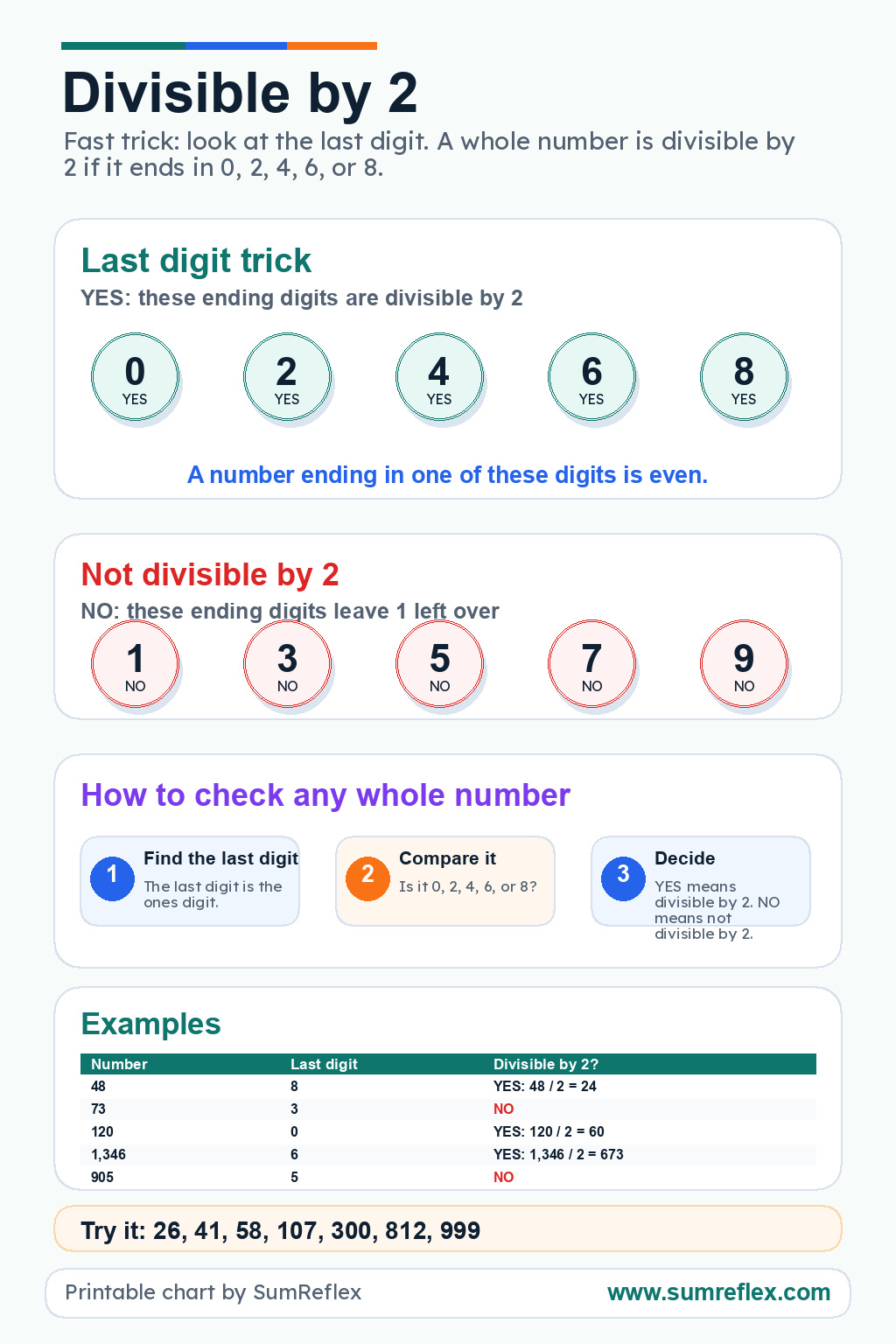
The divisible by 2 chart works best when learners understand why the shortcut is so small. Every complete ten can be split into two equal groups, so the tens, hundreds, and thousands parts are already safe. The only part that can change the answer is the ones digit. If the number ends in 0, 2, 4, 6, or 8, that last piece also forms pairs. If the number ends in 1, 3, 5, 7, or 9, one item is left over and the number cannot be divided evenly by 2.
That is why this printable should sit near early even-and-odd practice. A learner who still needs the pair idea can use the even and odd numbers chart first, then return here when the same idea appears as a divisibility rule. The language changes from pairs to factors, but the visible decision is still the ending digit.
A classroom rhythm for using the sheet
A simple routine keeps the chart from becoming a poster that learners glance at without thinking. Give one number at a time and ask the class to cover every digit except the last one. They should say the final digit aloud, name whether that digit is on the chart, and then make the full statement: 348 is divisible by 2 because 8 is an even ending. That spoken step matters because it ties the small observation back to the whole number.
For independent work, have students write two columns labeled yes and no. They can sort mixed numbers quickly, but ask them to mark the final digit in each number before writing the answer. The mark shows the evidence. When the page is used with the divisible by 2 lesson, the same routine can move from guided examples to short exit-ticket checks without changing the wording.
Mistakes this reference helps uncover
The most common error is reading a familiar number pattern too broadly. Some learners treat any number containing an even digit as divisible by 2, so 237 may be marked incorrectly because it has a 2 in the hundreds place. The chart gives a clean correction: only the last digit gets the vote. Another mistake appears when zero is ignored. A number ending in 0 is divisible by 2 because zero can be shared evenly, and every ten already contains five pairs.
The chart also helps separate divisibility by 2 from divisibility by 5 and 10. All numbers ending in 0 pass this rule, but a number ending in 5 does not. A quick comparison with the divisible by 5 chart or the divisible by 10 chart makes that difference visible instead of leaving it as a memorized list.
Where this chart naturally fits next
After learners can use the rule without hesitation, the page becomes useful in factor work. Dividing by 2 is often the first check when breaking down a number, testing whether a value is prime, or simplifying a larger calculation. The Factor Calculator can confirm a completed list of factors, but this chart gives students the first mental test before they reach for a calculator.
The chart also prepares students for compound divisibility rules. Divisibility by 6 begins with this same even-ending check and then adds the digit-sum test for 3. Divisibility by 4 and 8 also require evenness, but they do not stop at the last digit. That makes this printable a starting point rather than a finished unit: once the ending-digit habit is secure, learners are ready to compare nearby rules with a sharper eye.