



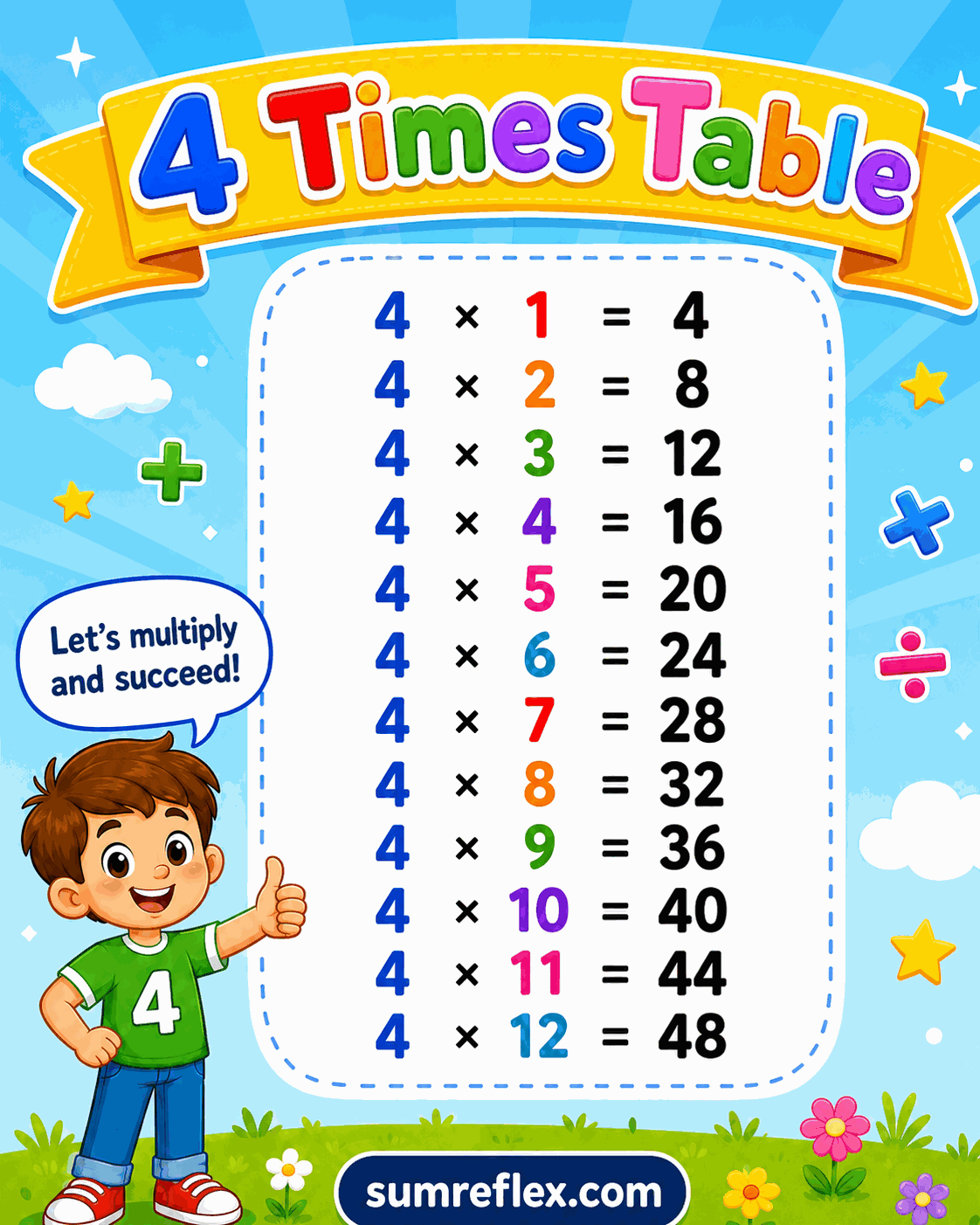
Four table reasoning guide
Using doubled twos and arrays to learn the 4 table
Four can be seen as two pairs
A group of four often appears as two pairs: four legs on a chair, four wheels on a small car, four corners on a paper, or four sides on a square. These examples give students an image for the row before they focus on memorization. The chart records what happens as those groups repeat.
Four times 6 means 6 groups of four, or 24 total objects. If students can picture the groups, the product has meaning. That meaning helps the row stay stable when facts appear out of order.
Double, then double again
A strong strategy for the 4 table is to double twice. For 4 x 7, double 7 to get 14, then double 14 to get 28. For 4 x 9, double 9 to 18, then double 18 to 36. This strategy works because four is two times two.
Students who need a stepping stone can use the 2 times table chart first. The 4 table extends that same doubling idea one more step.
Arrays make the product easy to defend
The 4 row is a good place to use arrays because four rows are easy to draw. A student can draw four rows of eight dots, count 32, and match that total to 4 x 8. This visual proof is stronger than simply copying the number from the chart.
Arrays also let students compare 4 x 8 and 8 x 4. The rectangle turns, but the total stays 32. That observation quietly supports the commutative property through a picture.
Skip counting by fours supports the row
Counting 4, 8, 12, 16, 20 can help students move through the facts, especially at the beginning. The skip count by 4 chart is useful for that sequence work. This times-table page connects each landing to a multiplication expression.
Ask students to point to a product and name its fact. If they point to 32, they should say 4 x 8 or 8 x 4. This keeps the counting pattern linked to factor pairs.
Every answer should be even, but not every even answer belongs
Products in the 4 table are even, but not every even number is a multiple of 4. The number 18 is even, but it does not appear in the 4 row. This distinction helps students avoid using the even-number clue too broadly.
For older learners, the divisible by 4 chart explains how to test larger numbers. The times-table chart gives the early multiple list that makes that rule easier to understand later.
A useful practice sequence
Practice the row in three ways: say it forward, solve selected facts out of order, and rebuild one missed fact with double-double reasoning. That combination checks memory, flexibility, and understanding without turning the page into a long drill.
For a real-object prompt, use table legs, chair legs, or four corners on each card. Ask how many legs are on 6 tables or how many corners are on 9 cards. Then match the story to the chart. These small contexts keep the 4 row grounded in visible groups.
A reverse check is also helpful. Show 36 and ask which 4 fact makes it. Students can think backward from 4 x 10 = 40 and subtract one group of 4 to reach 36, so the hidden factor is 9.
That backward move prepares students for division.