



Counting by pairs guide
Building even-number fluency with twos
Pairs make the pattern concrete
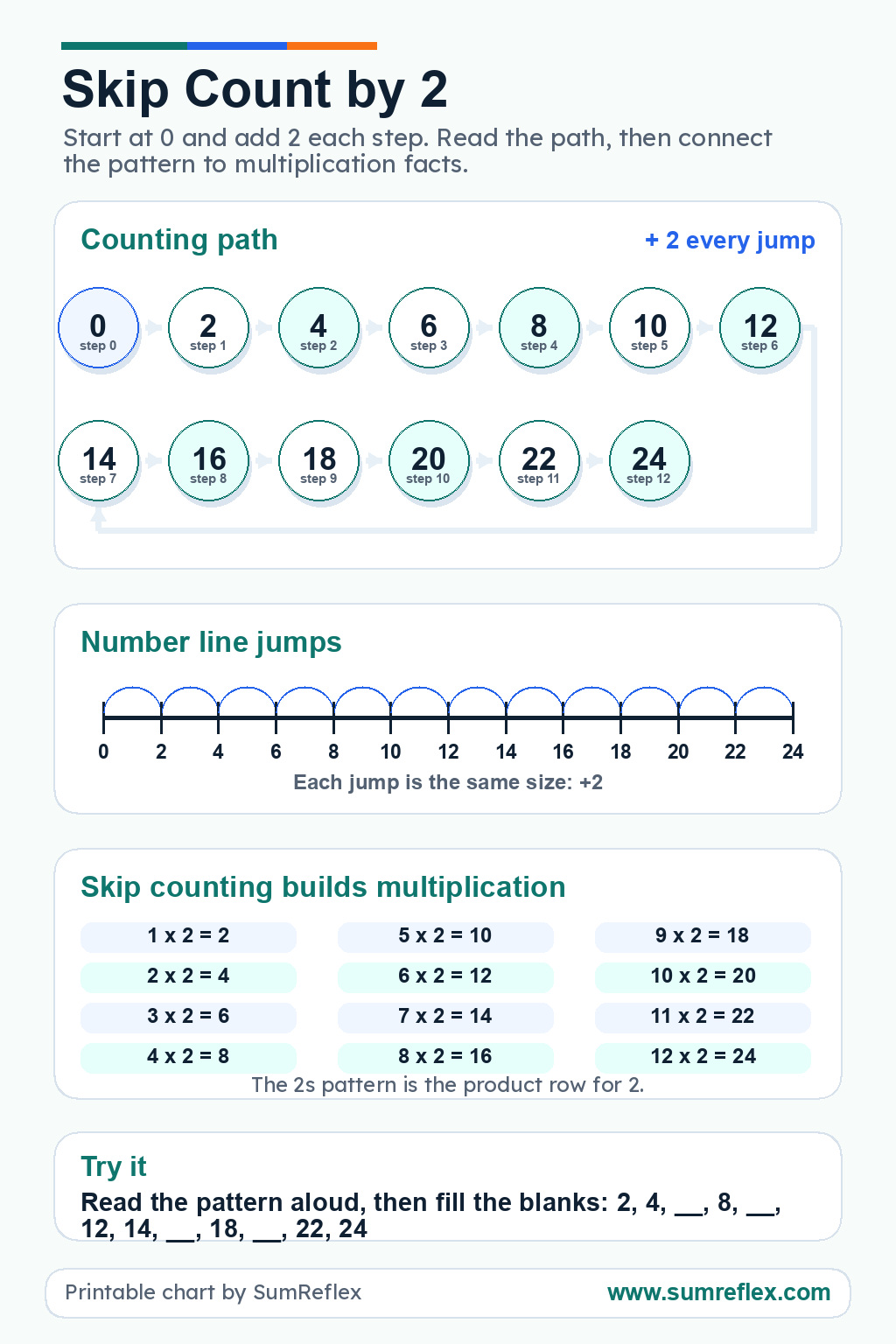
Counting by 2 begins with a very physical idea: one pair, another pair, and another pair after that. When students count socks, shoes, eyes, wheels on bicycles, or hands raised by partners, the numbers 2, 4, 6, 8, and 10 stop feeling like a chant and start feeling like counted groups.
The chart keeps that pair structure visible. Each new number means one more set of two has joined the total. That is the idea students need before the language of multiplication feels natural. Two groups of 2 make 4, three groups of 2 make 6, and the count continues without asking students to memorize facts in isolation.
Even numbers are the landing spots
Every jump in the twos sequence lands on an even number. Students should notice that the ones digit cycles through 0, 2, 4, 6, and 8 as the numbers grow. This observation prepares them for later sorting work, where they must decide whether a number can be split into two equal groups.
For a page focused only on that sorting idea, pair this printable with the even and odd numbers chart. The two pages reinforce each other: one shows the moving count, and the other names the categories created by pairing.
Doubles give students a second route
The twos chart is also a doubles chart. Counting 2, 4, 6, 8, 10 matches the facts 1 x 2, 2 x 2, 3 x 2, 4 x 2, and 5 x 2, but many children hear those facts more easily as double 1, double 2, double 3, double 4, and double 5. That second route helps when a multiplication fact is not yet automatic.
A useful practice prompt is, "What double helped you find that count?" If a student says 14, they can connect it to double 7. This keeps the chart from becoming a passive poster and turns it into a reasoning tool.
Two-step jumps on a number line
The number line part of the chart matters because it shows equal movement. Learners who count by ones may still reach the correct answers, but they are doing more work than necessary. Seeing one jump from 0 to 2, then another from 2 to 4, shows that the count has a fixed step size.
Ask students to touch each landing point while saying the number aloud. Then cover a middle value, such as 12 or 18, and have them name the missing count by looking at the neighbors. This builds flexible recognition, not only recitation from the beginning.
From counting to divisibility
Later, the same pattern becomes a divisibility rule. A whole number that appears in the twos sequence is divisible by 2. The divisible by 2 chart explains the ending-digit shortcut, but students understand it better after they have seen enough twos landing on even numbers.
This connection is worth naming: skip counting builds the list of multiples, and divisibility checks whether a number belongs to that list. The language is different, but the structure is the same.
When the times table is ready
Once students can move through the count without hesitation, the 2 times table chart gives the same values in fact form. Keep both references nearby for a while. The skip-count chart answers, "What number comes next?" The times-table chart answers, "How many are in this many groups of two?"