


Thirteen table extension notes
Building the 13 table from tens and threes
Thirteen asks students to use a strategy
The 13 row has fewer obvious memory hooks than smaller rows. That makes it a good place to strengthen multiplication reasoning. Instead of asking students to memorize the products cold, use the chart after they split each fact into parts they already understand.
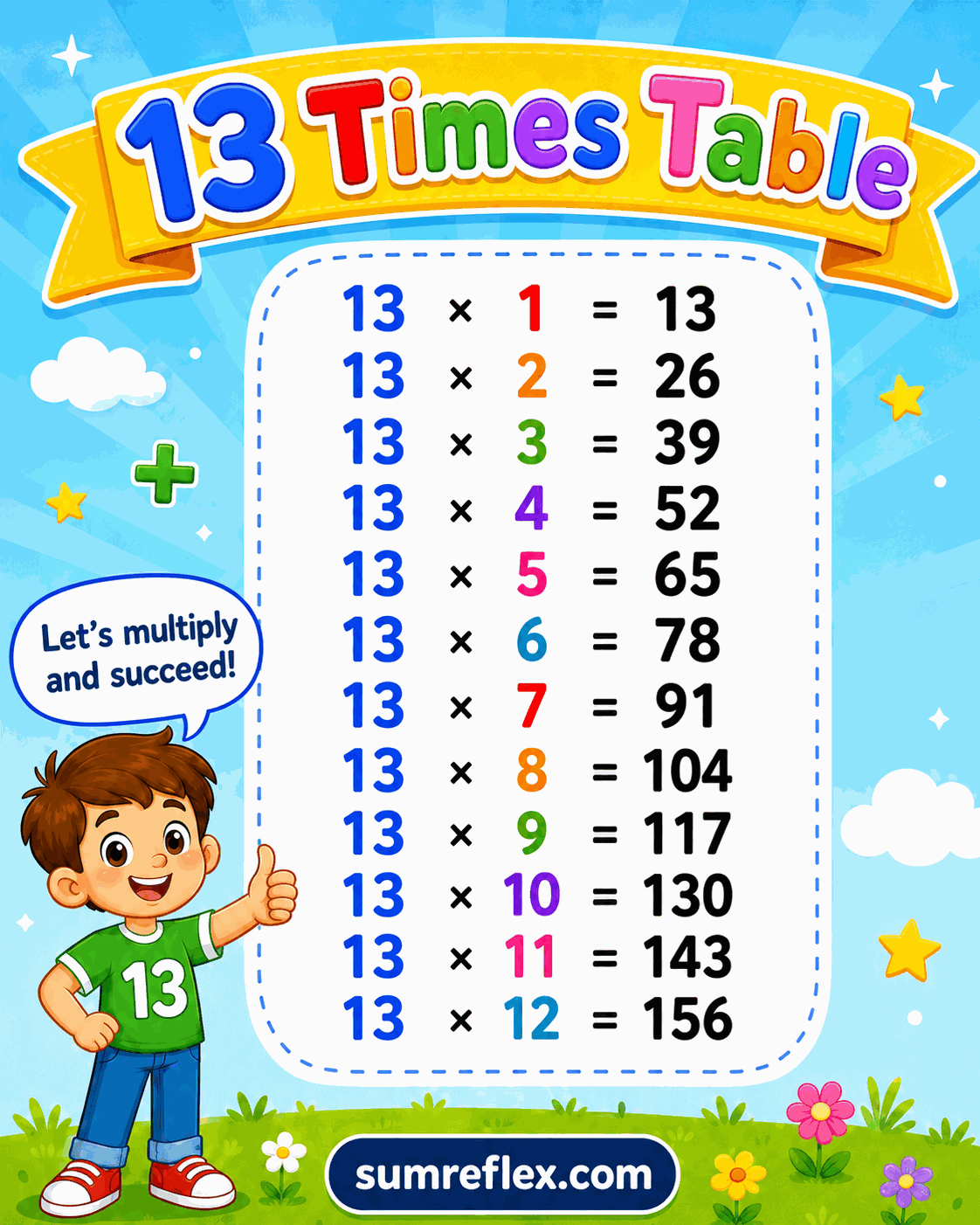
For 13 x 6, the product can be built as 10 x 6 plus 3 x 6. That gives 60 plus 18, or 78. The chart confirms the final answer, but the important work is the split. Students learn that larger facts can be constructed from familiar facts.
Ten and three are the working pieces
The 10 plus 3 structure works for every fact in the row. Thirteen times 8 becomes 80 plus 24. Thirteen times 11 becomes 110 plus 33. Thirteen times 15 becomes 150 plus 45. This gives students a repeatable process rather than a random list of products.
The 3 times table chart can help when the three-part is slow, while the 10 times table chart supports the tens part. The 13 chart is where those two pieces meet.
Products over 100 need careful addition
The 13 table crosses 100 quickly enough that students must watch place value. A learner who writes 13 x 9 as 107 may have added 90 and 27 incorrectly. The chart can catch the error, but students should also be asked to show the partial products so the mistake can be found.
A useful written format is two short lines: 10 x 9 = 90 and 3 x 9 = 27. Then the student adds 90 + 27 = 117. This format is slower than recall, but it builds accuracy and supports mental math later.
Prime factor thinking appears in the background
Thirteen is prime, so the row is not a doubled version of a smaller table like 14 or 16. That makes the products feel less familiar at first. Older students can connect this observation with the prime and composite numbers chart, where 13 belongs in the prime group.
This does not mean the table is hard for the sake of being hard. It means the best support is decomposition: use 10 and 3, estimate the size, add carefully, and then check the chart.
Best use of this printable
Use the page for enrichment, mental math practice, and students preparing for tables through 20. The 1 to 20 times table chart is useful after this row is understood. This single-table page is better when students need enough room to practice the 10 plus 3 strategy without scanning a large grid.
A helpful routine is to ask for one product, one estimate, and one explanation. For 13 x 12, the estimate should be a little above 120, the product is 156, and the explanation is 120 plus 36. Those three pieces make the answer much more trustworthy than a copied value.
The page can also support reverse checks. If a student sees 169, they can reason that 13 x 13 is a square fact. If they see 104, they can break it into 80 plus 24 and connect it to 13 x 8. Reverse use gives the row more staying power.
Why the products deserve repeated exposure
The 13 row is not usually practiced as often as rows from 2 through 12, so students may need several short sessions. Five minutes of strategy work across a few days is better than one long drill. The chart gives a stable visual record while the products become more familiar.