



Prime and composite guide
Classifying numbers by the factors they actually have
Factor count is the deciding test
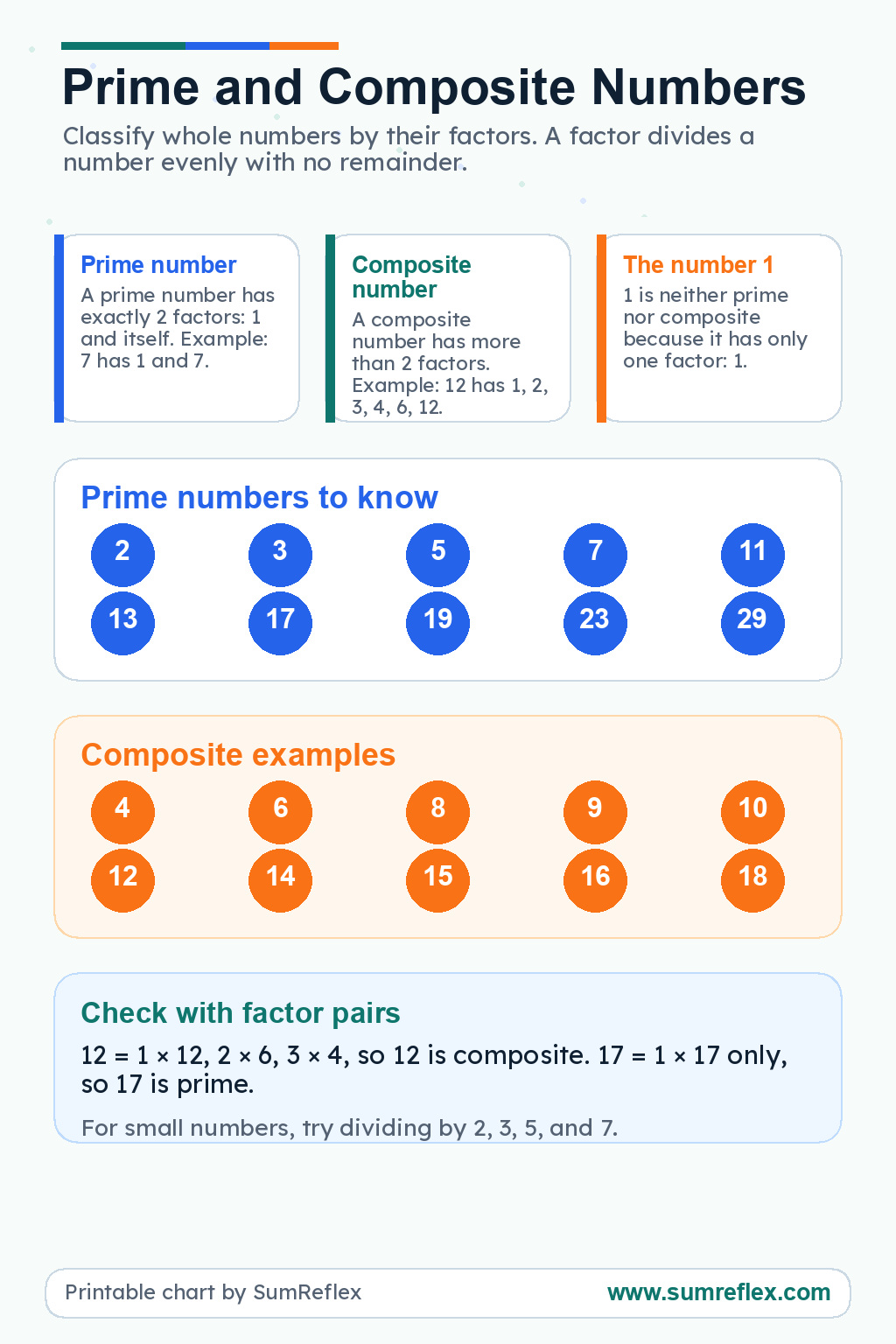
A prime number has exactly two factors: 1 and the number itself. A composite number has more than two factors. That means the decision is not based on whether the number is large, small, odd, or familiar. It is based on the factor list. This chart keeps that test visible so students can explain their classification.
For example, 7 is prime because its only factors are 1 and 7. The number 12 is composite because it has 1, 2, 3, 4, 6, and 12 as factors. Writing the factor list or factor pairs turns the classification into evidence. Without that evidence, students may call a number prime simply because they do not immediately see a factor.
Why 1 sits outside both groups
The number 1 is a common source of confusion. It is not prime because it does not have exactly two factors. It has only one factor: 1. It is not composite because it does not have more than two factors. The chart should make this visible instead of hiding 1 at the edge of a list.
Ask students to compare 1, 2, and 4. The number 1 has one factor. The number 2 has exactly two factors, 1 and 2, so it is prime. The number 4 has three factors, 1, 2, and 4, so it is composite. That small comparison teaches the categories more clearly than a long memorized list.
Factor pairs make composite numbers easier to see
Composite numbers are often easiest to prove with factor pairs. For 18, students can list 1 x 18, 2 x 9, and 3 x 6. Since more than one pair exists, 18 has more than two factors. Factor pairs also help students avoid duplicate counting because each pair shows two factors at once.
If students struggle to find pairs, use nearby divisibility charts as supports. The divisible by 2 chart, divisible by 3 chart, and divisible by 5 chart can help them test common factors before they decide whether a number is prime.
Prime does not mean odd
Many prime numbers are odd, but odd does not mean prime. The number 9 is odd and composite because it has factors 1, 3, and 9. The number 15 is odd and composite because it has factors 1, 3, 5, and 15. The number 2 is the only even prime because every larger even number is divisible by 2 and therefore has more than two factors.
These examples are useful because they break shortcuts that students invent too early. The chart should encourage factor checking, not visual guessing. When learners can explain why 21 is composite and 23 is prime, they are using the rule correctly.
Where the chart leads next
Prime and composite sorting leads directly into factor trees, greatest common factors, least common multiples, and fraction simplification. The Factor Calculator can confirm a factor list after students try one by hand, while the Prime Factorization Calculator shows how composite numbers break into prime factors.
For classroom practice, give students a number and ask for a verdict plus evidence. A complete response should say the category and list enough factors to prove it. That evidence-based answer is the reason this chart is more useful than a simple prime-number list.
A short extension is to ask students for the smallest factor that proves a number is composite. Finding that one factor builds efficiency without abandoning the full definition.