



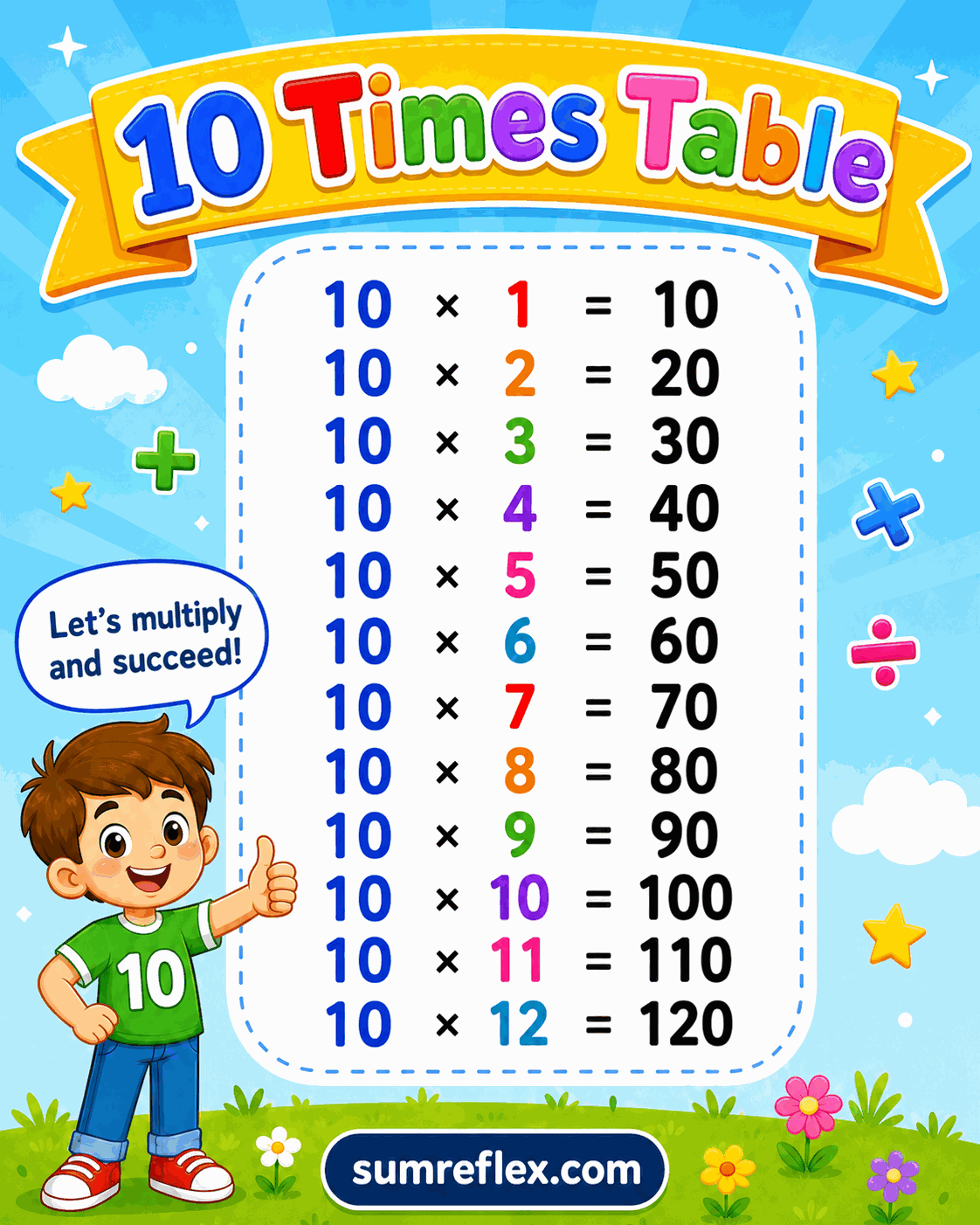
Ten table teaching guide
Using the 10 table as a place-value anchor
A product of ten means one more ten-group
The 10 table is often introduced as the row where products end in zero, but students need more than the surface pattern. Ten times 6 means 6 groups of 10, which is 60. Ten times 11 means 11 groups of 10, which is 110. The chart gives those totals in order so learners can see that each new fact adds another complete ten.
Use base-ten language while students read the page. Ten groups of 4 are 4 tens. Ten groups of 9 are 9 tens. Ten groups of 12 are 12 tens. This keeps the row tied to quantity instead of a rule that sounds like decoration added to a digit.
The zero is a place holder with a job
The final zero in 70 or 120 is not just a mark that appears after multiplying by 10. It tells the reader that there are no leftover ones. That is the place-value reason the 10 table connects naturally to numbers such as 30, 80, and 150. The product has been organized into tens.
For students who need that structure made visible, the place value chart is a strong companion page. The times-table chart gives the multiplication row, while the place-value page explains what the digits mean after the product is written.
Skip counting and multiplication should meet
A learner may be able to say 10, 20, 30, 40 without connecting the count to multiplication facts. The chart should be used to join those ideas. When the count lands on 80, ask which fact produced it. The answer is 10 x 8 or 8 x 10, depending on the factor order being practiced.
The skip count by 10 chart is the better page when the goal is movement through the counting sequence. This times-table page is better when the goal is reading each product as a fact.
A fast row still deserves reasoning
Because the 10 row feels easy, students may rush and miss the bigger idea. Ask them to compare 10 x 7 with 7 x 10, then explain why both products are 70. The same total can be read as ten groups of seven or seven groups of ten. That short conversation prepares learners for the commutative property without needing a formal lecture.
A simple practice routine is to cover the products, say the factor, predict the answer, and then uncover the row. Students should also estimate before looking. Ten times any whole number should be noticeably larger than the original factor but still easy to locate on the tens sequence.
Where the divisibility rule comes from
The products in this table all pass the divisibility-by-10 test. That is not a separate fact to memorize. It is the same row viewed from another direction. If a number is made from complete groups of 10, it is divisible by 10. If it has leftover ones, it does not belong in the row.
The divisible by 10 chart explains that checking rule. Pairing the two pages helps students understand that multiplication builds multiples, while divisibility asks whether a number is one of those multiples.
How this page fits with larger grids
After students can read the 10 row smoothly, the 1 to 10 times table chart gives them the row inside a full grid. Keep this single-table page nearby for focused review, especially when a learner needs place-value support rather than another crowded multiplication page.