



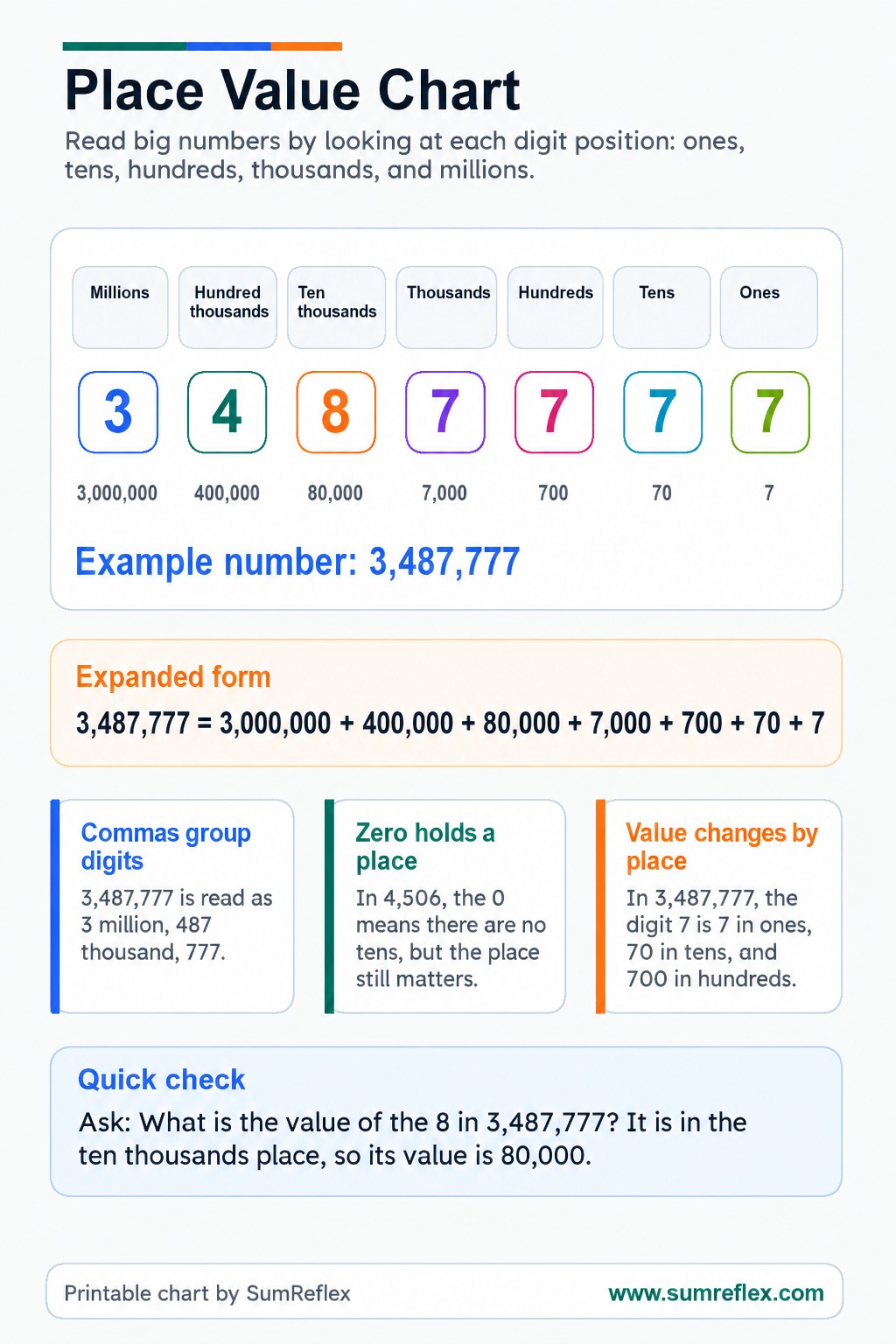
Place value reference
Reading each digit by its position, not just its shape
A digit changes value when it changes place
The same digit can mean very different amounts depending on its position. A 5 in the ones place means 5. A 5 in the hundreds place means 500. A 5 in the hundred thousands place means 500,000. This chart gives students a visual structure for that idea. They can point to a digit, name its place, and then say the value created by that position.
That distinction matters because many place-value errors come from reading digits as isolated symbols. In 3,482,715, the 8 is not just "an 8." It is 80,000 because it sits in the ten thousands place. The chart helps students slow down enough to name the place before naming the value.
Comma periods make large numbers readable
Commas group large numbers into periods: ones, thousands, millions, and beyond. Each period has hundreds, tens, and ones inside it. When students see 3,482,715, they can read the millions period, then the thousands period, then the ones period. This grouping keeps a large number from becoming a long string of digits.
The chart can support a simple reading routine. Start at the left, read the first period, say its period name, move to the next period, and continue. Students should not say the word "and" inside whole-number names unless their local curriculum expects it. The chart keeps the groups visible so the reading sounds organized.
Expanded form proves the value of each digit
Expanded form is where place value becomes explicit. A number such as 3,482,715 can be written as 3,000,000 + 400,000 + 80,000 + 2,000 + 700 + 10 + 5. That written form shows the contribution of every nonzero digit. It also reveals why zeros matter, because a zero may hold a place even when it does not add value by itself.
Ask students to write expanded form after they use the chart. If they can write the expanded form correctly, they probably understand the digit positions. If they skip a place or give a digit the wrong value, the chart shows exactly where the misunderstanding occurred.
Zero placeholders need to stay visible
Zeros can be quiet but important. In 4,028, the zero in the hundreds place tells us there are no hundreds. Without that placeholder, the remaining digits would shift into different places and the number would change. Students need to learn that a zero may not add value, but it can still protect the value of surrounding digits.
Use examples with internal zeros, such as 5,040 or 208,016. Ask students to name every place, including the zero places. This helps them read and write large numbers accurately and prepares them for decimal place value later.
Where place value connects next
Place value supports number names, rounding, divisibility, decimals, and operations. The reading large numbers chart extends the naming side, while the rounding decimal numbers chart uses place-value positions to decide how a decimal should change.
For checking very large calculations after the place-value reasoning is complete, the Big Number Calculator can handle values that are awkward to compute by hand. The chart remains the better tool for explaining what the digits mean before any calculation begins.