



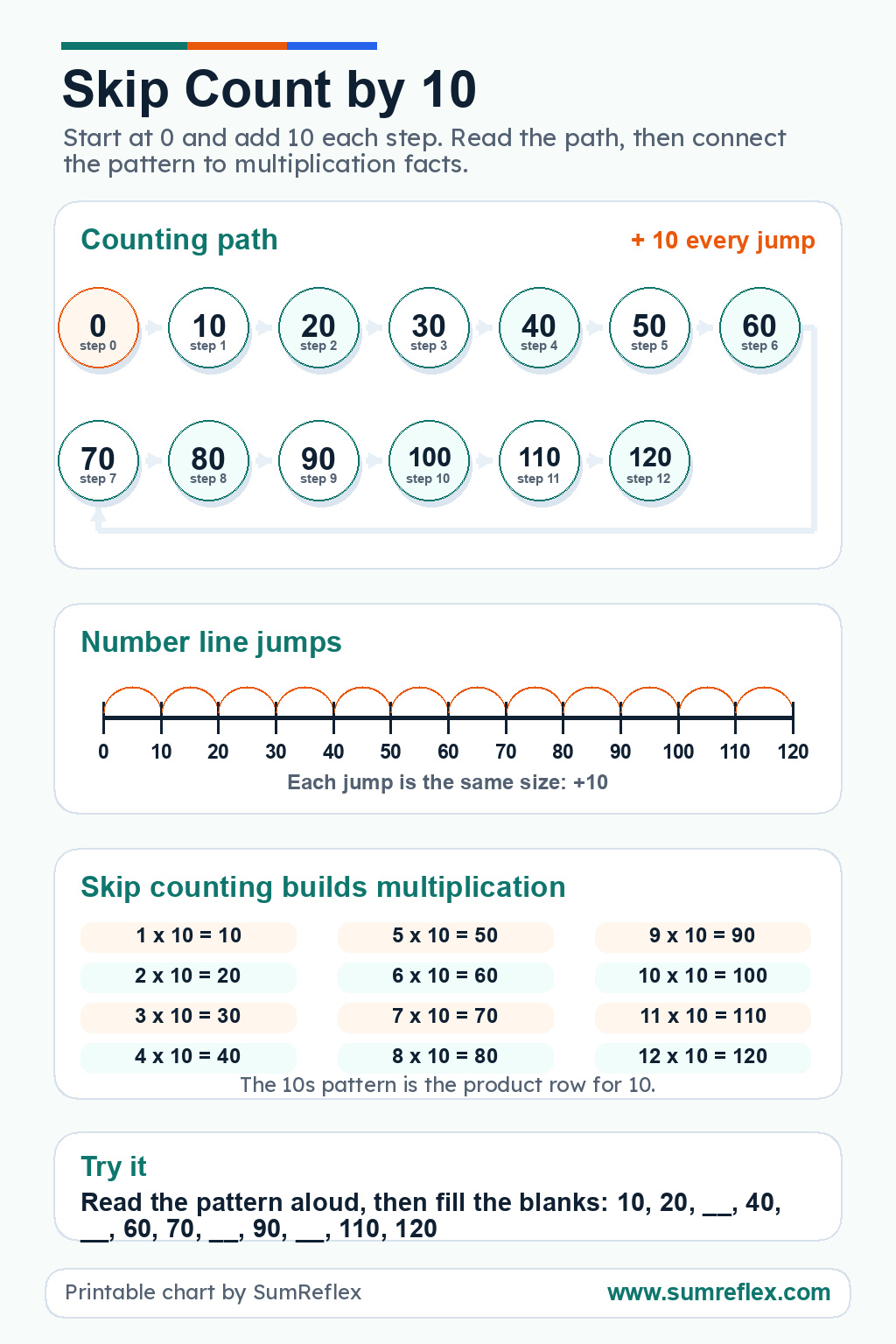
Counting by tens guide
Using tens to connect skip counting with place value
Every step adds one ten
Counting by 10 is more than saying numbers that end in zero. Each step adds one group of ten. From 20 to 30, another ten is added. From 70 to 80, the same size jump happens again. The chart makes those equal jumps visible so students can connect the spoken count to place value.
This is a useful point for students who are learning tens and ones. The number 60 means 6 tens and 0 ones. When the count moves to 70, the tens digit increases by one while the ones digit stays zero. That pattern prepares learners for adding tens mentally and for reading two-digit numbers with confidence.
The ending zero is a clue, not the whole lesson
Students quickly notice that the 10s pattern ends in 0. That observation is helpful, but the chart should push them further. Ask what the digit before the zero means. In 90, the 9 tells how many tens are present. In 120, there are 12 tens. This keeps the count tied to value instead of surface appearance.
The same idea connects to the divisible by 10 chart. A whole number ending in 0 can be grouped into tens evenly. Skip counting by 10 builds the sequence of those multiples before the divisibility language appears.
Multiplication facts become predictable
The 10 times table is often one of the first rows students can trust. One group of 10 is 10, five groups of 10 is 50, and twelve groups of 10 is 120. The chart lets students point to the count and match it to a multiplication statement. This makes multiplication feel like organized counting rather than a new disconnected operation.
For a focused multiplication page, the 10 times table chart can sit beside this reference. The skip-count page shows the counting rhythm, while the times-table page gives the facts in multiplication form.
Money, measurement, and schedules make tens useful
Counting by 10 appears in real settings: dimes, centimeter marks, scores, groups of ten objects, and quick estimates. Students can count dimes as 10, 20, 30, 40 cents. They can also count by tens on a measuring tape or in classroom bundles. Real examples make the pattern feel practical.
A good activity is to give students a set of objects grouped into tens, then ask them to count the groups before counting leftovers. This bridges skip counting and place value because each group is treated as one ten.
A quick practice routine
Have students read the chart forward, backward, and from a middle number. Starting at 40 and counting 50, 60, 70 is stronger than always beginning at 0. Later, cover several numbers and ask students to fill them in. The goal is flexible tens movement, not only reciting one sequence from memory.
For written practice, give a short strip such as 30, 40, blank, 60, blank, 80 and ask students to complete it before checking the chart. Then switch the direction: 120, 110, blank, 90, blank. Backward tens prepare students for subtraction by 10 and for reading number grids where movement can go up or down.
Keep the work short but repeated. A few tens questions at the start of a math block can strengthen place-value habits without turning the chart into a long worksheet.