



Divisibility by 10 teacher notes
Using the divisible by 10 chart to make the final-zero rule meaningful
The single zero that decides the test
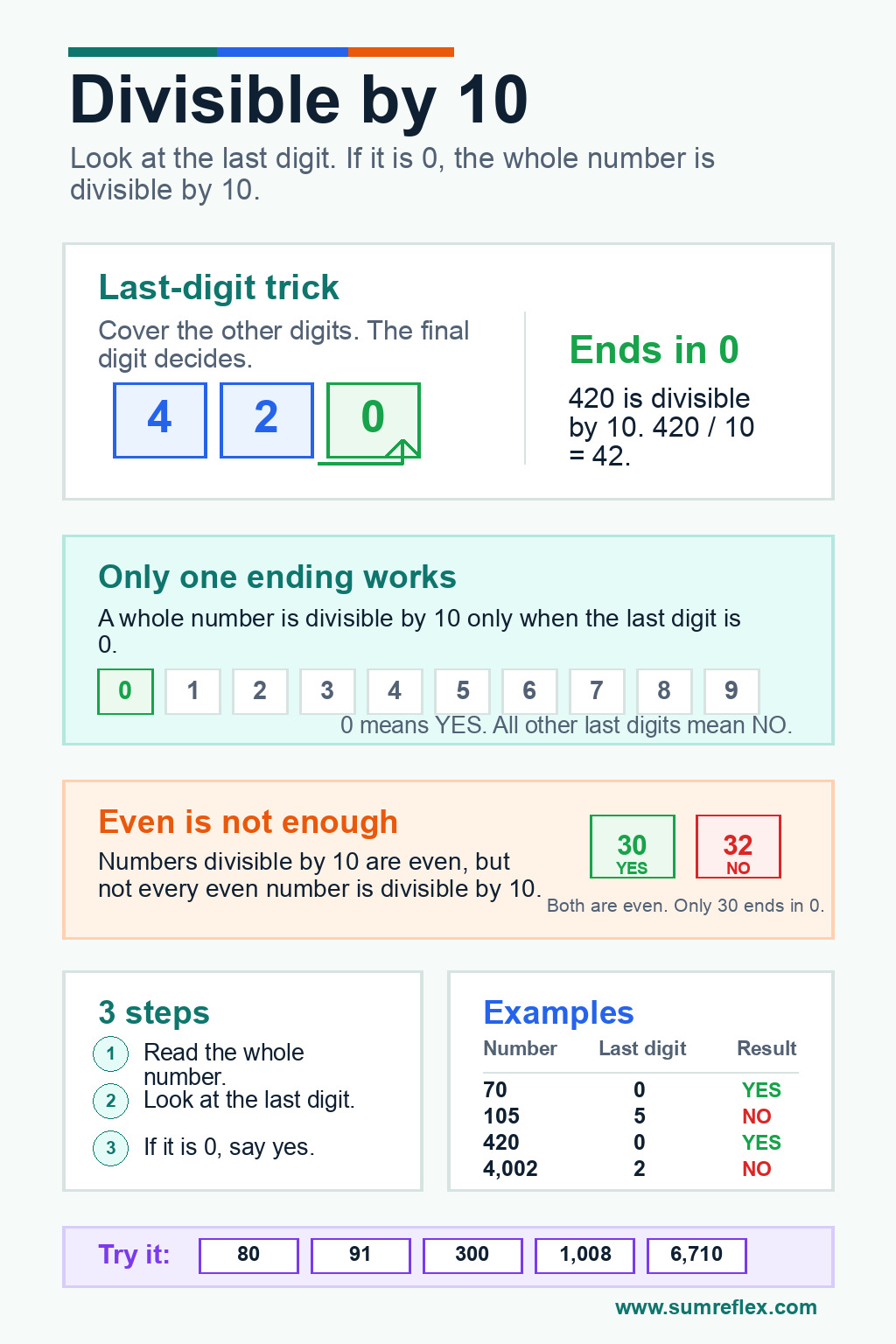
The divisible by 10 chart teaches a rule that looks almost too easy: a whole number is divisible by 10 when it ends in 0. The reason comes from place value. Ten is one ten and zero ones, so any number made from complete tens can be shared into groups of 10 with nothing left over. A number ending in 4, 6, or 8 may be even, but it still has extra ones beyond complete tens, so it does not divide evenly by 10.
The chart is most useful when students connect the final zero to the structure of the number. In 470, the 47 tells how many tens are present. In 4,700, the number has 470 tens. The final zero is not a decoration; it shows that the ones place is empty. That place-value meaning keeps the rule from becoming a shallow visual shortcut.
Using tens structure instead of guesswork
A good routine is to ask two questions. First, what is the last digit? Second, does the number represent complete tens? If the final digit is 0, both answers support yes. If the final digit is anything else, the number has leftover ones and fails the test. Students can then divide a passing number by 10 to see the zero disappear from the ones place, which reinforces the relationship between the rule and base-ten notation.
The divisible by 10 lesson can carry that explanation into examples and practice. For students who need more place-value support, the place value chart is a natural companion because it shows why the ones position controls whether a number is made of complete tens.
How learners mix up 2, 5, and 10
The final-zero rule sits inside a small family of ending tests. Every number divisible by 10 is also divisible by 2 and divisible by 5, but the reverse does not always work. A number ending in 6 passes the 2 test but fails the 10 test. A number ending in 5 passes the 5 test but fails the 10 test. Only the ending 0 passes all three.
That relationship is easier to teach with side-by-side references. Use the divisible by 2 chart for even endings and the divisible by 5 chart for 0-or-5 endings, then let students mark which endings overlap. The overlap shows why divisibility by 10 is stricter than either separate rule.
Helpful next pages after the ten rule
After students understand the chart, the rule becomes useful in rounding, estimation, mental multiplication, and checking products. Multiplying by 10 adds a zero in whole-number work, and dividing by 10 shifts place value in the opposite direction. The chart can sit beside quick practice where students decide whether a number can be split into equal groups of ten before doing any longer calculation.
For follow-up work, the Factor Calculator can confirm full factor lists, while the Least Common Multiple Calculator can use multiples of 10 in shared-cycle problems. The printable should remain the first stop when students only need the divisibility decision. It gives the mental rule in a form they can see, say, and apply without opening a calculation tool.
A final quick check is to ask for a quotient: if 830 passes the rule, 830 divided by 10 is 83. That answer confirms the number was made from complete tens.