



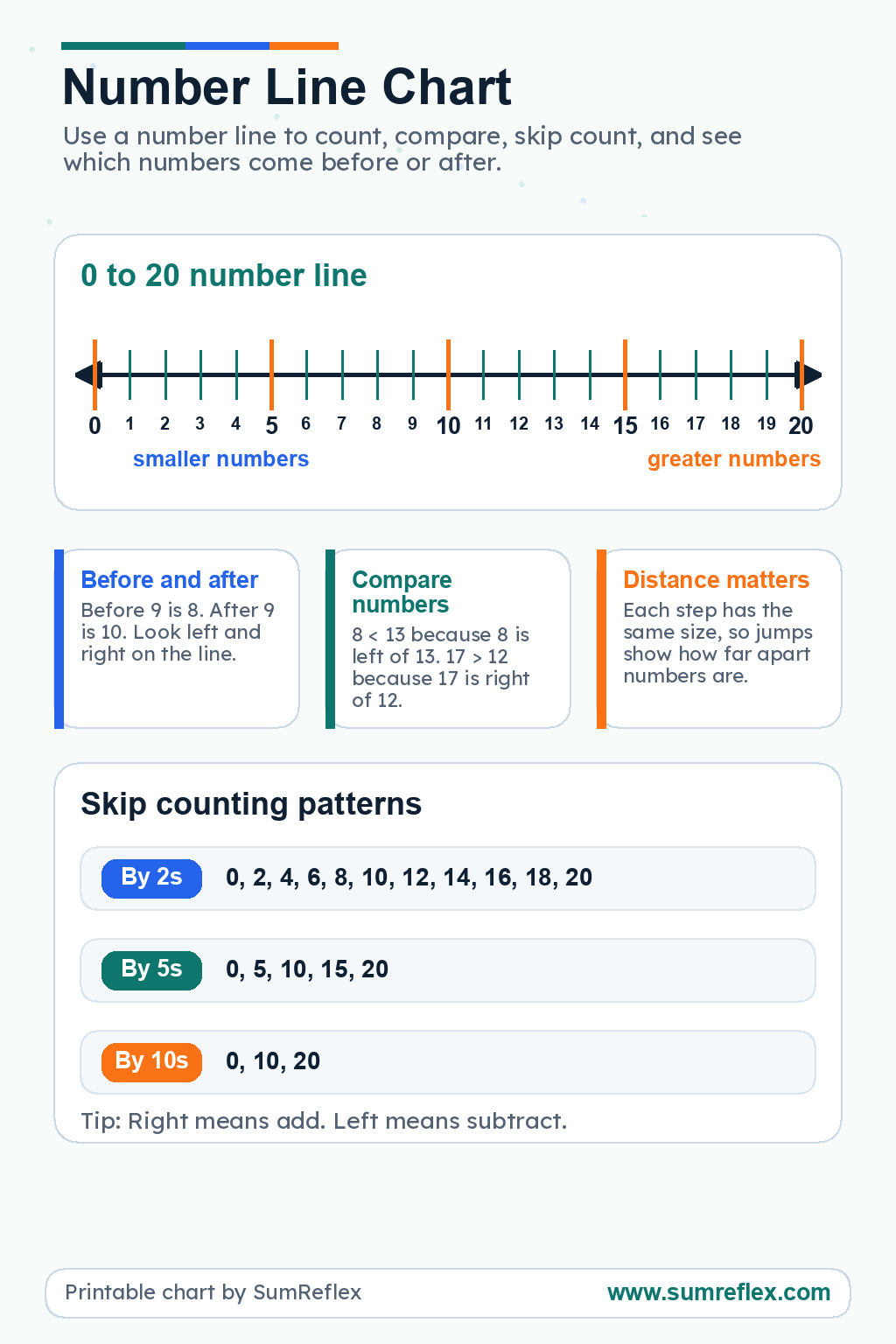
Number line study guide
Using a number line as a map of order and distance
Order becomes visible
A number line turns counting into a picture. The numbers appear in order, with smaller values to the left and greater values to the right. This matters because students can see that 14 is greater than 9 without relying only on memory. They can also see that 8 comes before 9 and after 7 because it has a fixed place in the sequence.
The equal spacing is just as important as the labels. Each step on the line represents one count. That spacing helps students understand distance between numbers. The gap from 3 to 6 is three steps, and the gap from 12 to 17 is five steps. The chart makes those differences countable.
Direction explains addition and subtraction
Moving right on a number line increases the number, so it supports addition and counting forward. Moving left decreases the number, so it supports subtraction and counting backward. A student solving 7 + 4 can start at 7 and hop four steps to the right. A student solving 13 - 5 can start at 13 and hop five steps to the left. The movement gives meaning to the operation.
Use the chart before introducing abstract rules. Ask students to place a finger on the starting number, say the operation, then move in the correct direction one step at a time. This slows the process enough for teachers to see whether the child understands the direction, the number of hops, and the landing value.
Comparing numbers with left and right language
Comparison symbols are easier when students can describe location first. A number to the left is less. A number to the right is greater. If two numbers are at the same point, they are equal. The chart lets students justify statements such as 8 < 13 by saying that 8 is left of 13.
This visual explanation is especially helpful for learners who reverse the greater-than or less-than symbols. Instead of memorizing which way a symbol opens, they can first decide which number is larger by looking at the line. The symbol comes after the comparison, not before it.
Skip counting grows out of equal jumps
Skip counting is simply repeated equal movement. Counting by 2s means jumping two spaces each time. Counting by 5s means jumping five spaces. Counting by 10s means jumping ten spaces. The number line helps students see why these patterns land on certain numbers and skip over others.
Pair this chart with the skip count by 2 chart, skip count by 5 chart, or skip count by 10 chart when learners are ready for longer patterns. The number line gives the movement model, while the skip-counting pages extend the sequence.
From whole numbers to rounding and negatives
A 0 to 20 number line is an early tool, but the idea grows. Later, students use number lines for rounding, fractions, decimals, negative numbers, and coordinate graphs. The habit stays the same: locate the value, compare its position, and reason from distance. When students begin rounding whole numbers, the rounding numbers chart can build on this same midpoint idea.
For practice, ask students to create their own small number line for a problem instead of always using the printed one. Drawing the line shows whether they understand equal spacing and order. The printable remains the model they can check against.