



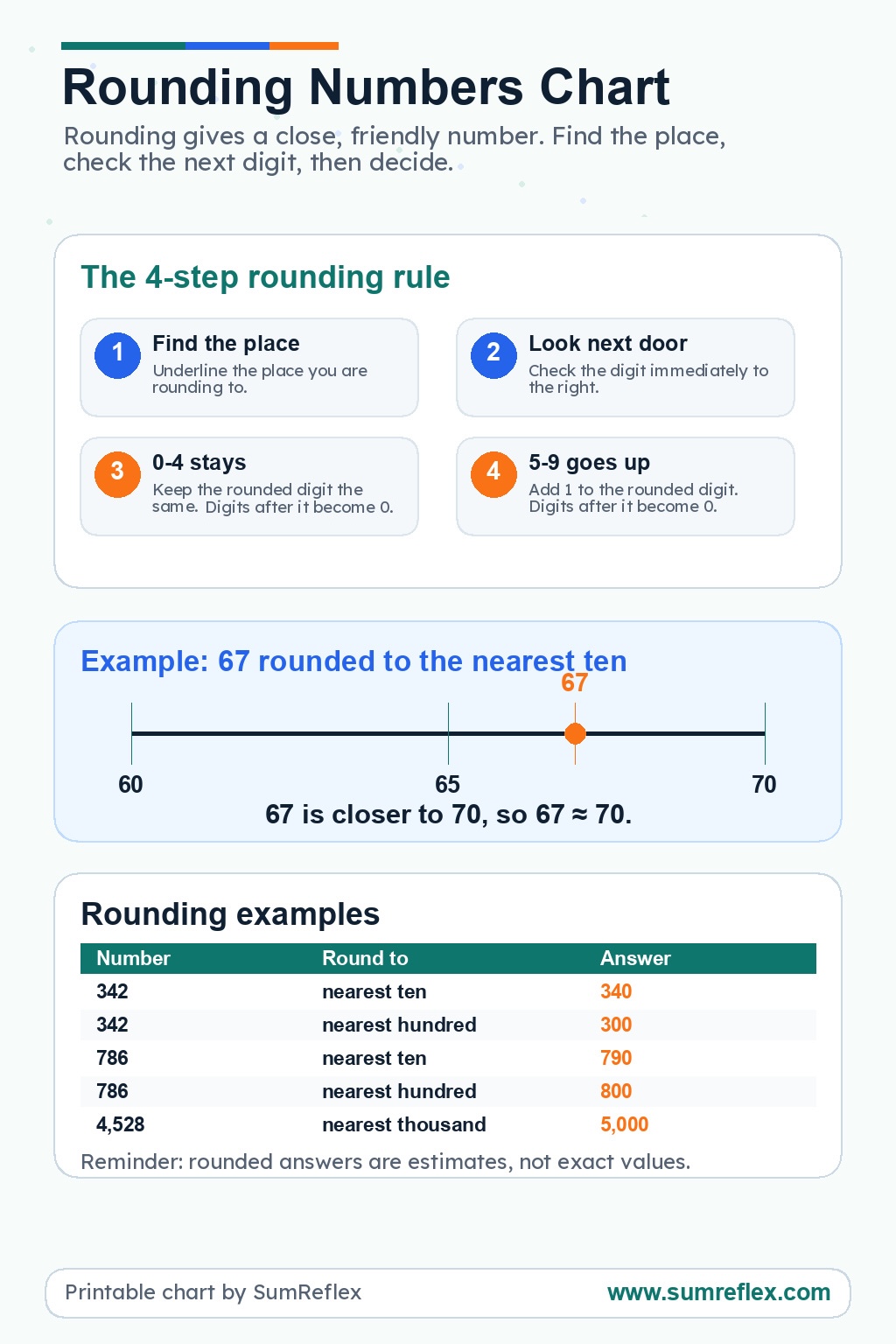
Whole-number rounding guide
Rounding whole numbers by place value and distance
Rounding starts with a target place
Students need to know the place they are rounding to before they look at any digit. Rounding 4,672 to the nearest ten is different from rounding it to the nearest hundred or nearest thousand. The chart helps learners mark the target digit first, then use the next digit as the decision maker. Without that first mark, students often round to whichever place catches their eye.
A useful written routine is to underline the target place and circle the digit to its right. If the circled digit is 0, 1, 2, 3, or 4, the target digit stays. If the circled digit is 5, 6, 7, 8, or 9, the target digit increases by one. The digits after the target place become zeros in whole-number rounding.
A number line explains why 5 changes direction
The rounding rule is easier to trust when students see it on a number line. The number 67 is between 60 and 70. It is closer to 70 because it is past the halfway point of 65. The number 64 is closer to 60 because it is before that midpoint. The chart gives students a way to connect the digit rule with distance.
This matters because many learners memorize "5 or more, round up" without understanding closeness. Ask them to draw a quick line from one benchmark to the next, place the original number, and decide which benchmark is nearer. The digit rule then becomes a shortcut for a distance decision.
Estimation is the reason for the skill
Rounding is not only a worksheet procedure. It helps students estimate sums, differences, products, costs, distances, and quantities. If a store total is 48 dollars, rounding to 50 gives a quick mental estimate. If a town is 1,984 people, rounding to about 2,000 makes the size easier to discuss. The chart should be used with real estimation questions so students understand why a close, simpler number is useful.
A good classroom prompt is to ask whether the rounded number is reasonable. Rounding 7,482 to the nearest thousand gives 7,000 or 7,500? The place requested decides the benchmark, not the desire for a nice-looking number. The chart keeps the place-value request visible.
When zeros replace digits
After rounding a whole number, every digit to the right of the target place becomes zero. Those zeros are placeholders that preserve the size of the number. If 6,438 rounds to 6,400 to the nearest hundred, the two zeros show that the answer is still in the thousands, not just 64.
This connects directly to the place value chart. Students who understand digit positions are less likely to drop zeros incorrectly. When decimals enter the lesson, the rounding decimal numbers chart should be used because decimal place formatting has its own details.
Practice after the chart
For deeper support, the Rounding Whole Numbers lesson gives worked examples and a longer explanation. For checking answers after students mark the target place by hand, the Rounding Calculator can confirm the result.
The chart is best used as the desk reference during practice: mark the place, check one digit, decide whether the target changes, replace later digits with zeros, and ask whether the rounded number is close to the original.