



Grade 4 number sense lesson
Divisible by 2: Last Digit Trick, Examples, Chart, and Practice
A whole number is divisible by 2 when it can be split into two equal groups with no remainder. The fastest trick is to check the last digit.
What does divisible by 2 mean?
A number is divisible by 2 if you can divide it by 2 evenly.
Evenly means there is no remainder.
For example, 18 is divisible by 2 because 18 / 2 = 9 with no remainder.
But 19 is not divisible by 2 because 19 / 2 leaves 1 left over.
Another way to say this is: a number divisible by 2 is an even number.
Printable Divisible by 2 trick chart
Use this SumReflex chart to remember the last digit trick for divisibility by 2.
The same chart is also available in the Printable Number Reference Charts section with print and download buttons.
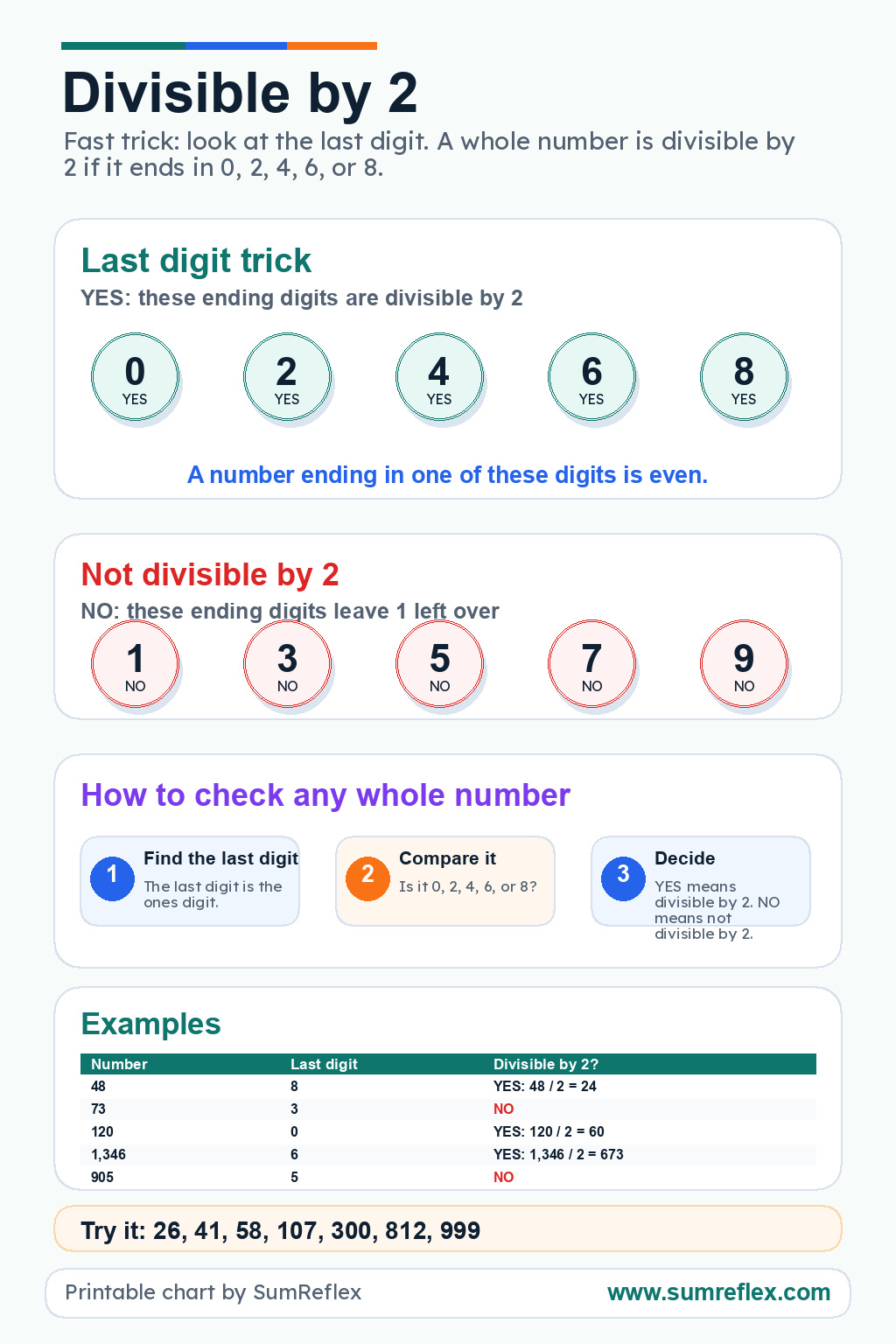
The last digit trick
To check if a whole number is divisible by 2, look only at the last digit.
If the last digit is 0, 2, 4, 6, or 8, the number is divisible by 2.
If the last digit is 1, 3, 5, 7, or 9, the number is not divisible by 2.
That is the whole trick. You do not need to divide the whole number first.
Why does the last digit trick work?
Every group of ten is divisible by 2.
10 / 2 = 5, 20 / 2 = 10, 100 / 2 = 50, and 1,000 / 2 = 500.
So the tens, hundreds, thousands, and larger place values are already safe for dividing by 2.
That means the only part that can make the number odd or even is the ones digit.
If the ones digit can split into two equal groups, the whole number can split into two equal groups.
Ending digits that are divisible by 2
Numbers ending in 0 are divisible by 2. Examples: 10, 40, 120, 900.
Numbers ending in 2 are divisible by 2. Examples: 12, 52, 302, 1,002.
Numbers ending in 4 are divisible by 2. Examples: 24, 64, 414, 2,354.
Numbers ending in 6 are divisible by 2. Examples: 36, 76, 516, 9,876.
Numbers ending in 8 are divisible by 2. Examples: 18, 98, 708, 6,218.
Ending digits that are not divisible by 2
Numbers ending in 1, 3, 5, 7, or 9 are not divisible by 2.
Examples: 21, 43, 75, 107, and 999 are not divisible by 2.
Each of these numbers leaves 1 left over after making pairs.
That is why they are called odd numbers.
Step-by-step method
Step 1: Find the last digit.
Step 2: Ask whether the last digit is 0, 2, 4, 6, or 8.
Step 3: If yes, the number is divisible by 2.
Step 4: If no, the number is not divisible by 2.
Example: 1,346 ends in 6. Since 6 is on the yes list, 1,346 is divisible by 2.
Examples with solutions
Example 1: Is 48 divisible by 2? The last digit is 8. Since 8 is even, 48 is divisible by 2. 48 / 2 = 24.
Example 2: Is 73 divisible by 2? The last digit is 3. Since 3 is odd, 73 is not divisible by 2.
Example 3: Is 120 divisible by 2? The last digit is 0. Since 0 is on the yes list, 120 is divisible by 2. 120 / 2 = 60.
Example 4: Is 905 divisible by 2? The last digit is 5. Since 5 is odd, 905 is not divisible by 2.
Example 5: Is 9,002 divisible by 2? The last digit is 2. Since 2 is even, 9,002 is divisible by 2. 9,002 / 2 = 4,501.
Example 6: Is 0 divisible by 2? Yes. 0 / 2 = 0, so 0 is even and divisible by 2.
Using pairs to understand the rule
Dividing by 2 means making pairs.
If 14 students line up in pairs, each pair has 2 students and nobody is left alone. So 14 is divisible by 2.
If 15 students line up in pairs, 1 student is left without a partner. So 15 is not divisible by 2.
That same idea works for any whole number. Even numbers make complete pairs. Odd numbers leave 1 left over.
Word problem examples
Example: A teacher has 36 pencils and wants to split them equally between 2 boxes. Can she do it? Yes, because 36 ends in 6. Each box gets 18 pencils.
Example: There are 47 stickers. Can they be shared equally by 2 students with none left over? No, because 47 ends in 7.
Example: A class has 28 students. Can the class make teams of 2? Yes, because 28 ends in 8. There will be 14 teams.
Common mistakes
Do not check the first digit. For 314, the first digit is 3, but the last digit is 4, so 314 is divisible by 2.
Do not add the digits for this rule. Adding digits is useful for divisibility by 3 and 9, not for divisibility by 2.
Do not say every number with a 2 somewhere is divisible by 2. The number 125 has a 2, but it ends in 5, so it is not divisible by 2.
Do not forget 0. A whole number ending in 0 is divisible by 2.
Quick practice
1. Is 26 divisible by 2? Answer: yes, because it ends in 6.
2. Is 41 divisible by 2? Answer: no, because it ends in 1.
3. Is 58 divisible by 2? Answer: yes, because it ends in 8.
4. Is 107 divisible by 2? Answer: no, because it ends in 7.
5. Is 300 divisible by 2? Answer: yes, because it ends in 0.
6. Is 812 divisible by 2? Answer: yes, because it ends in 2.
7. Is 999 divisible by 2? Answer: no, because it ends in 9.
The big idea
Divisibility by 2 is one of the easiest number tricks because the last digit tells the answer.
If a whole number ends in 0, 2, 4, 6, or 8, it is divisible by 2.
If it ends in 1, 3, 5, 7, or 9, it is not divisible by 2.
This rule is also the same idea as even and odd numbers: even numbers are divisible by 2, and odd numbers are not.