



Grade 4 number sense lesson
Divisible by 10: Last Digit Trick, Examples, Chart, and Practice
A whole number is divisible by 10 when it can be divided into ten equal groups with no remainder. The fastest trick is to check whether the last digit is 0.
What does divisible by 10 mean?
A number is divisible by 10 if you can divide it by 10 evenly.
Evenly means there is no remainder.
For example, 80 is divisible by 10 because 80 / 10 = 8 with no remainder.
But 84 is not divisible by 10 because 84 / 10 leaves 4 left over.
You can also think of it as making ten equal groups. If the groups are equal and nothing is left over, the number is divisible by 10.
Printable Divisible by 10 trick chart
Use this SumReflex chart to remember the last digit trick for divisibility by 10.
The same chart is also available in the Printable Number Reference Charts section with print and download buttons.
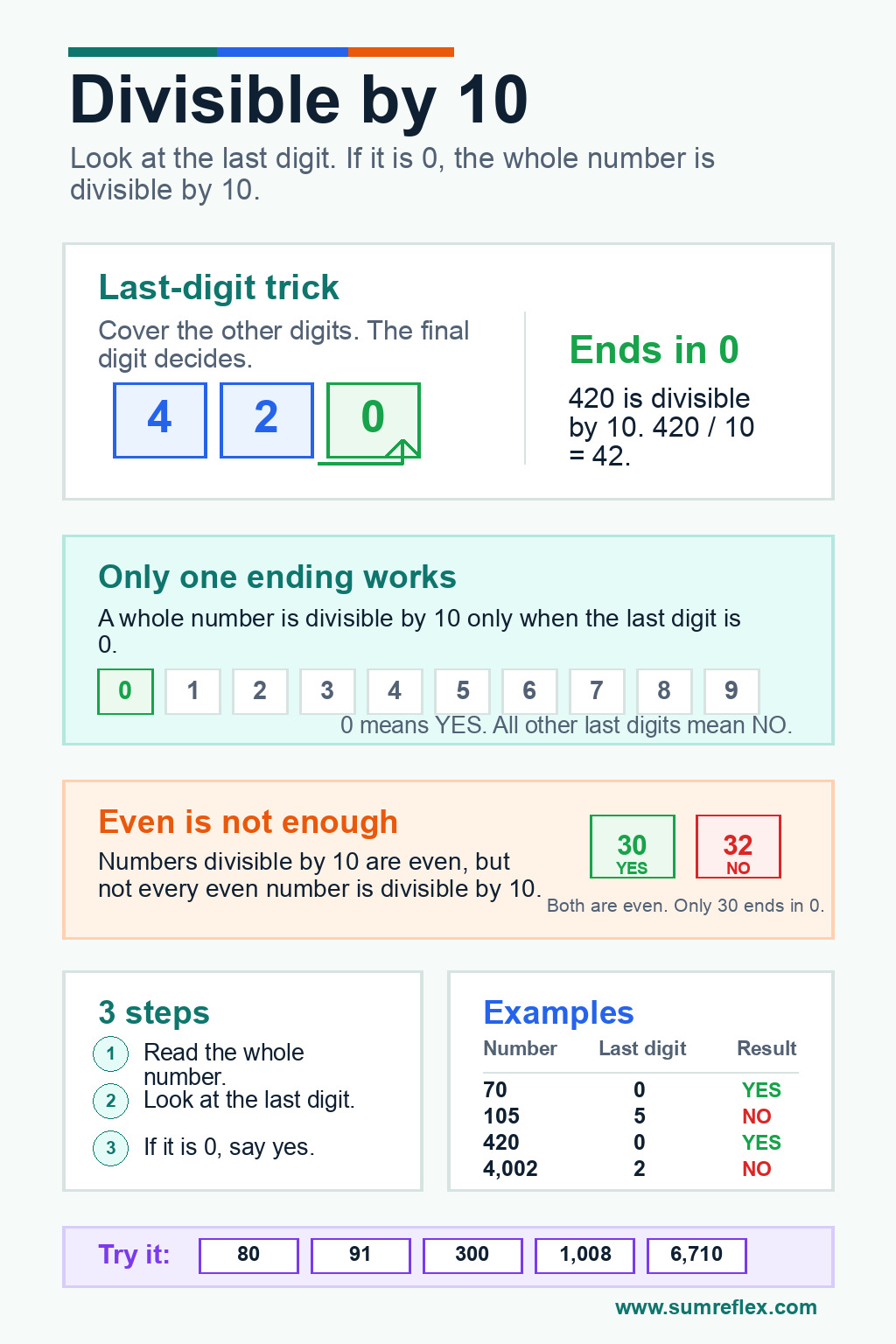
The last digit trick
To check if a whole number is divisible by 10, look at the last digit.
If the last digit is 0, the number is divisible by 10.
If the last digit is not 0, the number is not divisible by 10.
For example, 420 ends in 0, so 420 is divisible by 10. 420 / 10 = 42.
Only one ending works
For whole numbers, divisibility by 10 has one simple ending: 0.
Numbers like 10, 20, 30, 40, 50, 100, 230, 1,000, and 6,710 are divisible by 10 because they end in 0.
Numbers ending in 1, 2, 3, 4, 5, 6, 7, 8, or 9 are not divisible by 10.
Example: 1,008 is not divisible by 10 because its last digit is 8.
Even is not enough
Every number divisible by 10 is even because it ends in 0.
But not every even number is divisible by 10.
For example, 32 is even, but 32 is not divisible by 10 because it does not end in 0.
That is why the test for divisibility by 10 is stricter than the test for divisibility by 2.
Why does the trick work?
The number 10 is the base of our place value system.
When a whole number ends in 0, it has no extra ones left after making groups of ten.
For example, 420 means 42 tens and 0 ones, so it divides evenly by 10.
But 424 means 42 tens and 4 extra ones, so it does not divide evenly by 10.
Step-by-step method
Step 1: Read the whole number.
Step 2: Look at the last digit.
Step 3: If the last digit is 0, the number is divisible by 10.
Step 4: If the last digit is not 0, the number is not divisible by 10.
Example: 6,710 ends in 0, so 6,710 is divisible by 10. 6,710 / 10 = 671.
Examples with solutions
Example 1: Is 70 divisible by 10? Yes. The last digit is 0, so 70 / 10 = 7.
Example 2: Is 105 divisible by 10? No. The last digit is 5, not 0.
Example 3: Is 420 divisible by 10? Yes. The last digit is 0, so 420 / 10 = 42.
Example 4: Is 4,002 divisible by 10? No. The last digit is 2, not 0.
Example 5: Is 1,230 divisible by 10? Yes. The last digit is 0, so 1,230 / 10 = 123.
Example 6: Is 9,999 divisible by 10? No. The last digit is 9, not 0.
Tougher examples
Example: Is 100,000 divisible by 10? Yes. It ends in 0, so it divides evenly by 10. 100,000 / 10 = 10,000.
Example: Is 54,310 divisible by 10? Yes. The final digit is 0, so 54,310 / 10 = 5,431.
Example: Is 800,006 divisible by 10? No. The last digit is 6, so it has 6 ones left over.
Example: Is 7,000 divisible by 10? Yes. It ends in 0, and 7,000 / 10 = 700.
Word problem examples
Example: A teacher has 420 pencils and wants to put 10 pencils in each cup. Can she do it with none left over? Yes, because 420 ends in 0. She can make 42 cups.
Example: A game has 105 points to split equally among 10 players. Can the points be shared with none left over? No, because 105 ends in 5.
Example: A store packs 6,710 buttons into bags of 10. Will any buttons be left over? No. 6,710 ends in 0, so it is divisible by 10.
Common mistakes
Do not use the rule for 2. Ending in 0, 2, 4, 6, or 8 tells you a number is even, but divisibility by 10 needs a final 0.
Do not use the rule for 5. Ending in 0 or 5 works for divisibility by 5, but only ending in 0 works for divisibility by 10.
Do not ignore the last digit after a comma. In 6,710, the last digit is 0. In 6,701, the last digit is 1.
Do not think a large number is automatically divisible by 10. The size does not matter; the final digit matters.
Quick practice
1. Is 80 divisible by 10? Answer: yes, because the last digit is 0.
2. Is 91 divisible by 10? Answer: no, because the last digit is 1.
3. Is 300 divisible by 10? Answer: yes, because the last digit is 0.
4. Is 1,008 divisible by 10? Answer: no, because the last digit is 8.
5. Is 6,710 divisible by 10? Answer: yes, because the last digit is 0.
6. Is 54,315 divisible by 10? Answer: no, because the last digit is 5.
7. Is 100,000 divisible by 10? Answer: yes, because the last digit is 0.
The big idea
Divisibility by 10 is a last-digit rule.
A whole number is divisible by 10 only when the last digit is 0.
Even numbers are not always divisible by 10.
When you see a final 0, you can divide by 10 with no remainder.