



First-grade measurement guide
Turning early measurement words into fair classroom actions
Measurement starts with comparing
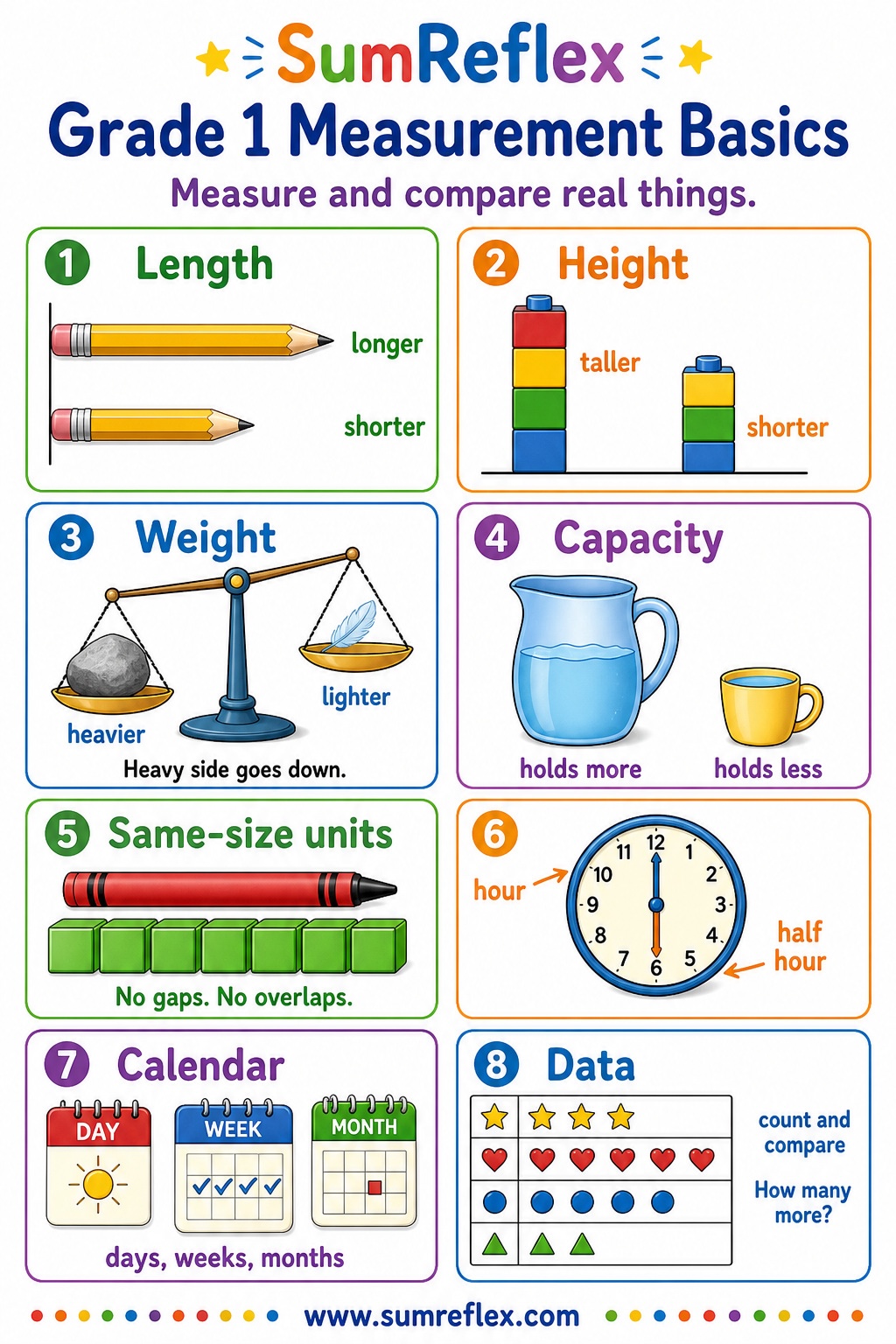
Grade 1 measurement begins before rulers and formulas. Students first learn to compare objects with words such as longer, shorter, taller, heavier, lighter, holds more, and holds less. This chart keeps those words visible so children can connect the language to real objects. A pencil can be longer than a crayon. A water bottle can hold more than a cup. A backpack can feel heavier than a notebook.
The key is to ask students to explain what feature they are comparing. Longer is about length. Taller is about height. Heavier is about weight. Holds more is about capacity. When children name the attribute first, they are less likely to compare objects randomly. The chart gives teachers and parents a shared vocabulary for those conversations.
Fair measuring needs same-size units
Nonstandard measurement is a major Grade 1 skill because it teaches fairness before standard units appear. Students might measure a desk with paper clips, blocks, cubes, or counters. The important rule is that the units must be the same size, placed end to end, and lined up without gaps or overlaps. If one child uses large blocks and another uses small cubes, the numbers cannot be compared fairly.
This chart can sit near a measurement station as a reminder. Start at the same end. Use matching units. Keep the units touching. Count every unit carefully. Those actions seem simple, but they create the foundation for later centimeter and inch measurement. A ruler only makes sense after students understand why equal units matter.
Time and calendar language belong in the same conversation
First-grade measurement also includes time. Students may read clocks to the hour or half hour, name days of the week, talk about yesterday and tomorrow, and use calendar words for events. The chart brings those ideas together because children experience them together during school routines. Morning meeting, lunch time, dismissal, birthdays, and class schedules all use time language.
For more focused calendar support, the days of the week chart gives the weekly order, while the months of the year chart gives the yearly order. This Grade 1 chart is the overview that reminds students these are all ways of measuring and organizing time.
Data questions grow from counting real things
Simple data work fits naturally with measurement because students count, compare, and describe groups. A class may count favorite fruits, weather days, shoe colors, or how many cubes long different objects are. The important Grade 1 questions are direct: Which has more? Which has fewer? How many in all? How many more does one group have than another?
Use the chart before graphing or tally activities. Ask students to state what was counted and what question they are answering. This helps them understand that a data display is not just a picture; it is a way to compare information. Measurement language and data language both depend on careful observation.
How to use the page during hands-on lessons
Keep the chart close while students measure classroom objects. Choose one panel at a time instead of trying to cover the whole page in one lesson. For a length activity, focus only on longer, shorter, same-size units, and no gaps. For a capacity activity, compare containers and use holds more or holds less. For a time activity, connect the chart to the class clock and daily schedule.
When students are ready for more unit names, the units of measurement chart and units for measuring length chart can extend the vocabulary. This first-grade page should remain the simple reference for fair measuring actions and everyday comparison words.