



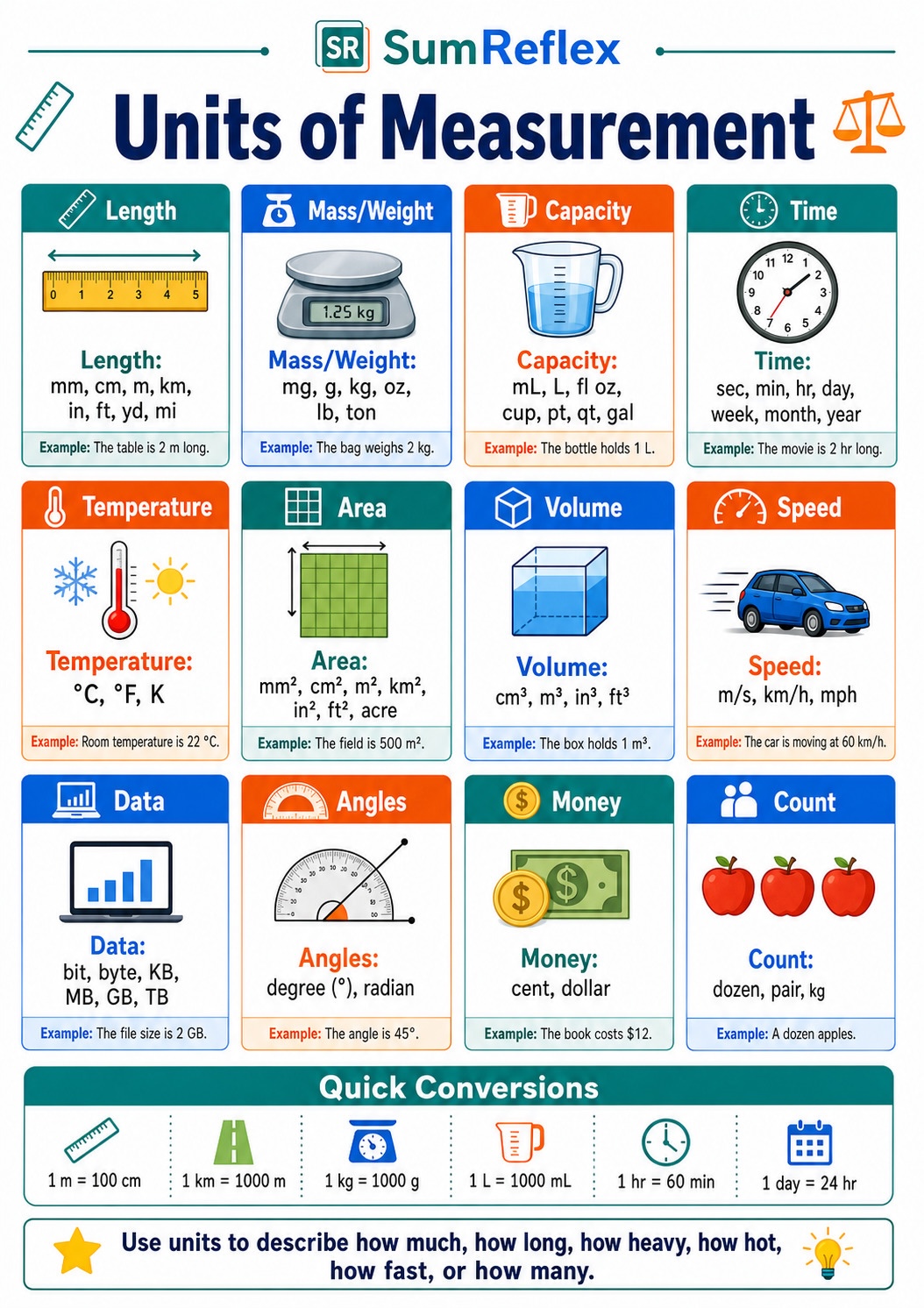
Measurement unit family guide
Choosing the correct measurement family before choosing a unit
Start with the quantity, not the abbreviation
A unit only makes sense after students know what is being measured. If a question asks how far, the student needs a length unit. If it asks how heavy, the unit belongs to mass or weight. If it asks how much liquid a container holds, capacity is the right family. If it asks how much flat surface is covered, area units are needed. This chart groups units by purpose so learners can make that first decision before they worry about symbols.
That habit prevents strange answers. A room should not be measured in kilograms. A bottle capacity should not be measured in square centimeters. A temperature should not be labeled in miles. The chart helps students catch those mismatches by connecting each unit family to the kind of question it answers.
Unit families give math words a home
Length units include millimeters, centimeters, meters, kilometers, inches, feet, yards, and miles. Mass or weight units include grams, kilograms, ounces, pounds, and tons. Capacity units include milliliters, liters, cups, pints, quarts, and gallons. Time units include seconds, minutes, hours, days, weeks, months, and years. Area and volume use square and cubic units because they measure space in different dimensions.
The chart also includes categories that students may not always think of as measurement. Data storage uses bytes, kilobytes, megabytes, and larger digital units. Angle measure uses degrees and radians. Money uses cents and dollars. Counts can use pairs, dozens, and scores. Seeing these groups together helps students understand that measurement is a way to describe many kinds of quantities, not only ruler work.
Anchor facts are useful after the family is chosen
Conversions such as 1 meter equals 100 centimeters, 1 kilogram equals 1,000 grams, 1 liter equals 1,000 milliliters, 1 hour equals 60 minutes, and 1 day equals 24 hours are important anchor facts. They should come after the unit family decision. If students jump straight to memorized conversions, they may choose a fact that belongs to the wrong measurement type.
Use the chart as a two-step reference. First, identify the family. Second, choose an anchor fact or a more detailed chart. For length-specific conversion work, the units of length conversion chart gives more detail than this broad page. For time notation, the 24-hour clock chart handles a different kind of time reading.
Broad charts are best for sorting problems
This printable is especially useful before mixed measurement word problems. Students can sort each problem by what it asks: distance, weight, liquid amount, elapsed time, temperature, surface area, volume, speed, angle, money, data, or count. Once the problem is sorted, the correct unit options become easier to choose. The chart becomes a reading tool as much as a math reference.
For younger students, pair this page with the Grade 1 measurement basics chart, which teaches comparing words and fair measuring actions. Older students can use this broader chart as a quick map before moving into formulas, conversions, or calculator checks.
Where calculators fit after unit thinking
A calculator can check arithmetic, but it cannot decide whether a unit makes sense in the original question. Students should use the chart first to choose the measurement family, then complete any conversion or calculation. After that, the Conversion Calculator can confirm unit changes, while topic-specific tools such as the Area Calculator or Volume Calculator can support geometry work.
The strongest habit is simple: read the question, name the quantity, choose the unit family, then calculate. This chart exists for that first half of the work, where many wrong answers actually begin.