



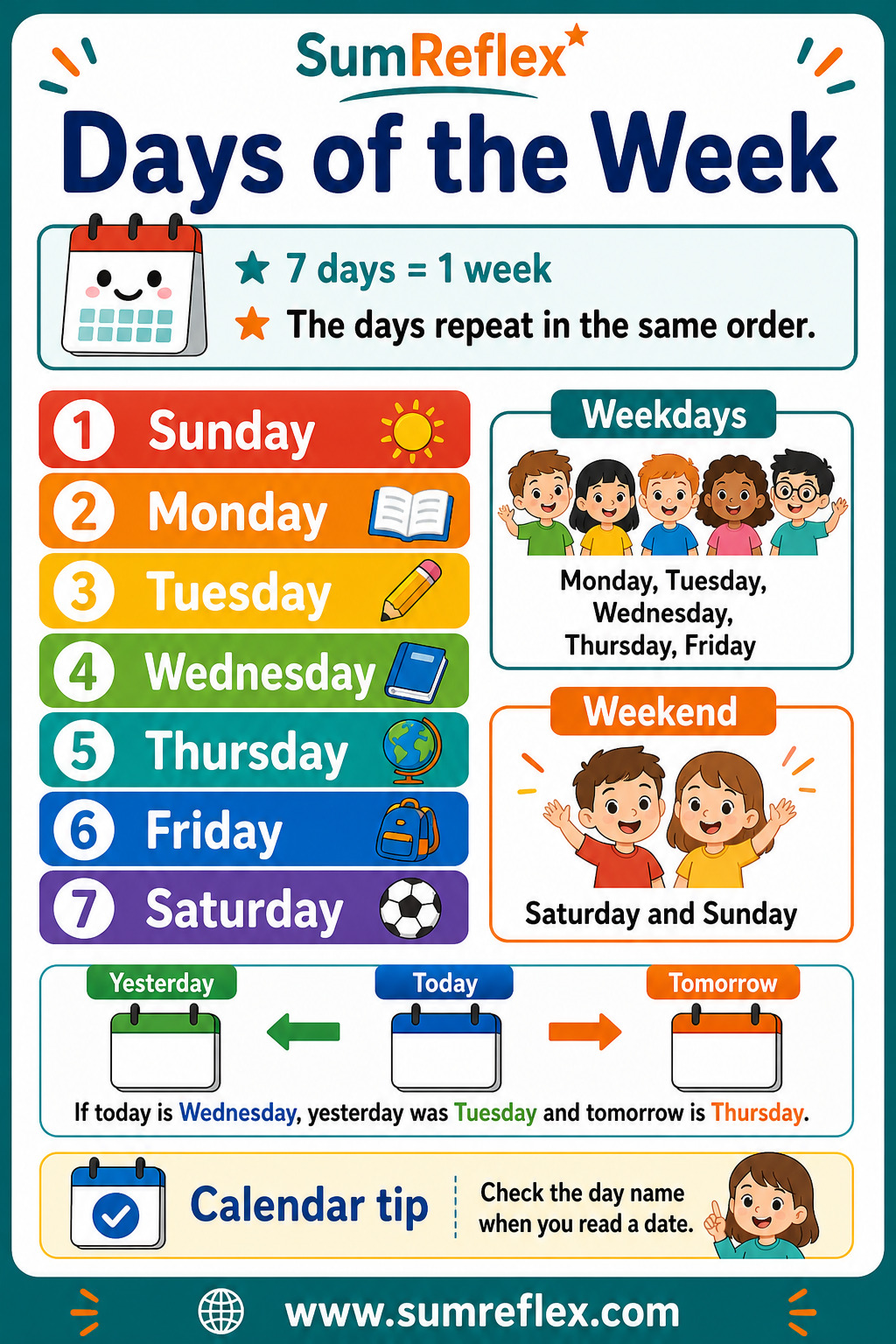
Weekly calendar guide
Building confidence with day order and relative time words
The week is a repeating cycle
The seven days of the week are not just a list to memorize once. They repeat in the same order again and again. After Saturday, the sequence returns to Sunday. This circular idea helps students answer questions about yesterday, tomorrow, next week, and recurring events. The chart keeps all seven names visible so learners can follow the cycle with a finger before they remember it independently.
During calendar time, ask students to read the sequence forward and then start from different days. If today is Wednesday, what comes next? If today is Sunday, what came before it? Starting from different positions prevents students from knowing only the chant from Sunday to Saturday. They begin to understand the order from any point in the week.
Yesterday and tomorrow depend on today
Relative time words can be confusing because the answer changes every day. Yesterday is not a fixed day name. Tomorrow is not a fixed day name. Both depend on what today is. The chart supports that idea by showing the day before and the day after in a visible order. Students can point to today, move one step back for yesterday, and move one step forward for tomorrow.
A useful routine is to ask three connected questions: What day is today? What day was yesterday? What day will tomorrow be? Then change the starting day and repeat. This practice helps students use the chart as a reasoning tool rather than a poster they simply recite.
Weekdays and weekend have different uses
The chart also separates Monday through Friday from Saturday and Sunday. That distinction is useful for school schedules, work calendars, appointments, due dates, and family plans. Students may know the day names but still need help understanding why Saturday and Sunday are often grouped as the weekend.
Ask students to sort simple events by weekday or weekend: school assembly, Saturday game, Monday homework, Sunday visit, Friday spelling test. This turns the day names into calendar meaning. It also prepares students to read schedules where the type of day matters as much as the name.
Connect day names with dates and clocks
Day names become more useful when students connect them with dates and times. A complete schedule might say Tuesday, March 12 at 14:30. The day tells where the event sits in the week, the date tells where it sits in the month, and the time tells when it happens during the day. This chart gives the weekly piece of that larger calendar skill.
For nearby references, use the months of the year chart when students need the yearly order and the 24-hour clock chart when time notation appears in schedules. For checking a specific calendar question, the Day of the Week Calculator can confirm which weekday belongs to a date.
Simple practice that grows with the learner
For early learners, use the chart for naming and pointing. For stronger learners, hide one day name and ask them to fill the gap. Later, ask questions that cross the weekend boundary, such as "What is tomorrow if today is Saturday?" or "What was yesterday if today is Monday?" Those boundary questions show whether students truly understand the repeating cycle.