


Formula reference guide
Using a formula wall chart without turning geometry into memorization
Start by sorting the problem
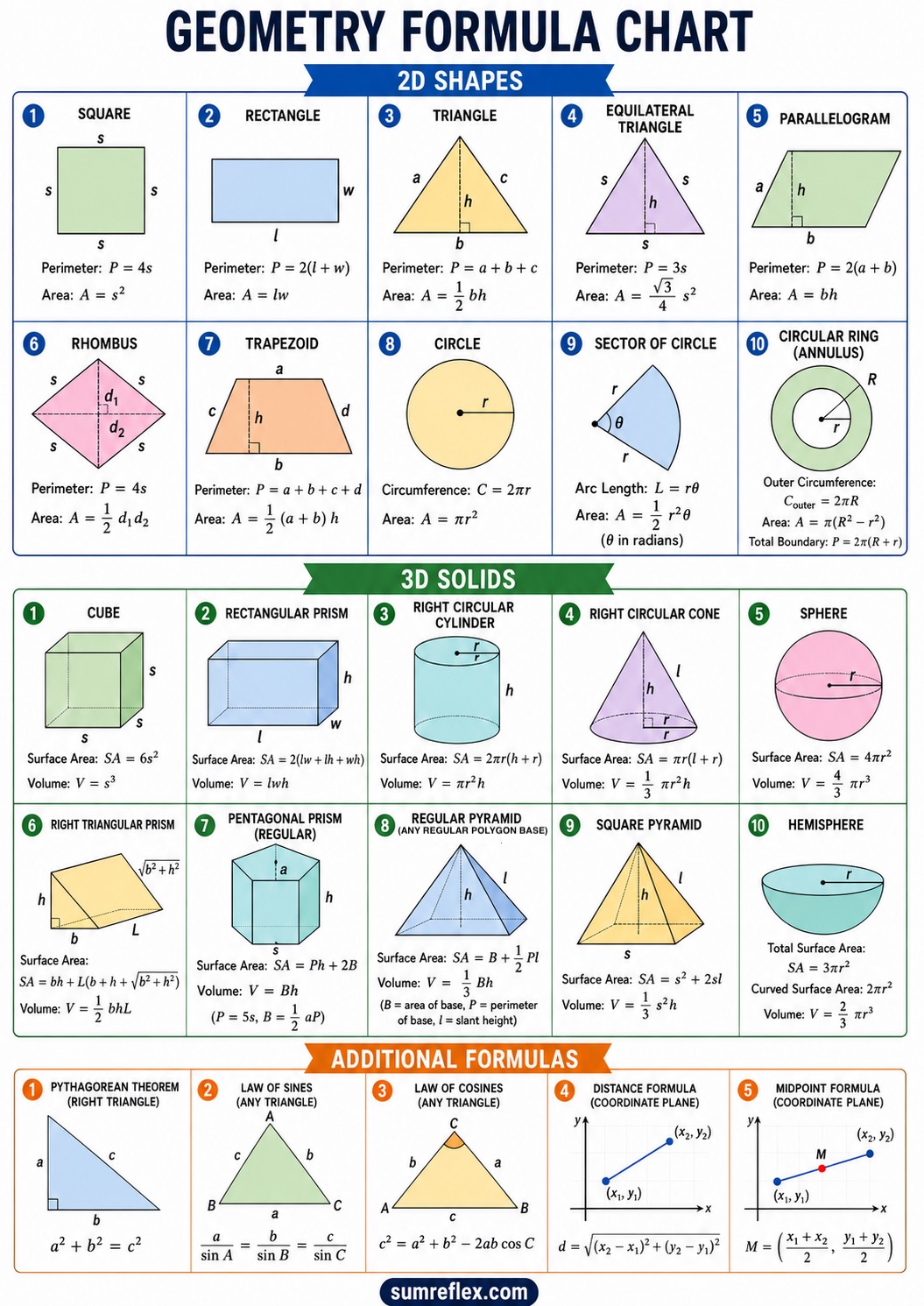
A formula chart works best when students use it after reading the problem, not before. The first question should be simple: is the shape flat or solid? Flat shapes lead to perimeter, circumference, or area. Solid figures lead to surface area or volume. That sorting step prevents a student from grabbing a familiar formula just because the shape looks similar.
The chart is arranged so students can compare formulas by measurement type. A rectangle area formula and a rectangular-prism volume formula both use multiplication, but they answer different questions. The chart helps students see that difference by keeping 2D and 3D sections apart.
The unit label is part of the answer
Perimeter and circumference answers use length units because only distance is being measured. Area and surface area answers use square units because they measure covering. Volume answers use cubic units because three dimensions are involved. The formula may produce the number, but the unit tells whether the number describes the right kind of measurement.
When students check homework with this chart, ask them to circle the unit label before checking the arithmetic. A correct number with the wrong unit usually means the problem was sorted incorrectly, or the final answer was copied without understanding what was measured.
Use the chart beside written setup
The chart should not replace written work. A strong setup names the shape, writes the formula, substitutes the measurements, and then simplifies. That habit is especially helpful for formulas that share letters such as radius, height, slant height, side length, base area, and perimeter of a base.
For example, a cone uses slant height in its surface area formula, but vertical height in its volume formula. Seeing both formulas on the chart is useful, but students still need to mark which height the problem gives. The written setup is where that choice becomes visible.
Pair this printable with focused lessons
Use the geometry formulas lesson when students need a guided explanation of plane-shape and solid-figure formulas. Use the area and perimeter chart when the lesson is only about flat shapes. Use the common solid figures chart when students still need to identify 3D shapes and their parts before measuring them.
After students write their setup, calculators can help check arithmetic. The Area Calculator, Surface Area Calculator, and Volume Calculator are useful after the formula choice has already been made.
A quick classroom routine
Give students one mixed list of problems: a fence problem, a flooring problem, a paint-the-box problem, and a fill-the-tank problem. Before anyone calculates, have them write only the measurement type: perimeter, area, surface area, or volume. Then let them use the chart to choose a formula.
That short routine keeps the printable active. Students are not just looking up answers; they are matching language, shape, measurement type, formula, and unit label.