Grade 6 geometry lesson
Geometry Formulas for Plane Shapes and Solid Figures
A complete Grade 6 geometry formula guide with definitions, formulas, chart support, and worked examples for plane shapes, solid figures, triangles, and coordinate formulas.
How to use geometry formulas
A geometry formula is not just something to memorize. It is a shortcut that works only after the shape, measurement type, and given values are clear.
Perimeter and circumference measure distance around a shape. Area measures flat space. Surface area measures outside covering on a solid. Volume measures how much space a solid holds.
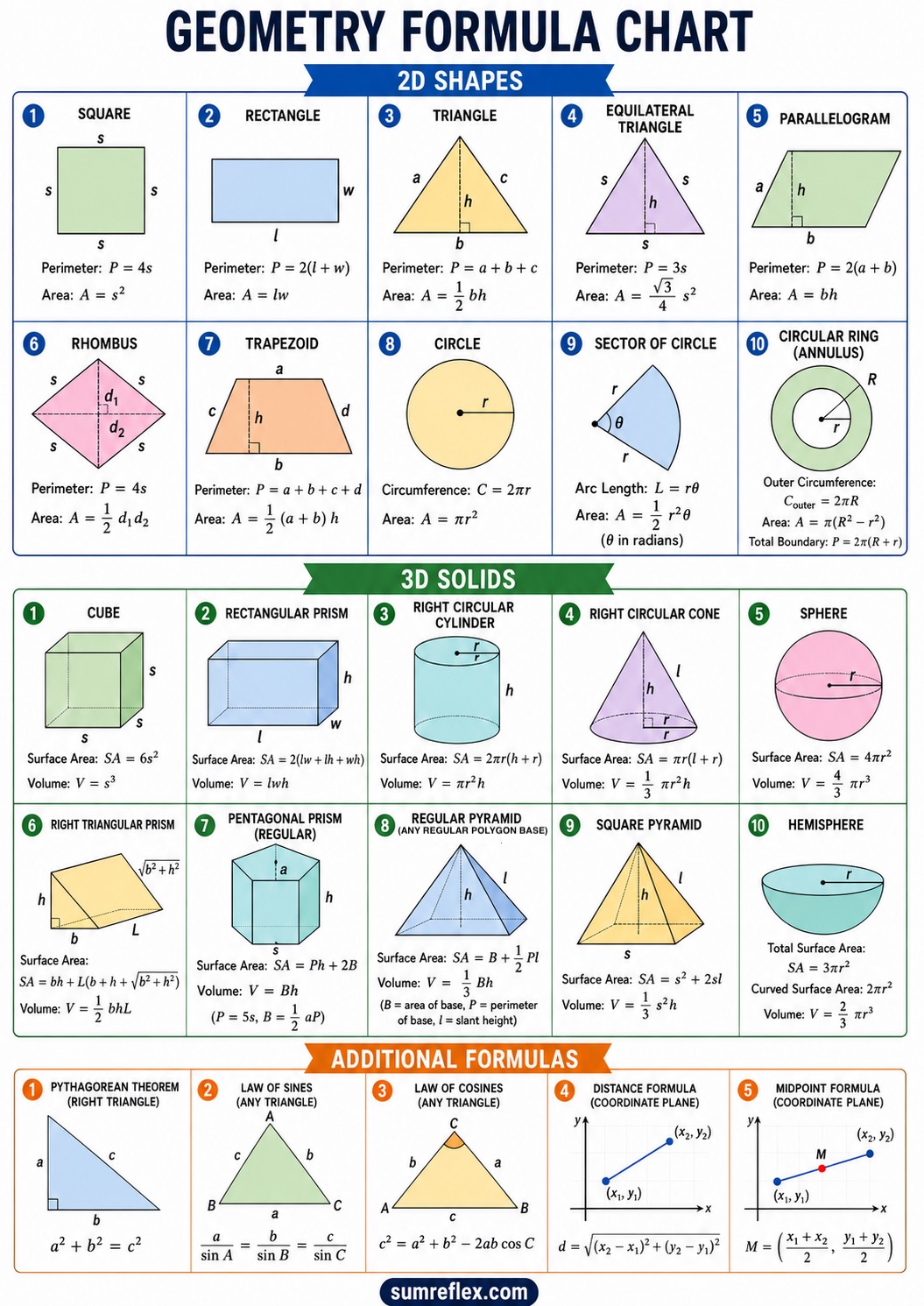
The chart on this page has 25 formula groups: 10 for 2D shapes, 10 for 3D solids, and 5 additional triangle or coordinate formulas. Each group below gives the definition, formula, and a step-by-step solved example.
Printable geometry formula chart
Use this chart as the quick reference, then use the sections below when a formula needs a full explanation or a worked example.
The same chart is also available in the Printable Geometry Charts section with print and download options.
1. Square formulas
Definition: A square is a four-sided plane shape with four equal sides and four right angles.
Formulas: Perimeter \(P=4s\). Area \(A=s^2\). The letter \(s\) means side length.
Example: A square has side length 6 cm. Find the perimeter and area.
Step 1: Write the perimeter formula: \[P=4s\]
Step 2: Substitute \(s=6\): \[P=4(6)=24\]
Step 3: Write the area formula: \[A=s^2\]
Step 4: Substitute \(s=6\): \[A=6^2=36\]
Answer: The perimeter is 24 cm, and the area is 36 square centimeters.
2. Rectangle formulas
Definition: A rectangle is a four-sided plane shape with opposite sides equal and four right angles.
Formulas: Perimeter \(P=2(l+w)\). Area \(A=lw\). The letters \(l\) and \(w\) mean length and width.
Example: A rectangle is 12 m long and 5 m wide. Find the perimeter and area.
Step 1: Use the perimeter formula: \[P=2(l+w)\]
Step 2: Substitute the measurements: \[P=2(12+5)=2(17)=34\]
Step 3: Use the area formula: \[A=lw\]
Step 4: Substitute the measurements: \[A=12(5)=60\]
Answer: The perimeter is 34 m, and the area is 60 square meters.
3. Triangle formulas
Definition: A triangle is a plane shape with three sides. For area, the height must be perpendicular to the chosen base.
Formulas: Perimeter \(P=a+b+c\). Area \(A=\frac{1}{2}bh\).
Example: A right triangle has sides 6 cm, 8 cm, and 10 cm. Use base 8 cm and height 6 cm.
Step 1: Add all three sides for perimeter: \[P=a+b+c=6+8+10=24\]
Step 2: Write the area formula: \[A=\frac{1}{2}bh\]
Step 3: Substitute \(b=8\) and \(h=6\): \[A=\frac{1}{2}(8)(6)=24\]
Answer: The perimeter is 24 cm, and the area is 24 square centimeters.
4. Equilateral triangle formulas
Definition: An equilateral triangle has three equal sides and three equal angles.
Formulas: Perimeter \(P=3s\). Area \(A=\frac{\sqrt{3}}{4}s^2\).
Example: An equilateral triangle has side length 10 cm.
Step 1: Use the perimeter formula: \[P=3s=3(10)=30\]
Step 2: Use the area formula: \[A=\frac{\sqrt{3}}{4}s^2\]
Step 3: Substitute \(s=10\): \[A=\frac{\sqrt{3}}{4}(10)^2=25\sqrt{3}\]
Step 4: Approximate if needed: \[25\sqrt{3}\approx43.3\]
Answer: The perimeter is 30 cm, and the area is \(25\sqrt{3}\), or about 43.3 square centimeters.
5. Parallelogram formulas
Definition: A parallelogram is a four-sided plane shape with both pairs of opposite sides parallel.
Formulas: Perimeter \(P=2(a+b)\). Area \(A=bh\). The height is the perpendicular distance between the bases.
Example: A parallelogram has side lengths 9 cm and 14 cm. Its base is 14 cm, and its height is 6 cm.
Step 1: Use the perimeter formula: \[P=2(a+b)=2(9+14)=46\]
Step 2: Use the area formula: \[A=bh\]
Step 3: Substitute \(b=14\) and \(h=6\): \[A=14(6)=84\]
Answer: The perimeter is 46 cm, and the area is 84 square centimeters.
6. Rhombus formulas
Definition: A rhombus is a four-sided plane shape with four equal sides. Its diagonals can be used to find area.
Formulas: Perimeter \(P=4s\). Area \(A=\frac{1}{2}d_1d_2\).
Example: A rhombus has side length 5 cm and diagonals 8 cm and 6 cm.
Step 1: Use the perimeter formula: \[P=4s=4(5)=20\]
Step 2: Use the diagonal area formula: \[A=\frac{1}{2}d_1d_2\]
Step 3: Substitute \(d_1=8\) and \(d_2=6\): \[A=\frac{1}{2}(8)(6)=24\]
Answer: The perimeter is 20 cm, and the area is 24 square centimeters.
7. Trapezoid formulas
Definition: A trapezoid is a four-sided plane shape with one pair of parallel sides. The parallel sides are the bases.
Formulas: Perimeter \(P=a+b+c+d\). Area \(A=\frac{1}{2}(a+b)h\), where \(a\) and \(b\) are the bases.
Example: A trapezoid has bases 10 cm and 16 cm, other sides 7 cm and 9 cm, and height 6 cm.
Step 1: Add all sides for perimeter: \[P=10+16+7+9=42\]
Step 2: Use the area formula: \[A=\frac{1}{2}(a+b)h\]
Step 3: Substitute values: \[A=\frac{1}{2}(10+16)(6)=78\]
Answer: The perimeter is 42 cm, and the area is 78 square centimeters.
8. Circle formulas
Definition: A circle is the set of all points the same distance from a center point. That distance is the radius.
Formulas: Circumference \(C=2\pi r\). Area \(A=\pi r^2\).
Example: A circle has radius 5 m.
Step 1: Use the circumference formula: \[C=2\pi r=2\pi(5)=10\pi\]
Step 2: Use the area formula: \[A=\pi r^2=\pi(5)^2=25\pi\]
Step 3: Approximate if needed: \[10\pi\approx31.4,\quad 25\pi\approx78.5\]
Answer: The circumference is \(10\pi\) m, and the area is \(25\pi\) square meters.
9. Sector of a circle formulas
Definition: A sector is a slice of a circle formed by two radii and the arc between them.
Formulas: Arc length \(L=r\theta\). Sector area \(A=\frac{1}{2}r^2\theta\). The angle \(\theta\) must be measured in radians.
Example: A sector has radius 6 cm and angle \(\theta=\frac{\pi}{3}\) radians.
Step 1: Use the arc length formula: \[L=r\theta=6\left(\frac{\pi}{3}\right)=2\pi\]
Step 2: Use the sector area formula: \[A=\frac{1}{2}r^2\theta\]
Step 3: Substitute the values: \[A=\frac{1}{2}(6)^2\left(\frac{\pi}{3}\right)=6\pi\]
Answer: The arc length is \(2\pi\) cm, and the sector area is \(6\pi\) square centimeters.
10. Circular ring formulas
Definition: A circular ring, or annulus, is the region between two circles with the same center.
Formulas: Outer circumference \(C_{\text{outer}}=2\pi R\). Area \(A=\pi(R^2-r^2)\). Total boundary \(P=2\pi(R+r)\).
Example: A circular ring has outer radius \(R=7\) cm and inner radius \(r=3\) cm.
Step 1: Find the outer circumference: \[C_{\text{outer}}=2\pi(7)=14\pi\]
Step 2: Find the ring area: \[A=\pi(7^2-3^2)=\pi(49-9)=40\pi\]
Step 3: Find the total boundary: \[P=2\pi(7+3)=20\pi\]
Answer: The outer circumference is \(14\pi\) cm, the area is \(40\pi\) square centimeters, and the total boundary is \(20\pi\) cm.
11. Cube formulas
Definition: A cube is a solid figure with six square faces and all edges equal.
Formulas: Surface area \(SA=6s^2\). Volume \(V=s^3\).
Example: A cube has side length 4 in.
Step 1: Use the surface area formula: \[SA=6s^2=6(4)^2=96\]
Step 2: Use the volume formula: \[V=s^3=4^3=64\]
Answer: The surface area is 96 square inches, and the volume is 64 cubic inches.
12. Rectangular prism formulas
Definition: A rectangular prism is a box-shaped solid with rectangular faces.
Formulas: Surface area \(SA=2(lw+lh+wh)\). Volume \(V=lwh\).
Example: A rectangular prism is 8 cm long, 5 cm wide, and 3 cm high.
Step 1: Find surface area: \[SA=2(8\cdot5+8\cdot3+5\cdot3)\]
Step 2: Simplify: \[SA=2(40+24+15)=158\]
Step 3: Find volume: \[V=8\cdot5\cdot3=120\]
Answer: The surface area is 158 square centimeters, and the volume is 120 cubic centimeters.
13. Right circular cylinder formulas
Definition: A right circular cylinder has two matching circular bases and a straight height between them.
Formulas: Surface area \(SA=2\pi r(h+r)\). Volume \(V=\pi r^2h\).
Example: A cylinder has radius 3 cm and height 10 cm.
Step 1: Use the surface area formula: \[SA=2\pi(3)(10+3)=78\pi\]
Step 2: Use the volume formula: \[V=\pi(3)^2(10)=90\pi\]
Answer: The surface area is \(78\pi\) square centimeters, and the volume is \(90\pi\) cubic centimeters.
14. Right circular cone formulas
Definition: A right circular cone has one circular base and one vertex above the center of the base.
Formulas: Surface area \(SA=\pi r(l+r)\). Volume \(V=\frac{1}{3}\pi r^2h\). The letter \(l\) is slant height, and \(h\) is vertical height.
Example: A cone has radius 6 cm, vertical height 8 cm, and slant height 10 cm.
Step 1: Use the surface area formula with slant height: \[SA=\pi(6)(10+6)=96\pi\]
Step 2: Use the volume formula with vertical height: \[V=\frac{1}{3}\pi(6)^2(8)=96\pi\]
Answer: The surface area is \(96\pi\) square centimeters, and the volume is \(96\pi\) cubic centimeters.
15. Sphere formulas
Definition: A sphere is a perfectly round solid where every point on the surface is the same distance from the center.
Formulas: Surface area \(SA=4\pi r^2\). Volume \(V=\frac{4}{3}\pi r^3\).
Example: A sphere has radius 3 m.
Step 1: Find surface area: \[SA=4\pi(3)^2=36\pi\]
Step 2: Find volume: \[V=\frac{4}{3}\pi(3)^3=36\pi\]
Answer: The surface area is \(36\pi\) square meters, and the volume is \(36\pi\) cubic meters.
16. Right triangular prism formulas
Definition: A right triangular prism has two matching triangular bases and rectangular side faces.
Formulas: Surface area \(SA=bh+L(b+h+\sqrt{b^2+h^2})\). Volume \(V=\frac{1}{2}bhL\).
Example: The triangular base has legs \(b=6\) cm and \(h=8\) cm. The prism length is \(L=12\) cm.
Step 1: Find the missing side of the right-triangle base: \[\sqrt{6^2+8^2}=10\]
Step 2: Find surface area: \[SA=6(8)+12(6+8+10)=48+288=336\]
Step 3: Find volume: \[V=\frac{1}{2}(6)(8)(12)=288\]
Answer: The surface area is 336 square centimeters, and the volume is 288 cubic centimeters.
17. Regular pentagonal prism formulas
Definition: A regular pentagonal prism has two matching regular pentagon bases and rectangular side faces.
Formulas: Surface area \(SA=Ph+2B\). Volume \(V=Bh\). For a regular pentagon, \(P=5s\) and \(B=\frac{1}{2}aP\).
Example: A regular pentagonal prism has side \(s=6\) cm, apothem \(a=4\) cm, and height \(h=10\) cm.
Step 1: Find the base perimeter: \[P=5s=5(6)=30\]
Step 2: Find the base area: \[B=\frac{1}{2}aP=\frac{1}{2}(4)(30)=60\]
Step 3: Find surface area: \[SA=Ph+2B=30(10)+2(60)=420\]
Step 4: Find volume: \[V=Bh=60(10)=600\]
Answer: The surface area is 420 square centimeters, and the volume is 600 cubic centimeters.
18. Regular pyramid formulas
Definition: A regular pyramid has a regular polygon base and triangular side faces meeting at one vertex.
Formulas: Surface area \(SA=B+\frac{1}{2}Pl\). Volume \(V=\frac{1}{3}Bh\).
Example: A regular pyramid has base area \(B=96\) square cm, base perimeter \(P=40\) cm, slant height \(l=13\) cm, and vertical height \(h=12\) cm.
Step 1: Find surface area: \[SA=96+\frac{1}{2}(40)(13)=96+260=356\]
Step 2: Find volume: \[V=\frac{1}{3}(96)(12)=384\]
Answer: The surface area is 356 square centimeters, and the volume is 384 cubic centimeters.
19. Square pyramid formulas
Definition: A square pyramid has a square base and four triangular side faces.
Formulas: Surface area \(SA=s^2+2sl\). Volume \(V=\frac{1}{3}s^2h\).
Example: A square pyramid has base side \(s=10\) cm, slant height \(l=13\) cm, and vertical height \(h=12\) cm.
Step 1: Find surface area: \[SA=10^2+2(10)(13)=100+260=360\]
Step 2: Find volume: \[V=\frac{1}{3}(10)^2(12)=400\]
Answer: The surface area is 360 square centimeters, and the volume is 400 cubic centimeters.
20. Hemisphere formulas
Definition: A hemisphere is half of a sphere. It has one curved surface and one circular flat base.
Formulas: Total surface area \(SA=3\pi r^2\). Curved surface area \(CSA=2\pi r^2\). Volume \(V=\frac{2}{3}\pi r^3\).
Example: A hemisphere has radius 6 cm.
Step 1: Find total surface area: \[SA=3\pi(6)^2=108\pi\]
Step 2: Find curved surface area: \[CSA=2\pi(6)^2=72\pi\]
Step 3: Find volume: \[V=\frac{2}{3}\pi(6)^3=144\pi\]
Answer: The total surface area is \(108\pi\) square centimeters, the curved surface area is \(72\pi\) square centimeters, and the volume is \(144\pi\) cubic centimeters.
21. Pythagorean theorem
Definition: The Pythagorean theorem works in a right triangle and connects the two legs with the hypotenuse.
Formula: \(a^2+b^2=c^2\), where \(c\) is the hypotenuse.
Example: A right triangle has legs 9 cm and 12 cm. Find the hypotenuse.
Step 1: Substitute the leg lengths: \[9^2+12^2=c^2\]
Step 2: Simplify: \[81+144=225\]
Step 3: Take the square root: \[c=\sqrt{225}=15\]
Answer: The hypotenuse is 15 cm.
22. Law of sines
Definition: The law of sines works in many non-right triangles when a side and its opposite angle are known.
Formula: \[\frac{a}{\sin A}=\frac{b}{\sin B}=\frac{c}{\sin C}\]
Example: In a triangle, \(A=30^\circ\), \(B=45^\circ\), and \(a=10\). Find side \(b\).
Step 1: Set up the matching ratios: \[\frac{10}{\sin 30^\circ}=\frac{b}{\sin 45^\circ}\]
Step 2: Solve for \(b\): \[b=\frac{10\sin 45^\circ}{\sin 30^\circ}\]
Step 3: Substitute exact values: \[b=\frac{10(\sqrt{2}/2)}{1/2}=10\sqrt{2}\]
Answer: Side \(b=10\sqrt{2}\), or about 14.14 units.
23. Law of cosines
Definition: The law of cosines works in any triangle and is especially useful when two sides and the included angle are known.
Formula: \(c^2=a^2+b^2-2ab\cos C\).
Example: A triangle has sides \(a=7\), \(b=10\), and included angle \(C=60^\circ\). Find side \(c\).
Step 1: Substitute into the formula: \[c^2=7^2+10^2-2(7)(10)\cos 60^\circ\]
Step 2: Use \(\cos 60^\circ=\frac{1}{2}\): \[c^2=49+100-140\left(\frac{1}{2}\right)=79\]
Step 3: Take the square root: \[c=\sqrt{79}\approx8.89\]
Answer: Side \(c=\sqrt{79}\), or about 8.89 units.
24. Distance formula
Definition: The distance formula finds the straight-line distance between two points on the coordinate plane.
Formula: \[d=\sqrt{(x_2-x_1)^2+(y_2-y_1)^2}\]
Example: Find the distance between \((2,3)\) and \((8,11)\).
Step 1: Substitute the points: \[d=\sqrt{(8-2)^2+(11-3)^2}\]
Step 2: Simplify the differences: \[d=\sqrt{6^2+8^2}\]
Step 3: Finish the square root: \[d=\sqrt{36+64}=\sqrt{100}=10\]
Answer: The distance is 10 units.
25. Midpoint formula
Definition: The midpoint formula finds the point halfway between two coordinate points.
Formula: \[M=\left(\frac{x_1+x_2}{2},\frac{y_1+y_2}{2}\right)\]
Example: Find the midpoint between \((2,3)\) and \((8,11)\).
Step 1: Substitute the coordinates: \[M=\left(\frac{2+8}{2},\frac{3+11}{2}\right)\]
Step 2: Add the coordinates: \[M=\left(\frac{10}{2},\frac{14}{2}\right)\]
Step 3: Divide: \[M=(5,7)\]
Answer: The midpoint is \((5,7)\).
How to choose the right formula
Name the shape first. A rectangle, rhombus, cylinder, and cone all use different measurements.
Read the measurement word. Around, border, fence, or frame points to perimeter or circumference. Cover, paint, wrap, or tile points to area or surface area. Fill, hold, or capacity points to volume.
Check the letters before substituting. Radius and diameter are different. Vertical height and slant height are different. Base length and base area are different.
Use the unit as a final test. Perimeter and circumference use length units, area and surface area use square units, and volume uses cubic units.
Common geometry formula mistakes
Do not use diameter in a radius formula unless you divide the diameter by 2 first.
Do not use a slanted side as height unless it is perpendicular to the base.
Do not use cone slant height for volume. Cone volume uses vertical height.
Do not write area or surface area with cubic units. Those measurements use square units.
Do not write volume with square units. Volume needs cubic units.
Do not copy a formula before naming the shape. The shape tells you which formula is allowed.
Practice with the formula chart
Cover the solved examples and choose one formula group from the chart. Write the definition, copy the formula, make up clean measurements, and solve your own example.
After that, compare your setup with the matching worked example on this page. The goal is not only to get the answer, but to show the formula choice, substitution, arithmetic, and unit label clearly.
For calculation checks after written work, use the Area Calculator, Surface Area Calculator, Volume Calculator, or Triangle Calculator.