

3D geometry reference
Teaching solid figures as objects with visible parts
Turn shape names into part names
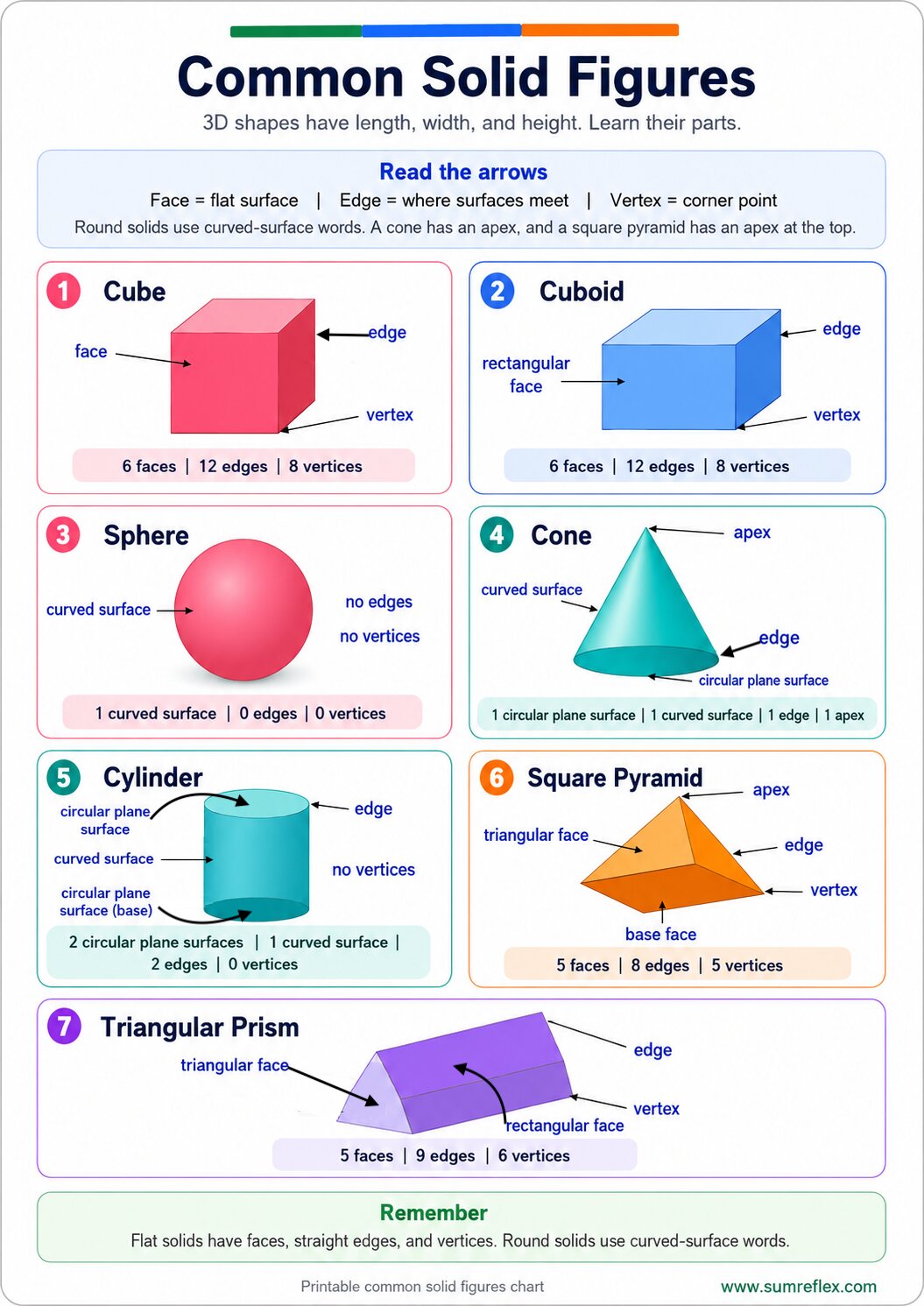
Students often learn 3D shape names before they learn how to discuss the parts of those shapes. They may know that a box is a cube or cuboid, but not yet have the language to explain its faces, edges, and vertices. This chart supports that step. The diagram labels let students point to each part while saying the word, which is especially helpful because solid figures are harder to read from a flat drawing than from a physical model.
Use the printable alongside classroom objects when possible. A die, can, cone, ball, cereal box, or triangular-prism package turns the chart into a checklist. Students can match the printed figure to the object, then identify which parts exist on that object and which do not. A sphere has a curved surface but no edges or vertices. A cube has flat faces, straight edges, and vertices where edges meet. The contrast is where the vocabulary starts to become meaningful.
Faces, edges, and vertices need touchable language
For young learners, the difference between a face and an edge can feel abstract until the words are tied to touch. A face is the flat part the hand can rest on. An edge is the line where two faces meet. A vertex is the corner point where edges come together. The chart keeps those labels visible so students can use them while handling blocks or looking at diagrams.
Counting should come after identification. If students rush to count faces, edges, or vertices before naming what they are counting, they often include curved surfaces incorrectly or miss hidden back edges in a drawing. Ask them to mark one example of each part on the chart first, then move to counts. That order makes the count a result of understanding rather than a memorized number.
Curved solids deserve different questions
Cones, cylinders, and spheres are useful because they interrupt the flat-face pattern. A cylinder has circular bases and one curved surface. A cone has a base, a curved surface, and an apex. A sphere has no flat face at all. Those examples prevent students from assuming every solid figure must behave like a box. They also prepare students for later surface area and volume work, where curved surfaces and bases are treated differently from rectangular faces.
When students are ready to move from naming shapes to measuring them, the Volume Calculator and Surface Area Calculator can check numerical work. This chart should come first, though, because formulas are easier to choose when students can identify what kind of solid they are measuring.
Using the chart before formulas
Before any formula lesson, ask students to sort the chart figures into groups: solids with only flat faces, solids with curved surfaces, solids with an apex, and solids with two matching bases. The same chart can also support a quick drawing task. Students choose one solid, sketch it, and label one face, edge, vertex, base, or curved surface where appropriate.
This kind of vocabulary work may look simple, but it prevents later mistakes. A student who understands the base of a prism or cylinder is more prepared to interpret height. A student who understands a vertex is less likely to call every point an apex. The printable gives that language a stable reference point during the transition from shape recognition to geometry reasoning.