



Grade 4 number sense lesson
Rounding Whole Numbers: Rules, Steps, Examples, and Practice
Rounding whole numbers means replacing a number with a nearby number that is easier to use. Find the place, look at the digit to the right, then round down or up.
What does rounding mean?
Rounding means changing a number to a nearby number that is easier to read, say, or use.
The rounded number is not usually the exact value. It is an estimate.
For example, 68 is close to 70, so we can round 68 to the nearest ten as 70.
Rounding helps when you estimate totals, check if an answer makes sense, read large numbers quickly, or talk about amounts without using every digit.
Printable rounding numbers chart
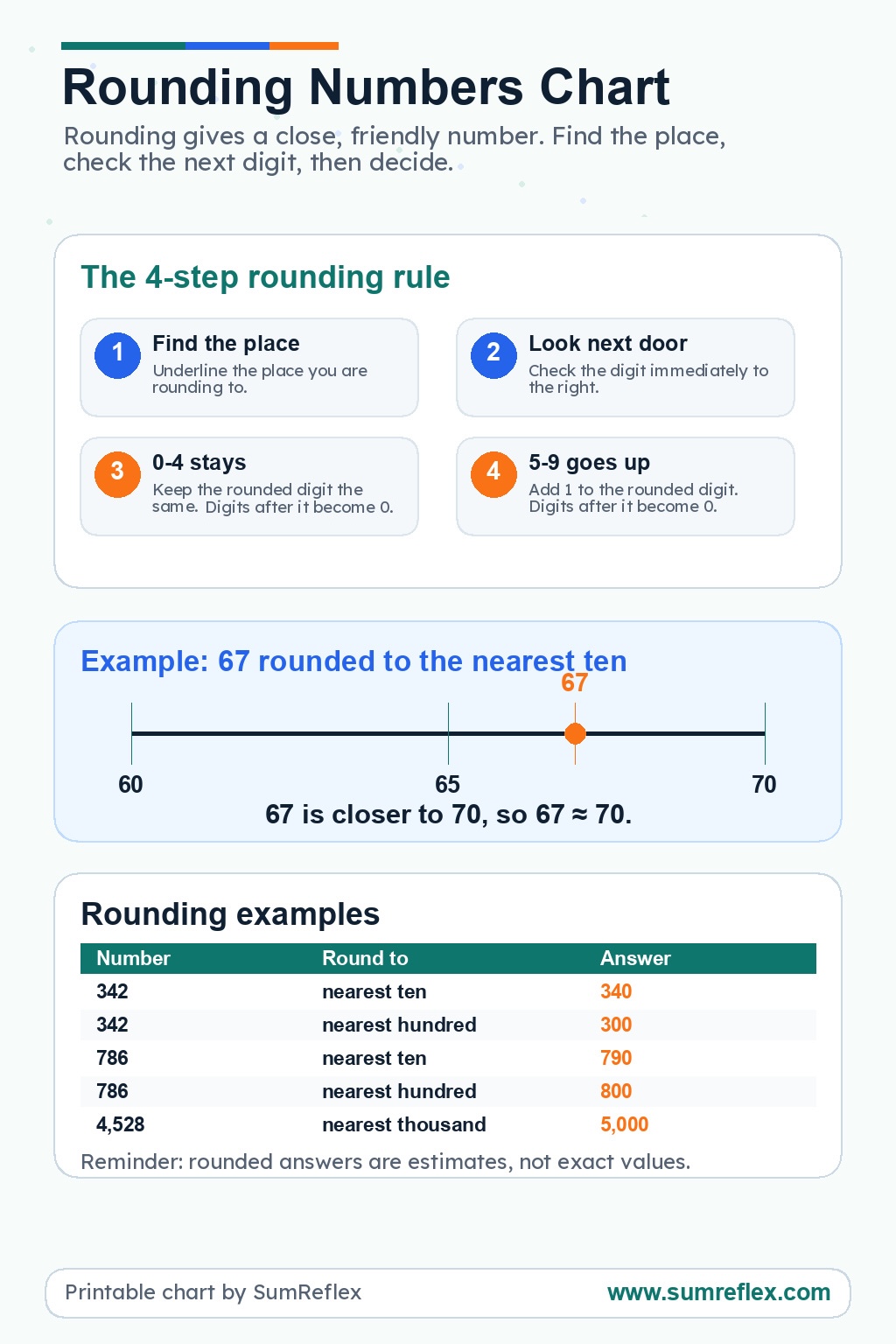
Use this SumReflex chart to remember the four main steps for rounding whole numbers.
The same chart is also available in the Printable Number Reference Charts section with print and download options.
The basic rounding rule
Step 1: Find the place you are rounding to.
Step 2: Look at the digit immediately to the right.
Step 3: If that digit is 0, 1, 2, 3, or 4, keep the rounding digit the same.
Step 4: If that digit is 5, 6, 7, 8, or 9, increase the rounding digit by 1.
Step 5: Change all digits to the right of the rounding place to zeros.
What does "nearest" mean?
When a problem says round to the nearest ten, choose the multiple of 10 that is closest.
When it says round to the nearest hundred, choose the multiple of 100 that is closest.
When it says round to the nearest thousand, choose the multiple of 1,000 that is closest.
If the number is exactly halfway between two choices, we usually round up in school math.
Example: 65 is halfway between 60 and 70, so it rounds to 70.
Place values used for rounding
Common whole-number rounding places are tens, hundreds, thousands, ten thousands, hundred thousands, and millions.
The place you round to decides which digit you keep or increase.
Example: In 48,372, the thousands digit is 8, the hundreds digit is 3, the tens digit is 7, and the ones digit is 2.
If you round 48,372 to the nearest thousand, you focus on the 8 in the thousands place and look at the 3 in the hundreds place.
Rounding to the nearest ten
To round to the nearest ten, look at the ones digit.
Example 1: Round 43 to the nearest ten. The ones digit is 3, so round down. 43 rounds to 40.
Example 2: Round 47 to the nearest ten. The ones digit is 7, so round up. 47 rounds to 50.
Example 3: Round 85 to the nearest ten. The ones digit is 5, so round up. 85 rounds to 90.
Example 4: Round 301 to the nearest ten. The ones digit is 1, so round down. 301 rounds to 300.
Example 5: Round 999 to the nearest ten. The ones digit is 9, so 999 rounds up to 1,000.
Rounding to the nearest hundred
To round to the nearest hundred, look at the tens digit.
Example 1: Round 326 to the nearest hundred. The tens digit is 2, so round down. 326 rounds to 300.
Example 2: Round 371 to the nearest hundred. The tens digit is 7, so round up. 371 rounds to 400.
Example 3: Round 650 to the nearest hundred. The tens digit is 5, so round up. 650 rounds to 700.
Example 4: Round 1,249 to the nearest hundred. The tens digit is 4, so round down. 1,249 rounds to 1,200.
Example 5: Round 9,950 to the nearest hundred. The tens digit is 5, so round up. 9,950 rounds to 10,000.
Rounding to the nearest thousand
To round to the nearest thousand, look at the hundreds digit.
Example 1: Round 4,382 to the nearest thousand. The hundreds digit is 3, so round down. 4,382 rounds to 4,000.
Example 2: Round 4,682 to the nearest thousand. The hundreds digit is 6, so round up. 4,682 rounds to 5,000.
Example 3: Round 12,500 to the nearest thousand. The hundreds digit is 5, so round up. 12,500 rounds to 13,000.
Example 4: Round 89,499 to the nearest thousand. The hundreds digit is 4, so round down. 89,499 rounds to 89,000.
Example 5: Round 999,500 to the nearest thousand. The hundreds digit is 5, so round up. 999,500 rounds to 1,000,000.
Rounding to the nearest ten thousand
To round to the nearest ten thousand, look at the thousands digit.
Example 1: Round 42,615 to the nearest ten thousand. The thousands digit is 2, so round down. 42,615 rounds to 40,000.
Example 2: Round 47,615 to the nearest ten thousand. The thousands digit is 7, so round up. 47,615 rounds to 50,000.
Example 3: Round 95,000 to the nearest ten thousand. The thousands digit is 5, so round up. 95,000 rounds to 100,000.
Example 4: Round 234,901 to the nearest ten thousand. The thousands digit is 4, so round down. 234,901 rounds to 230,000.
Example 5: Round 987,654 to the nearest ten thousand. The thousands digit is 7, so round up. 987,654 rounds to 990,000.
Rounding large whole numbers
The same rule works for large whole numbers. The place value gets bigger, but the thinking stays the same.
Example: Round 638,219 to the nearest hundred thousand. The hundred-thousands digit is 6. Look at the ten-thousands digit, 3. Since 3 is less than 5, round down. Answer: 600,000.
Example: Round 682,219 to the nearest hundred thousand. The hundred-thousands digit is 6. Look at the ten-thousands digit, 8. Since 8 is 5 or more, round up. Answer: 700,000.
Example: Round 4,521,709 to the nearest million. The millions digit is 4. Look at the hundred-thousands digit, 5. Since 5 rounds up, the answer is 5,000,000.
Example: Round 4,421,709 to the nearest million. The hundred-thousands digit is 4, so round down. Answer: 4,000,000.
Number line thinking
A number line helps rounding make sense instead of feeling like a memorized trick.
Example: 67 rounded to the nearest ten is between 60 and 70. The middle is 65. Since 67 is closer to 70, it rounds to 70.
Example: 142 rounded to the nearest hundred is between 100 and 200. The middle is 150. Since 142 is closer to 100, it rounds to 100.
Example: 186 rounded to the nearest hundred is between 100 and 200. Since 186 is closer to 200, it rounds to 200.
Example: 2,499 rounded to the nearest thousand is between 2,000 and 3,000. Since it is below 2,500, it rounds to 2,000.
Example: 2,500 rounded to the nearest thousand is exactly halfway, so it rounds up to 3,000.
Rounding numbers that already end in zeros
Sometimes a number is already rounded to the place asked.
Example: Round 3,400 to the nearest hundred. It is already at a hundred, so the answer is 3,400.
Example: Round 8,000 to the nearest thousand. It is already at a thousand, so the answer is 8,000.
Example: Round 50,000 to the nearest ten thousand. It is already at a ten thousand, so the answer is 50,000.
Do not change a number just because the problem says round. First check whether it is already on the requested place value.
What happens when rounding causes a new digit?
Sometimes rounding up creates a new place value.
Example: Round 99 to the nearest ten. The ones digit is 9, so round up. 99 rounds to 100.
Example: Round 999 to the nearest hundred. The tens digit is 9, so round up. 999 rounds to 1,000.
Example: Round 9,999 to the nearest thousand. The hundreds digit is 9, so round up. 9,999 rounds to 10,000.
Example: Round 999,999 to the nearest hundred thousand. The ten-thousands digit is 9, so round up. 999,999 rounds to 1,000,000.
This is not a mistake. It simply means the number was very close to the next larger place value.
Rounding for estimation
Rounding is useful when you want a quick estimate.
Example: 398 + 204 is close to 400 + 200, so the sum is about 600.
Example: 1,987 + 3,104 is close to 2,000 + 3,000, so the sum is about 5,000.
Example: 49 x 21 is close to 50 x 20, so the product is about 1,000.
Example: 6,204 - 1,889 is close to 6,200 - 1,900, so the difference is about 4,300.
An estimate should be close enough to help you think, but it is not meant to replace exact calculation when an exact answer is needed.
Common mistakes
Do not round every digit one by one. Round only to the place the question asks for.
Do not look at the wrong digit. To round to the nearest hundred, look at the tens digit, not the ones digit.
Do not forget to turn digits to the right into zeros.
Do not round down when the next digit is 5. In standard school rounding, 5 rounds up.
Do not change digits to the left of the rounding place, except when carrying happens because you round up from 9.
Do not confuse estimating with exact answers. Rounding gives an approximate number.
Mixed worked examples
1. Round 768 to the nearest ten. Look at the ones digit, 8. Round up. Answer: 770.
2. Round 768 to the nearest hundred. Look at the tens digit, 6. Round up. Answer: 800.
3. Round 4,281 to the nearest thousand. Look at the hundreds digit, 2. Round down. Answer: 4,000.
4. Round 4,781 to the nearest thousand. Look at the hundreds digit, 7. Round up. Answer: 5,000.
5. Round 64,502 to the nearest ten thousand. Look at the thousands digit, 4. Round down. Answer: 60,000.
6. Round 65,502 to the nearest ten thousand. Look at the thousands digit, 5. Round up. Answer: 70,000.
7. Round 849,999 to the nearest hundred thousand. Look at the ten-thousands digit, 4. Round down. Answer: 800,000.
8. Round 850,000 to the nearest hundred thousand. Look at the ten-thousands digit, 5. Round up. Answer: 900,000.
9. Round 2,499,999 to the nearest million. Look at the hundred-thousands digit, 4. Round down. Answer: 2,000,000.
10. Round 2,500,000 to the nearest million. Look at the hundred-thousands digit, 5. Round up. Answer: 3,000,000.
Practice questions
1. Round 34 to the nearest ten.
2. Round 86 to the nearest ten.
3. Round 248 to the nearest hundred.
4. Round 250 to the nearest hundred.
5. Round 3,481 to the nearest thousand.
6. Round 3,501 to the nearest thousand.
7. Round 78,249 to the nearest ten thousand.
8. Round 84,999 to the nearest ten thousand.
9. Round 451,020 to the nearest hundred thousand.
10. Round 999,999 to the nearest million.
Answers
1. 30.
2. 90.
3. 200.
4. 300.
5. 3,000.
6. 4,000.
7. 80,000.
8. 80,000.
9. 500,000.
10. 1,000,000.
Next step: rounding decimals
Once whole-number rounding feels comfortable, the next skill is rounding numbers with decimal points.
The idea is the same: find the place, look at the digit to the right, then decide whether to keep the digit or round up.
Study the next lesson here: Rounding Decimal Numbers.
The big idea
Rounding whole numbers makes numbers easier to use while keeping them close to the original value.
Find the rounding place, look at the digit to the right, then decide whether to keep the digit or raise it by 1.
Digits to the right become zeros because the answer is rounded to a larger place value.
Use the rounding solver below to check whole-number rounding to ones, tens, hundreds, thousands, ten thousands, hundred thousands, or millions.
Rounding solver
Check a rounding problem
Enter a number, choose whole-number rounding or decimal rounding, then select the exact place you want to round to.
4,682 rounded to the nearest ten is 4,680.