



Grade 5 number sense lesson
Rounding Decimal Numbers: Rules, Steps, Examples, and Practice
Rounding decimals means keeping a decimal close to its original value while making it shorter or easier to use.
What does rounding decimals mean?
Rounding a decimal means changing it to a nearby decimal that is easier to read, write, compare, or use in a calculation.
The rounded decimal is usually not the exact value. It is an estimate that stays close to the original number.
For example, 4.82 is close to 4.8 when we round to the nearest tenth. It is also close to 5 when we round to the nearest whole number.
Decimal rounding uses the same idea as whole-number rounding: find the place, look at the next digit, then decide whether the chosen digit stays the same or goes up by 1.
If the decimal begins as a fraction, first use Converting Fractions to Decimals, then return here when a repeating or long decimal must be rounded.
Printable rounding decimal numbers chart
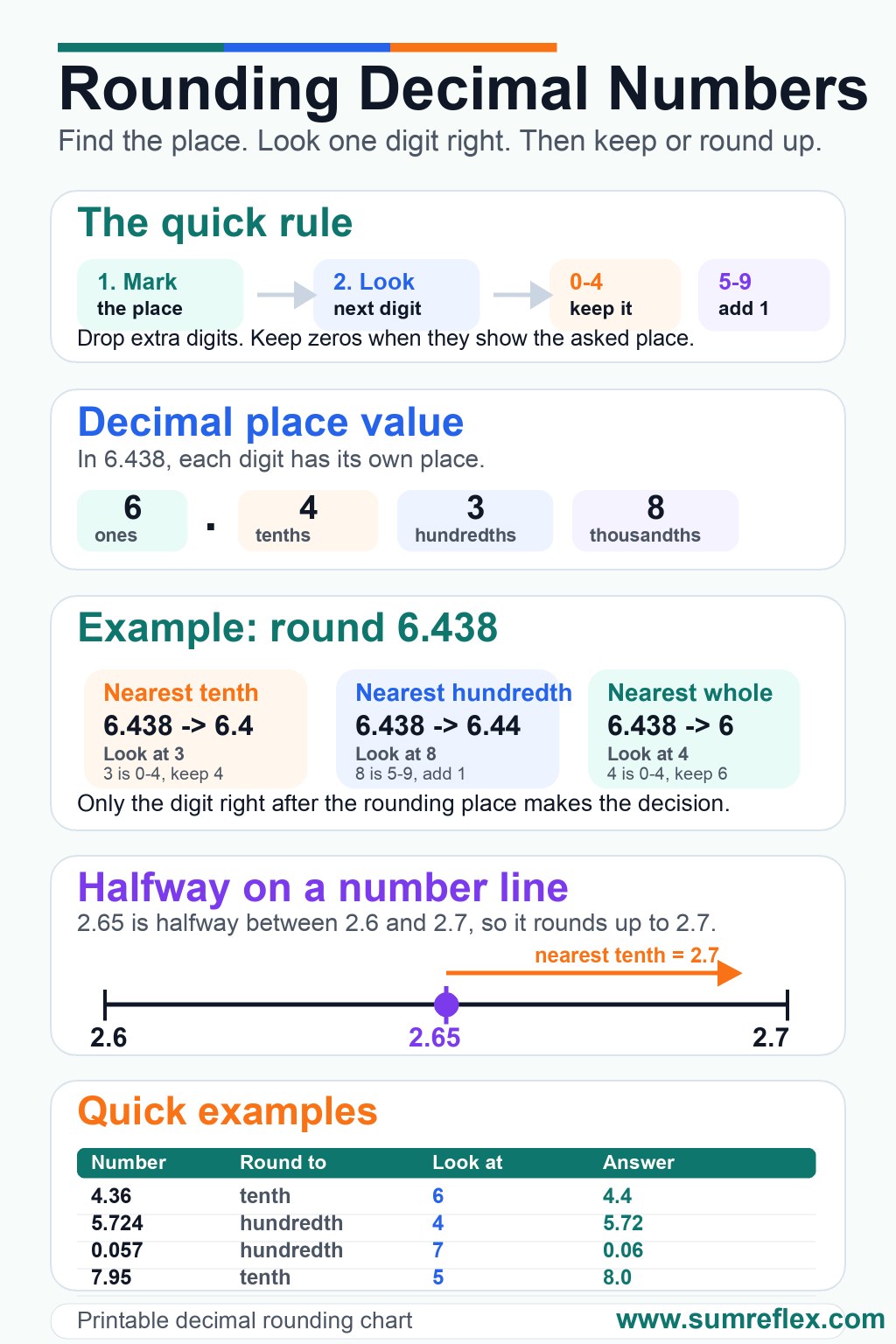
Use this SumReflex chart to remember the decimal rounding rule, decimal place value, and the meaning of halfway on a number line.
The same chart is also available in the Printable Number Reference Charts section with print and download options.
Decimal place value first
Before rounding decimals, students need to know the places after the decimal point.
In 6.438, the 6 is in the ones place, the 4 is in the tenths place, the 3 is in the hundredths place, and the 8 is in the thousandths place.
The first digit after the decimal point is tenths. The second digit is hundredths. The third digit is thousandths.
A helpful way to say it is: ones, decimal point, tenths, hundredths, thousandths.
The basic decimal rounding rule
Step 1: Find the decimal place you are rounding to.
Step 2: Look at the digit immediately to the right of that place.
Step 3: If the next digit is 0, 1, 2, 3, or 4, keep the rounding digit the same.
Step 4: If the next digit is 5, 6, 7, 8, or 9, increase the rounding digit by 1.
Step 5: Remove the extra digits to the right, unless the problem asks you to keep zeros for place value.
Round to the nearest whole number
To round a decimal to the nearest whole number, look at the tenths digit.
Example 1: Round 3.2 to the nearest whole number. The tenths digit is 2, so round down. Answer: 3.
Example 2: Round 3.8 to the nearest whole number. The tenths digit is 8, so round up. Answer: 4.
Example 3: Round 12.5 to the nearest whole number. The tenths digit is 5, so round up. Answer: 13.
Example 4: Round 0.49 to the nearest whole number. The tenths digit is 4, so round down. Answer: 0.
Example 5: Round 0.51 to the nearest whole number. The tenths digit is 5, so round up. Answer: 1.
Round to the nearest tenth
To round to the nearest tenth, keep one digit after the decimal point. Look at the hundredths digit.
Example 1: Round 4.32 to the nearest tenth. The tenths digit is 3. The hundredths digit is 2, so keep 3. Answer: 4.3.
Example 2: Round 4.36 to the nearest tenth. The hundredths digit is 6, so increase 3 to 4. Answer: 4.4.
Example 3: Round 7.95 to the nearest tenth. The hundredths digit is 5, so the 9 tenths rounds up. Answer: 8.0.
Example 4: Round 0.04 to the nearest tenth. The hundredths digit is 4, so round down. Answer: 0.0.
Example 5: Round 0.08 to the nearest tenth. The hundredths digit is 8, so round up. Answer: 0.1.
Round to the nearest hundredth
To round to the nearest hundredth, keep two digits after the decimal point. Look at the thousandths digit.
Example 1: Round 5.724 to the nearest hundredth. The hundredths digit is 2. The thousandths digit is 4, so keep 2. Answer: 5.72.
Example 2: Round 5.728 to the nearest hundredth. The thousandths digit is 8, so increase 2 to 3. Answer: 5.73.
Example 3: Round 9.995 to the nearest hundredth. The thousandths digit is 5, so 9.99 rounds up to 10.00.
Example 4: Round 0.006 to the nearest hundredth. The thousandths digit is 6, so 0.00 rounds up to 0.01.
Example 5: Round 14.201 to the nearest hundredth. The thousandths digit is 1, so the answer is 14.20.
Round to the nearest thousandth
To round to the nearest thousandth, keep three digits after the decimal point. Look at the ten-thousandths digit.
Example 1: Round 2.3842 to the nearest thousandth. The ten-thousandths digit is 2, so keep the thousandths digit. Answer: 2.384.
Example 2: Round 2.3847 to the nearest thousandth. The ten-thousandths digit is 7, so increase 4 to 5. Answer: 2.385.
Example 3: Round 0.9996 to the nearest thousandth. The next digit is 6, so 0.999 rounds up to 1.000.
Example 4: Round 18.4004 to the nearest thousandth. The ten-thousandths digit is 4, so the answer is 18.400.
Example 5: Round 18.4005 to the nearest thousandth. The ten-thousandths digit is 5, so the answer is 18.401.
Why 5 rounds up
In standard school rounding, a next digit of 5 means the number is at least halfway to the next rounded value.
Example: 2.65 rounded to the nearest tenth is halfway between 2.6 and 2.7. Since the next digit is 5, we round up to 2.7.
Example: 8.125 rounded to the nearest hundredth is halfway between 8.12 and 8.13. It rounds up to 8.13.
Some advanced settings use other rounding methods, but the school method students usually learn is: 5 or more rounds up.
Trailing zeros can matter
A trailing zero is a zero written at the end of a decimal, such as 4.50 or 8.0.
In decimal place value, 4.5 and 4.50 have the same value, but they do not show the same rounding place.
If a question says round to the nearest hundredth, the answer should usually show two decimal places.
Example: 14.201 rounded to the nearest hundredth is 14.20, not just 14.2, because 14.20 clearly shows the hundredths place.
Example: 7.95 rounded to the nearest tenth is 8.0, because 8.0 shows that the answer is rounded to the tenths place.
Rounding money
Money is usually written to the nearest cent, which means two decimal places.
Example 1: Round $6.238 to the nearest cent. Look at the thousandths digit, 8. Answer: $6.24.
Example 2: Round $12.994 to the nearest cent. The thousandths digit is 4, so the answer is $12.99.
Example 3: Round $12.995 to the nearest cent. The thousandths digit is 5, so the answer is $13.00.
Example 4: A snack costs $1.875 per serving. To the nearest cent, it is $1.88.
Rounding measurements
Measurements often need rounding because real measurements can have many decimal places.
Example 1: A pencil is 14.27 cm long. To the nearest tenth, it is 14.3 cm.
Example 2: A bottle holds 1.246 liters. To the nearest hundredth, it is 1.25 liters.
Example 3: A runner finishes in 12.684 seconds. To the nearest tenth, the time is 12.7 seconds.
Example 4: A ribbon is 0.406 m long. To the nearest hundredth, it is 0.41 m.
Rounding numbers less than 1
Decimals less than 1 can feel tricky because they begin with 0, but the rule is exactly the same.
Example 1: Round 0.37 to the nearest tenth. Look at the hundredths digit, 7. Answer: 0.4.
Example 2: Round 0.34 to the nearest tenth. Look at the hundredths digit, 4. Answer: 0.3.
Example 3: Round 0.058 to the nearest hundredth. Look at the thousandths digit, 8. Answer: 0.06.
Example 4: Round 0.0048 to the nearest thousandth. Look at the ten-thousandths digit, 8. Answer: 0.005.
When rounding creates a carry
Sometimes the digit you are rounding is 9. If it rounds up, it carries to the digit on the left.
Example 1: Round 3.96 to the nearest tenth. The hundredths digit is 6, so 3.9 rounds up to 4.0.
Example 2: Round 8.999 to the nearest hundredth. The thousandths digit is 9, so 8.99 rounds up to 9.00.
Example 3: Round 19.95 to the nearest tenth. The hundredths digit is 5, so the answer is 20.0.
This is not a mistake. It means the decimal was very close to the next whole number.
A simple way to mark the place
When students get confused, tell them to underline the place being rounded and circle the next digit.
Example: Round 6.438 to the nearest tenth. Underline 4 because it is the tenths digit. Circle 3 because it is the next digit. Since 3 is less than 5, the answer is 6.4.
Example: Round 6.438 to the nearest hundredth. Underline 3. Circle 8. Since 8 is 5 or more, the answer is 6.44.
The place you underline changes depending on what the question asks.
Do not round twice
One common mistake is rounding in steps instead of rounding directly from the original number.
Example: Round 2.349 to the nearest tenth.
Correct method: look directly at the hundredths digit in 2.349. The hundredths digit is 4, so the answer is 2.3.
Wrong method: 2.349 to 2.35, then 2.35 to 2.4. That changes the answer because the number was rounded twice.
Always round from the original number to the place the question asks for.
Decimal rounding and estimation
Rounding decimals is useful when an exact decimal is too long or when you want to estimate quickly.
Example: 4.98 + 2.03 is close to 5 + 2, so the sum is about 7.
Example: 9.76 x 3 is close to 10 x 3, so the product is about 30.
Example: 18.49 - 7.92 is close to 18.5 - 8, so the difference is about 10.5.
For exact answers, calculate carefully. For checking whether an answer makes sense, rounding is often enough.
Use the rounding calculator to check
After students understand the hand method, they can check longer decimals with the rounding solver at the bottom of this lesson or with the full SumReflex rounding calculator.
Use the calculator as a checker, not as a replacement for learning the place-value rule.
A good habit is to solve by hand first, then use the calculator to confirm the rounded value.
Mixed worked examples
1. Round 5.67 to the nearest whole number. Look at 6 in the tenths place. Round up. Answer: 6.
2. Round 5.47 to the nearest whole number. Look at 4 in the tenths place. Round down. Answer: 5.
3. Round 13.84 to the nearest tenth. Look at 4 in the hundredths place. Keep 8. Answer: 13.8.
4. Round 13.86 to the nearest tenth. Look at 6 in the hundredths place. Increase 8 to 9. Answer: 13.9.
5. Round 2.675 to the nearest hundredth. Look at 5 in the thousandths place. Increase 7 to 8. Answer: 2.68.
6. Round 0.794 to the nearest hundredth. Look at 4 in the thousandths place. Keep 9. Answer: 0.79.
7. Round 0.796 to the nearest hundredth. Look at 6 in the thousandths place. 0.79 rounds up to 0.80.
8. Round 43.999 to the nearest hundredth. Look at 9 in the thousandths place. Answer: 44.00.
9. Round 6.0004 to the nearest thousandth. Look at 4 in the ten-thousandths place. Answer: 6.000.
10. Round 6.0005 to the nearest thousandth. Look at 5 in the ten-thousandths place. Answer: 6.001.
Common mistakes to avoid
Do not look at every digit. Only the digit immediately to the right of the rounding place decides what happens.
Do not drop important zeros when the question asks for a certain decimal place. 4.50 can show hundredths, but 4.5 only shows tenths.
Do not round twice. Round straight from the original number.
Do not forget that 0.08 rounded to the nearest tenth is 0.1, not 0.
Do not treat decimals like whole numbers. In decimals, 0.9 is bigger than 0.89, even though 89 looks larger than 9.
Practice questions
1. Round 8.3 to the nearest whole number.
2. Round 8.7 to the nearest whole number.
3. Round 4.24 to the nearest tenth.
4. Round 4.25 to the nearest tenth.
5. Round 9.96 to the nearest tenth.
6. Round 12.348 to the nearest hundredth.
7. Round 12.344 to the nearest hundredth.
8. Round 0.057 to the nearest hundredth.
9. Round 0.9995 to the nearest thousandth.
10. Round 25.995 to the nearest hundredth.
11. Round $3.486 to the nearest cent.
12. Round 16.7492 to the nearest thousandth.
Answers
1. 8.
2. 9.
3. 4.2.
4. 4.3.
5. 10.0.
6. 12.35.
7. 12.34.
8. 0.06.
9. 1.000.
10. 26.00.
11. $3.49.
12. 16.749.
The big idea
Rounding decimal numbers is a place-value skill.
Find the place you are rounding to, look at the next digit, and use the 0 to 4 or 5 to 9 rule.
The extra decimal digits are removed, but zeros may stay when they show the requested place value.
Use the rounding solver below to choose decimal rounding and set how many digits should stay after the decimal point.
Rounding solver
Check a rounding problem
Enter a number, choose whole-number rounding or decimal rounding, then select the exact place you want to round to.
4,682 rounded to the nearest ten is 4,680.