



Grade 4 measurement lesson
Units of Measurement: Meaning, Examples, and Printable Chart
A unit of measurement tells what a number is describing, such as how long, how heavy, how much liquid, how hot, how fast, or how many.
What is a unit of measurement?
A unit of measurement is the name we put after a number so the number has meaning.
If someone says a table is 2, you do not know enough. If they say the table is 2 meters long, the number suddenly makes sense.
Simple rule: the number tells how much, and the unit tells what kind of measurement it is.
Why units are important
Units stop confusion. A 10 cm pencil, a 10 kg bag, and a 10 minute break all use the same number, but they describe different things.
In math word problems, the unit often tells you what operation or conversion to use. A problem about liters is usually about capacity. A problem about square meters is about area. A problem about miles per hour is about speed.
Good measurement work is not just calculating. It is choosing a sensible unit and checking whether the answer fits the real world.
Printable Units of Measurement chart
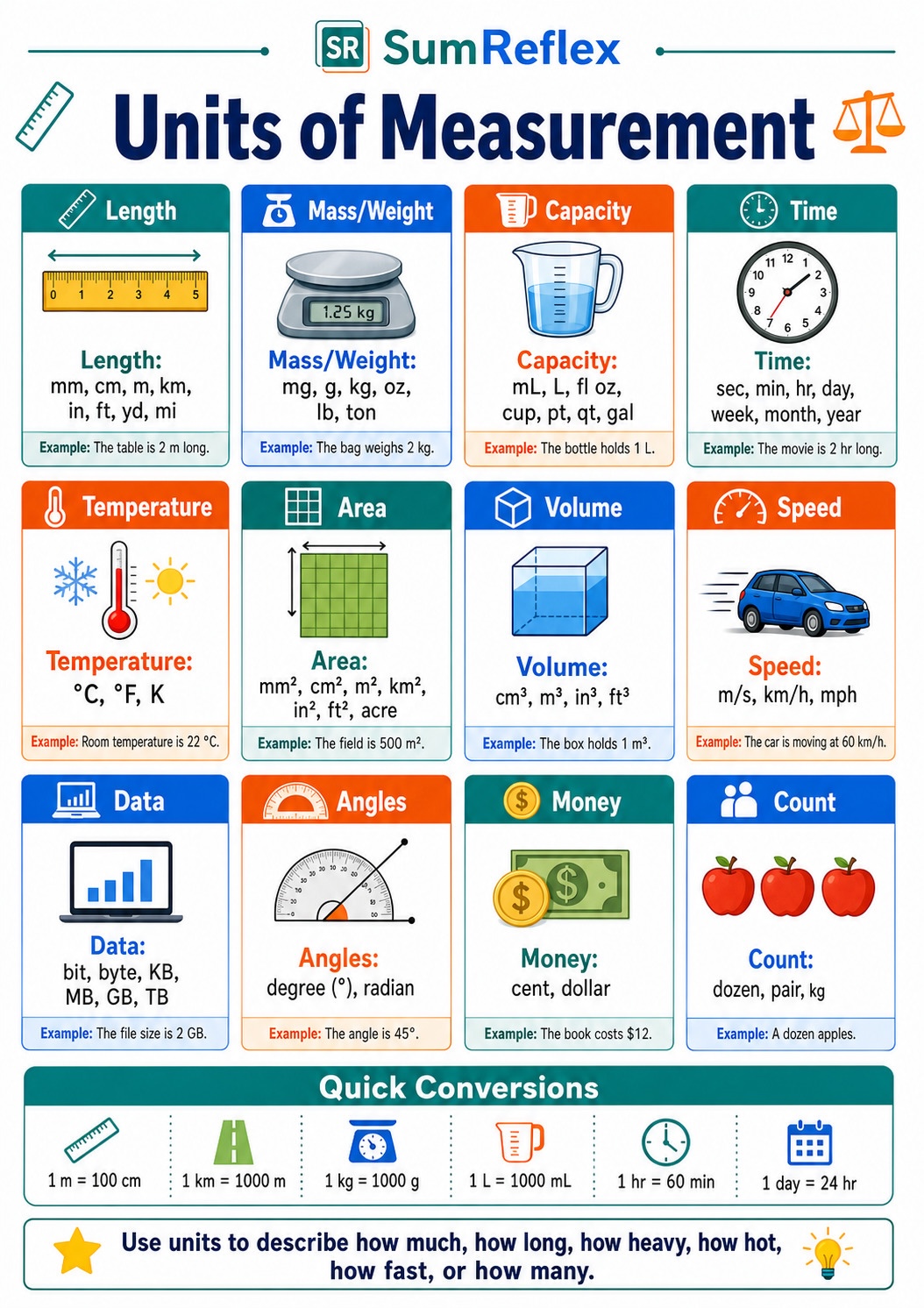
Use this SumReflex chart as a quick reference while reading the lesson. It groups common units by what they measure and includes the most useful quick conversions.
The same chart is also listed in the dedicated Printable Measurement Unit Charts section.
Two common measurement systems
The metric system is built around units such as meter, gram, liter, and Celsius. It is used in most countries and in science because it converts by powers of 10.
The U.S. customary system uses units such as inch, foot, yard, mile, ounce, pound, cup, pint, quart, gallon, and Fahrenheit.
Students often need both systems. For example, a science problem may use centimeters and grams, while a recipe or road sign may use cups, pounds, or miles.
Length units: measuring distance, height, and width
Length units measure how long, tall, wide, deep, or far something is.
Metric length units: millimeter (mm), centimeter (cm), meter (m), and kilometer (km). A millimeter is good for tiny thicknesses, a centimeter is good for a pencil or eraser, a meter is good for a room or door, and a kilometer is good for a road distance.
Customary length units: inch (in), foot (ft), yard (yd), and mile (mi). Inches measure small objects, feet measure height or room size, yards measure fields or fabric, and miles measure long travel distances.
Examples: a paper clip may be about 3 cm long, a desk may be about 1 m wide, a runner may complete 5 km, a person may be 5 ft 8 in tall, and a city may be 20 mi away.
For a focused guide with ruler reading, unit choosing, conversions, and practice, use the Units for Measuring Length lesson.
Mass and weight units: measuring how heavy something is
Mass tells how much matter an object has. Weight is the pull of gravity on that mass. In everyday school work, people often use weight to mean how heavy something feels.
Metric mass units: milligram (mg), gram (g), kilogram (kg), and metric ton or tonne. Milligrams are used for very tiny amounts such as medicine doses, grams for snacks or small objects, kilograms for people, backpacks, and pets, and tonnes for cars or large loads.
Customary weight units: ounce (oz), pound (lb), and ton. Ounces are useful for light items, pounds for body weight or groceries, and tons for very heavy objects.
Examples: a paper clip is about 1 g, a bag of flour might be 5 lb, a watermelon might be 4 kg, and a small car may weigh more than 1 ton.
Capacity units: measuring how much a container holds
Capacity tells how much liquid or pourable material a container can hold.
Metric capacity units: milliliter (mL) and liter (L). Milliliters are useful for medicine, small bottles, and measuring spoons. Liters are useful for water bottles, pitchers, aquariums, and fuel.
Customary capacity units: fluid ounce (fl oz), cup, pint (pt), quart (qt), and gallon (gal). These often appear in recipes, food labels, and containers in the United States.
Examples: a medicine spoon may hold 5 mL, a water bottle may hold 500 mL, a soda bottle may hold 2 L, a recipe may need 1 cup of milk, and a large jug may hold 1 gallon.
Time units: measuring duration and order
Time units measure how long something lasts or when it happens.
Common units include millisecond, second (sec), minute (min), hour (hr), day, week, month, year, decade, century, and millennium.
Examples: a blink takes a fraction of a second, a song might last 3 min, a school day may last 7 hr, a week has 7 days, a decade is 10 years, and a century is 100 years.
Time conversions are very common: 1 min = 60 sec, 1 hr = 60 min, 1 day = 24 hr, and 1 week = 7 days.
Temperature units: measuring how hot or cold
Temperature units measure how hot or cold something is.
Celsius (°C) is common in science and many countries. Water freezes at 0°C and boils at 100°C at normal pressure.
Fahrenheit (°F) is common in daily weather reports in the United States. Water freezes at 32°F and boils at 212°F at normal pressure.
Kelvin (K) is used in science. Kelvin does not use the degree symbol. It starts at absolute zero, the coldest possible temperature.
Examples: room temperature is about 20°C to 22°C, a hot day may be 95°F, and a science lesson about gases may use kelvin.
Area units: measuring flat surface space
Area tells how much flat surface is covered. Area uses square units because it counts unit squares.
Common area units include square millimeter (mm²), square centimeter (cm²), square meter (m²), square kilometer (km²), square inch (in²), square foot (ft²), square yard (yd²), acre, and hectare.
Examples: a postage stamp may be measured in cm², a bedroom floor in ft² or m², a farm field in acres, and a country or state in km².
If a rectangle is 6 m long and 4 m wide, its area is 24 m². The answer is square meters because the question is about surface space.
Volume units: measuring three-dimensional space
Volume tells how much space a solid object takes up or how much space is inside a 3D shape.
Common volume units include cubic millimeter (mm³), cubic centimeter (cm³), cubic meter (m³), cubic inch (in³), cubic foot (ft³), and cubic yard (yd³).
Capacity and volume are closely related, but they are often used in different contexts. Capacity is usually about containers and liquids. Volume is often about 3D shapes, boxes, tanks, and solid space.
Examples: a small cube might be measured in cm³, a moving box in ft³, concrete in yd³, and a swimming pool in m³ or liters.
Speed units: measuring distance over time
Speed tells how far something travels in a certain amount of time.
Common speed units include meters per second (m/s), kilometers per hour (km/h), miles per hour (mph), feet per second (ft/s), and knots for boats and aircraft.
Examples: a runner may move at 5 m/s, a car may travel at 60 mph, a road sign may show 100 km/h, and a ship may travel at 20 knots.
The word per is important. Miles per hour means miles for each hour. Meters per second means meters for each second.
Data units: measuring digital information
Data units measure digital information on computers, phones, and the internet.
Common data units include bit, byte (B), kilobyte (KB), megabyte (MB), gigabyte (GB), terabyte (TB), and sometimes petabyte (PB).
Examples: a short text file may be a few KB, a photo may be several MB, a phone may store 128 GB, and a large hard drive may store several TB.
A bit is the smallest basic data unit. A byte is usually 8 bits. In everyday storage, people usually talk about bytes, KB, MB, GB, and TB.
Angle units: measuring turns and openings
Angle units measure how much something turns or how wide an angle opens.
The most common school angle unit is the degree (°). A full turn is 360°, a straight angle is 180°, and a right angle is 90°.
A radian is another angle unit used more often in advanced math and science. A full turn is 2π radians.
Examples: clock hands make angles, a ramp has an angle, a protractor reads degrees, and a wheel makes a 360° turn.
Money units: measuring value
Money units measure value. They are not physical units like meters or grams, but they still describe how much.
In U.S. money, common units include cent, nickel, dime, quarter, dollar, and larger dollar amounts.
Examples: 100 cents = 1 dollar, 4 quarters = 1 dollar, and a book that costs $12 has a value of twelve dollars.
Other countries use different money units, such as euro and cent, pound and pence, rupee and paisa, or dirham and fils.
Counting units: measuring how many
Counting units help group objects.
Common counting units include single, pair, dozen, half dozen, score, gross, and ream.
Examples: a pair means 2, a dozen eggs means 12 eggs, half a dozen means 6, a score means 20, a gross means 144, and a ream of paper is usually 500 sheets.
Counting units are useful because they shorten repeated counting. Instead of saying 12 eggs every time, people can say one dozen eggs.
Science and electricity units
Older students also see units that measure science ideas. These are still measurement units because they attach a number to a real quantity.
Force: newton (N). Example: a push or pull can be measured in newtons.
Energy: joule (J), calorie (cal), and kilowatt-hour (kWh). Example: food energy may use calories, and electric bills often use kilowatt-hours.
Power: watt (W) and kilowatt (kW). Example: a light bulb might use 10 W, and a large appliance may use more than 1 kW.
Electricity: ampere (A) measures electric current, volt (V) measures electric potential, and ohm (Ω) measures resistance.
Pressure: pascal (Pa), bar, and pounds per square inch (psi). Example: tire pressure in the United States is often measured in psi.
Metric prefixes you will see often
Metric prefixes change the size of a unit. They work with meters, grams, liters, and many science units.
Milli- means one thousandth. A millimeter is one thousandth of a meter, and a milliliter is one thousandth of a liter.
Centi- means one hundredth. A centimeter is one hundredth of a meter.
Kilo- means one thousand. A kilometer is 1000 meters, and a kilogram is 1000 grams.
These prefixes make metric conversions easier because they use 10, 100, and 1000 instead of unrelated numbers.
How to choose the right unit
Ask two questions: What am I measuring? and How big is it?
If you are measuring the length of a small insect, millimeters make sense. If you are measuring the length of a classroom, meters make sense. If you are measuring the distance between cities, kilometers or miles make sense.
If you are measuring a spoonful of medicine, milliliters make sense. If you are measuring water in a bottle, liters make sense. If you are measuring a swimming pool, cubic meters or gallons may make sense.
A sensible unit makes the number easy to read. Writing 150 cm for a child height is easier than writing 1500 mm, even though both can describe the same height.
How to convert units
To convert units, stay inside the same kind of measurement. Convert length to length, mass to mass, capacity to capacity, and time to time.
Example 1: 3 m = 300 cm because 1 m = 100 cm, so 3 × 100 = 300.
Example 2: 4500 mL = 4.5 L because 1000 mL = 1 L, so 4500 ÷ 1000 = 4.5.
Example 3: 2 hr = 120 min because 1 hr = 60 min, so 2 × 60 = 120.
Example 4: 5 kg = 5000 g because 1 kg = 1000 g, so 5 × 1000 = 5000.
When changing from a larger unit to a smaller unit, the number usually gets bigger. When changing from a smaller unit to a larger unit, the number usually gets smaller.
For a focused length-only guide, use the Units of Length Conversion lesson.
Worked examples with units
Example: A ribbon is 2 m long. How many centimeters is that? Since 1 m = 100 cm, 2 m = 200 cm.
Example: A bottle holds 750 mL. Is that less than 1 L? Yes. Since 1 L = 1000 mL, 750 mL is three quarters of a liter.
Example: A movie lasts 1 hr 45 min. How many minutes is that? 1 hr is 60 min, so 60 + 45 = 105 min.
Example: A garden is 8 m long and 3 m wide. What is the area? 8 × 3 = 24, so the garden is 24 m².
Example: A car travels 120 miles in 2 hours. What is the speed? 120 ÷ 2 = 60, so the speed is 60 mph.
Common measurement mistakes
Do not drop the unit from the answer. An answer of 24 is unfinished if the correct answer is 24 m², 24 cm, or 24 minutes.
Do not mix measurement types. You cannot convert kilograms to centimeters because mass and length measure different things.
Do not use a unit that is too large or too small for the object. A pencil in kilometers or a city distance in millimeters would be technically possible but not useful.
Do not confuse area and volume. Area uses square units such as m². Volume uses cubic units such as m³.
Do not confuse mass and capacity. Kilograms measure how heavy something is, while liters measure how much a container holds.
Quick practice
1. Which unit would you use for the length of a pencil: cm or km? Use cm.
2. Which unit would you use for the mass of a backpack: kg or mL? Use kg.
3. Which unit would you use for water in a bottle: L or m²? Use L.
4. Convert 4 m to centimeters. 4 m = 400 cm.
5. Convert 3 L to milliliters. 3 L = 3000 mL.
6. A floor is 5 m by 4 m. The area is 20 m².
7. A drive is 90 miles in 3 hours. The speed is 30 mph.
The big idea
A unit is a label with a job. It tells whether the number is measuring length, mass, capacity, time, temperature, area, volume, speed, data, angle, value, or count.
When you understand what the unit measures, conversions and word problems become much easier to read.