



Grade 4 measurement lesson
Units for Measuring Length: Metric, Customary, Rulers, and Examples
Length units measure how long, tall, wide, deep, or far something is. Choose small units for small objects and large units for long distances.
What does length mean?
Length tells how long something is from one end to the other.
We also use length units when we talk about height, width, depth, and distance. A pencil has length. A door has height. A table has width. A swimming pool has depth. A road trip has distance.
Easy idea: if you can ask how long, how tall, how wide, how deep, or how far, you are probably measuring length.
Why length units matter
A number by itself is not enough. If someone says a ribbon is 8, we still need the unit. Is it 8 centimeters, 8 inches, 8 feet, or 8 meters?
The unit tells the size of each step. An 8 cm ribbon is short. An 8 m ribbon is much longer. Same number, very different length.
Good measuring means choosing a unit that makes sense, using the measuring tool correctly, and writing the unit with the answer.
Printable Units for Measuring Length chart
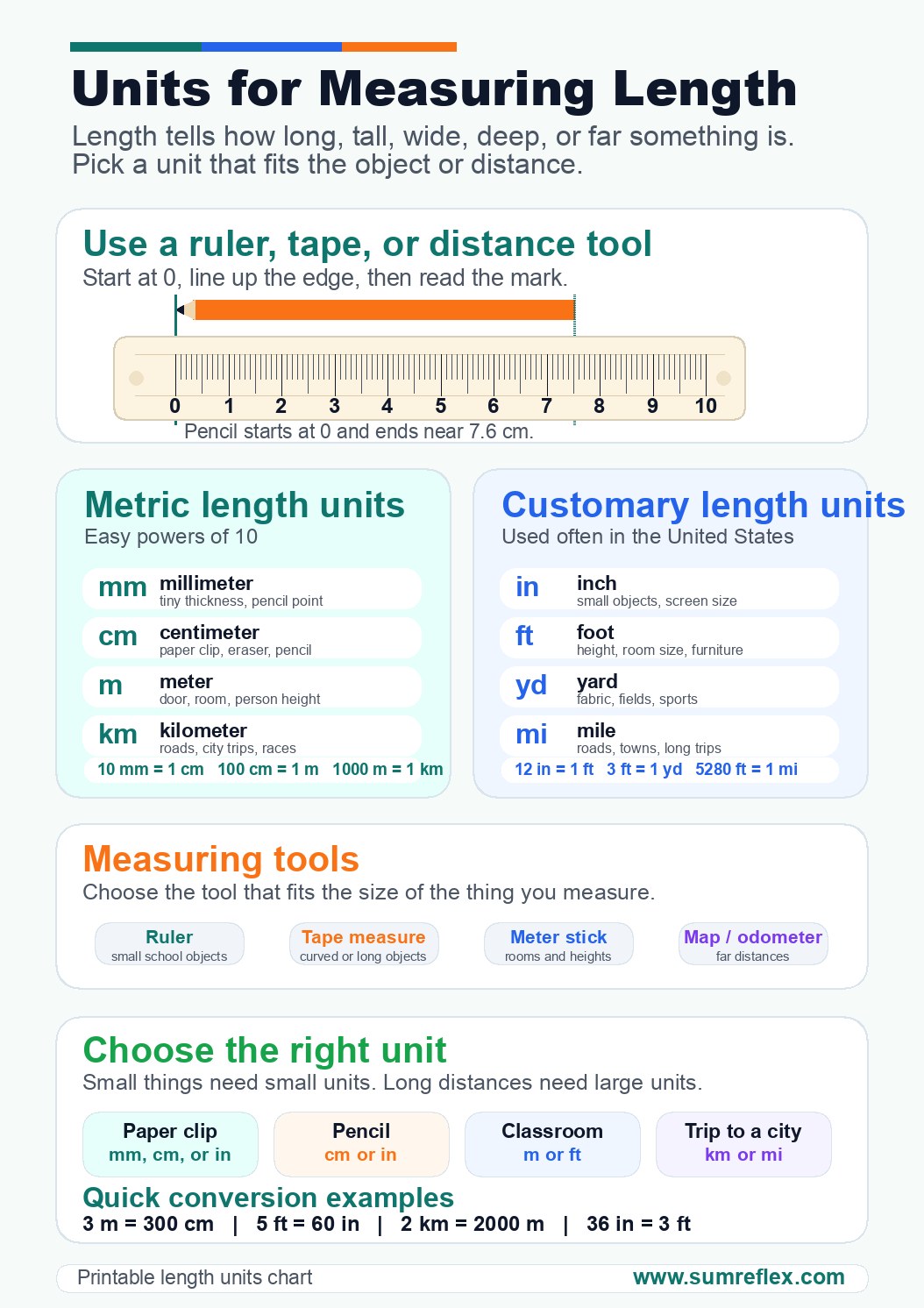
Use this chart while reading the lesson. It shows the main metric and U.S. customary length units, a ruler example, measuring tools, real-life uses, and quick conversions.
The same chart is also available in the Printable Measurement Unit Charts section for classroom walls, notebooks, and homework folders.
Things we measure with length units
Length: the distance from one end of an object to the other. Example: the length of a pencil.
Height: how tall something is from bottom to top. Example: the height of a child or a door.
Width: how wide something is from side to side. Example: the width of a desk.
Depth: how far down or far back something goes. Example: the depth of a box or pool.
Distance: how far apart two places are. Example: the distance from home to school.
Common tools for measuring length
Ruler: best for small school objects such as a pencil, eraser, paper clip, notebook, or sticker.
Meter stick: useful for bigger classroom objects, such as a table, door, whiteboard, or hallway section.
Yardstick: similar to a meter stick, but it uses yards, feet, and inches.
Tape measure: useful when the object is long, curved, or not easy to place under a ruler. People use tape measures for furniture, clothes, rooms, and building projects.
Odometer, map scale, or GPS: useful for long distances, such as miles or kilometers between places.
How to read a ruler correctly
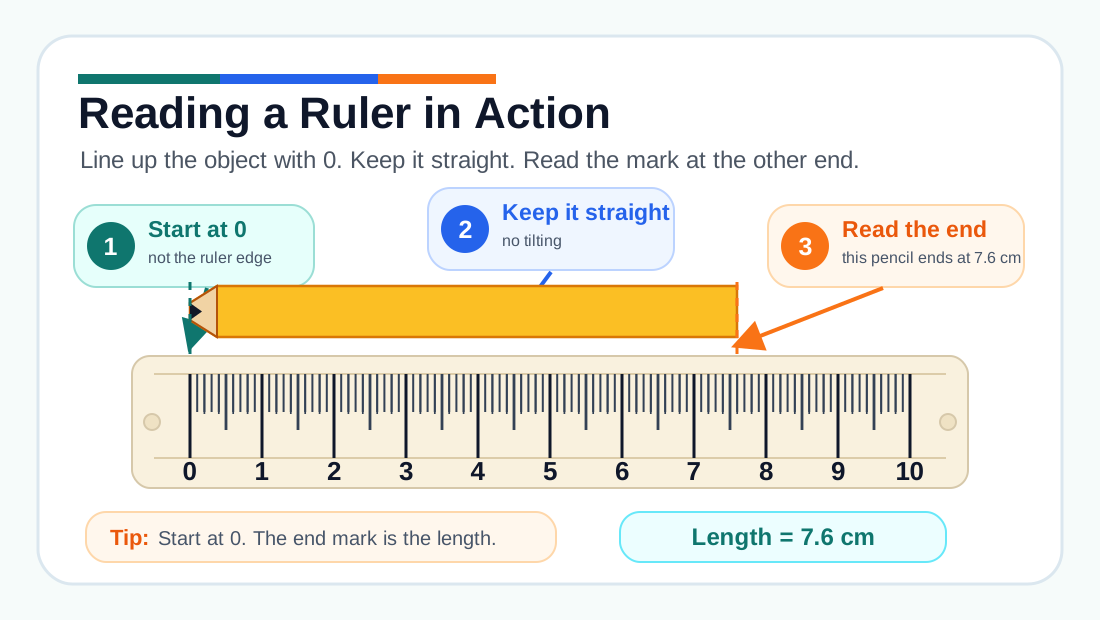
Step 1: Put the starting edge of the object at 0. Do not start at the edge of the ruler unless the 0 mark is there.
Step 2: Keep the object straight along the ruler. If it is tilted, the measurement can be wrong.
Step 3: Look at the mark where the object ends. Read the number and unit.
Step 4: Write the unit. For example, write 12 cm, not just 12.
Many rulers have centimeters on one side and inches on the other. Check which side you are using before you answer.
Metric units for measuring length
The metric system is used in most countries and in science. It is friendly for conversions because it is based on 10, 100, and 1000.
Millimeter (mm): a very small unit. Use millimeters for tiny lengths or thicknesses, such as the thickness of a coin, pencil point, small insect, or bead.
Centimeter (cm): a small unit. Use centimeters for classroom objects such as a paper clip, pencil, eraser, crayon, book, or hand span.
Meter (m): a bigger unit. Use meters for a person height, door height, room length, table length, or short running distance.
Kilometer (km): a long-distance unit. Use kilometers for roads, city distances, races, bike rides, and trips.
Important metric length facts
10 millimeters = 1 centimeter. So 5 cm = 50 mm.
100 centimeters = 1 meter. So 3 m = 300 cm.
1000 meters = 1 kilometer. So 4 km = 4000 m.
When you move from a larger metric unit to a smaller metric unit, multiply. When you move from a smaller metric unit to a larger metric unit, divide.
U.S. customary units for measuring length
The U.S. customary system is used often in the United States. You will see it on rulers, road signs, sports fields, clothing sizes, and building measurements.
Inch (in): good for small objects, screen sizes, book thickness, paper size, or the length of a crayon.
Foot (ft): good for height, room size, furniture, short distances, and building measurements.
Yard (yd): good for fabric, playgrounds, sports fields, and medium outdoor distances.
Mile (mi): good for long travel distances, road trips, and distances between towns or cities.
Important customary length facts
12 inches = 1 foot. So 2 ft = 24 in.
3 feet = 1 yard. So 4 yd = 12 ft.
1760 yards = 1 mile. This is useful for long distance conversions.
5280 feet = 1 mile. So 2 mi = 10,560 ft.
Customary conversions do not all use 10, so it helps to memorize the main facts.
Next step: length conversion
This lesson explains what length units mean and when to use each one.
For a focused guide on changing one length unit into another, study the Units of Length Conversion lesson.
It shows metric conversions, U.S. customary conversions, mixed units, word problems, and a printable conversion chart.
How to choose the best length unit
A good unit gives a number that is easy to read. You could say a pencil is 180 millimeters long, but 18 centimeters is usually easier.
Use mm for very tiny lengths or thicknesses.
Use cm or inches for small objects you can hold in your hand.
Use meters or feet for people, rooms, furniture, and classroom spaces.
Use yards for fields, fabric, or medium outdoor distances.
Use kilometers or miles for travel distances and roads.
Metric conversion examples
Example 1: A pencil is 18 cm long. How many millimeters is that? Since 1 cm = 10 mm, multiply 18 by 10. 18 cm = 180 mm.
Example 2: A door is 2 m tall. How many centimeters is that? Since 1 m = 100 cm, multiply 2 by 100. 2 m = 200 cm.
Example 3: A walking path is 3000 m long. How many kilometers is that? Since 1000 m = 1 km, divide 3000 by 1000. 3000 m = 3 km.
Example 4: A ribbon is 450 cm long. How many meters is that? Since 100 cm = 1 m, divide 450 by 100. 450 cm = 4.5 m.
Customary conversion examples
Example 1: A shelf is 4 ft long. How many inches is that? Since 1 ft = 12 in, multiply 4 by 12. 4 ft = 48 in.
Example 2: A ribbon is 36 in long. How many feet is that? Since 12 in = 1 ft, divide 36 by 12. 36 in = 3 ft.
Example 3: A fabric strip is 5 yd long. How many feet is that? Since 1 yd = 3 ft, multiply 5 by 3. 5 yd = 15 ft.
Example 4: A road is 2 mi long. How many feet is that? Since 1 mi = 5280 ft, multiply 2 by 5280. 2 mi = 10,560 ft.
Word problem examples with solutions
Problem 1: Mia measures a notebook and gets 24 cm. Her friend writes 240 mm. Are both measurements possible? Yes. Since 1 cm = 10 mm, 24 cm = 240 mm.
Problem 2: A classroom is 8 m long. Would centimeters or meters be better for the main answer? Meters are better because a room is large. You can convert it to 800 cm, but 8 m is easier to understand.
Problem 3: A soccer field is 100 yd long. Should we measure it in inches? No. Inches would make the number too large. Yards are a better unit for a field.
Problem 4: A town is 15 mi away. Which unit is more sensible: inches, feet, or miles? Miles are best because the distance is long.
Problem 5: A bug is 7 mm long. Would kilometers be a sensible unit? No. Kilometers are for long distances, not tiny objects.
Estimating before measuring
An estimate is a smart guess. Estimating first helps you notice if the final answer is unreasonable.
Before measuring a pencil, you might estimate 15 cm to 20 cm. If your ruler answer says 180 cm, you know something went wrong.
Before measuring a room, you might estimate 4 m to 10 m. If your answer says 4 cm, the unit or ruler reading is wrong.
A good habit is: estimate, measure, then check if the answer makes sense.
Common mistakes to avoid
Starting at 1 instead of 0: this makes the measurement too small by one unit.
Mixing units: do not add 3 m + 40 cm as 43 m. Convert first or write the answer as 3 m 40 cm.
Choosing a unit that is too small: measuring a road in inches makes the number hard to read.
Choosing a unit that is too large: measuring a paper clip in kilometers does not make sense.
Forgetting the unit: 12 cm and 12 in are not the same length.
Practice questions
1. Which unit is better for the length of an eraser: millimeters, kilometers, or miles?
2. Which unit is better for the distance between two cities: centimeters, meters, or miles?
3. Convert 6 m to centimeters.
4. Convert 90 cm to meters.
5. Convert 7 ft to inches.
6. Convert 48 in to feet.
7. A ribbon is 2 yd long. How many feet is that?
8. A race is 5 km long. How many meters is that?
9. A book is about 28 cm tall. Is that a sensible measurement?
10. A pencil is measured as 12 m long. What is probably wrong?
Practice answers
1. Millimeters, or centimeters, would make sense. Kilometers and miles are far too large.
2. Miles, or kilometers, would make sense for city distances.
3. 6 m = 600 cm because 1 m = 100 cm.
4. 90 cm = 0.9 m because 100 cm = 1 m.
5. 7 ft = 84 in because 7 x 12 = 84.
6. 48 in = 4 ft because 48 divided by 12 = 4.
7. 2 yd = 6 ft because 1 yd = 3 ft.
8. 5 km = 5000 m because 1 km = 1000 m.
9. Yes. A book can be around 28 cm tall.
10. The unit is probably wrong. A pencil might be 12 cm, not 12 m.