



Grade 4 measurement lesson
Units of Length Conversion: Metric, Customary, Steps, and Examples
Length conversion means changing the unit while keeping the same distance, such as changing meters to decimeters, hectometers to meters, or feet to inches.
What does length conversion mean?
Length conversion means writing the same length using a different unit.
The object or distance does not change. Only the unit changes.
For example, 1 meter and 100 centimeters describe the same length. The number changes because centimeters are smaller than meters.
This lesson focuses on converting length units in the full metric ladder: kilometer (km), hectometer (hm), decameter (dam), meter (m), decimeter (dm), centimeter (cm), and millimeter (mm). It also covers U.S. customary units: inches, feet, yards, and miles.
Printable units of length conversion chart
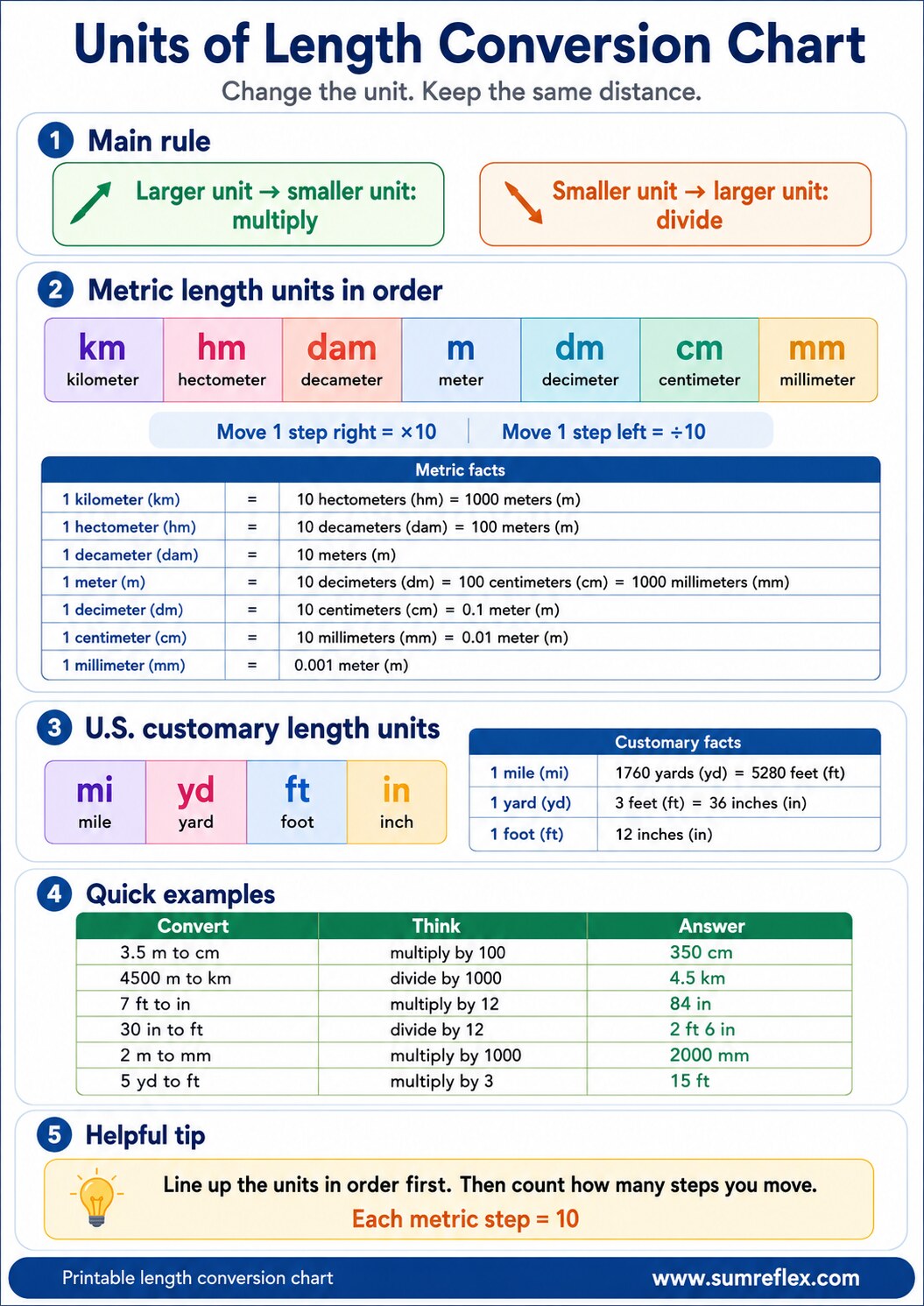
Use this SumReflex chart while studying the lesson. It shows the main conversion rule, metric length units in order, metric facts, U.S. customary facts, quick examples, and the step-counting tip.
The same chart is also available in the Printable Measurement Unit Charts section with print and download options.
Before converting, check the measurement type
Only convert length units to other length units.
You can convert meters to centimeters because both measure length.
You can convert feet to inches because both measure length.
You cannot convert centimeters to kilograms because centimeters measure length and kilograms measure mass.
A quick safety check is: What is being measured? If the answer is how long, tall, wide, deep, or far, use length units.
The main conversion rule
Larger unit to smaller unit: multiply.
Smaller unit to larger unit: divide.
Why? A larger unit contains many smaller units. So 1 meter contains 100 centimeters, and 1 foot contains 12 inches.
Example: 3 m = 300 cm because meters are larger than centimeters, so multiply by 100.
Example: 300 cm = 3 m because centimeters are smaller than meters, so divide by 100.
Metric length units
Metric length units sit on a ladder. From largest to smallest, the order is kilometer, hectometer, decameter, meter, decimeter, centimeter, millimeter.
The short form is easy to write as: km, hm, dam, m, dm, cm, mm.
Each neighbor is 10 times bigger or 10 times smaller than the next one.
10 mm = 1 cm, 10 cm = 1 dm, 10 dm = 1 m, 10 m = 1 dam, 10 dam = 1 hm, and 10 hm = 1 km.
That also means 1 m = 10 dm = 100 cm = 1000 mm and 1 km = 10 hm = 100 dam = 1000 m.
Metric conversions feel friendly because each step uses 10. You just need to count how many steps you move.
Metric conversion examples
Example 1: A toy car is 14 cm long. Convert 14 cm to millimeters. Centimeter to millimeter is 1 step right, so multiply by 10. 14 cm = 140 mm.
Example 2: A desk strip is 7.5 dm wide. Convert 7.5 dm to centimeters. Decimeter to centimeter is 1 step right, so multiply by 10. 7.5 dm = 75 cm.
Example 3: A classroom wall is 9 m long. Convert 9 m to decimeters. Meter to decimeter is 1 step right, so multiply by 10. 9 m = 90 dm.
Example 4: A garden path is 4 dam long. Convert 4 dam to meters. Decameter to meter is 1 step right, so multiply by 10. 4 dam = 40 m.
Example 5: A field road is 6 hm long. Convert 6 hm to meters. Hectometer to meter is 2 steps right, so multiply by 100. 6 hm = 600 m.
Example 6: A trail sign shows 7500 m. Convert 7500 m to kilometers. Meter to kilometer is 3 steps left, so divide by 1000. 7500 m = 7.5 km.
Example 7: A long ribbon is 425 cm. Convert 425 cm to decimeters. Centimeter to decimeter is 1 step left, so divide by 10. 425 cm = 42.5 dm.
Example 8: A map scale line is 0.8 hm. Convert 0.8 hm to decimeters. Hectometer to decimeter is 3 steps right, so multiply by 1000. 0.8 hm = 800 dm.
How to count metric ladder steps
Write the metric ladder in order: km, hm, dam, m, dm, cm, mm.
Count how many jumps it takes to move from the starting unit to the ending unit.
If you move right, multiply by 10 for each jump. One jump means x 10, two jumps means x 100, three jumps means x 1000.
If you move left, divide by 10 for each jump. One jump means / 10, two jumps means / 100, three jumps means / 1000.
Example 1: Convert 4.2 m to cm. On the ladder, m to dm to cm is 2 jumps right. Multiply by 100. 4.2 m = 420 cm.
Example 2: Convert 560 dam to km. On the ladder, dam to hm to km is 2 jumps left. Divide by 100. 560 dam = 5.6 km.
Example 3: Convert 0.35 km to m. On the ladder, km to hm to dam to m is 3 jumps right. Multiply by 1000. 0.35 km = 350 m.
Example 4: Convert 72 dm to dam. On the ladder, dm to m to dam is 2 jumps left. Divide by 100. 72 dm = 0.72 dam.
U.S. customary length units
The most common U.S. customary length units are inch (in), foot (ft), yard (yd), and mile (mi).
12 in = 1 ft.
3 ft = 1 yd.
1760 yd = 1 mi.
5280 ft = 1 mi.
Customary conversions need more memorizing because they do not all use powers of 10.
Customary conversion examples
Example 1: Convert 5 ft to inches. Since 1 ft = 12 in, multiply 5 by 12. 5 ft = 60 in.
Example 2: Convert 72 in to feet. Since 12 in = 1 ft, divide 72 by 12. 72 in = 6 ft.
Example 3: Convert 9 yd to feet. Since 1 yd = 3 ft, multiply 9 by 3. 9 yd = 27 ft.
Example 4: Convert 24 ft to yards. Since 3 ft = 1 yd, divide 24 by 3. 24 ft = 8 yd.
Example 5: Convert 2 mi to yards. Since 1 mi = 1760 yd, multiply 2 by 1760. 2 mi = 3520 yd.
Example 6: Convert 3 mi to feet. Since 1 mi = 5280 ft, multiply 3 by 5280. 3 mi = 15,840 ft.
Converting mixed customary units
A mixed length uses two units, such as 5 ft 8 in or 3 yd 2 ft.
To convert mixed units, convert each part to the same unit, then add.
Example 1: Convert 5 ft 8 in to inches. 5 ft = 5 x 12 = 60 in. Then 60 in + 8 in = 68 in.
Example 2: Convert 3 yd 2 ft to feet. 3 yd = 3 x 3 = 9 ft. Then 9 ft + 2 ft = 11 ft.
Example 3: Convert 2 yd 1 ft 6 in to inches. 2 yd = 72 in, 1 ft = 12 in, and 6 in stays 6 in. Total: 72 + 12 + 6 = 90 in.
Changing improper inches into feet and inches
Sometimes an answer in inches is better written as feet and inches.
Divide the inches by 12. The quotient is feet, and the remainder is inches.
Example 1: Convert 30 in to feet and inches. 30 divided by 12 is 2 remainder 6. 30 in = 2 ft 6 in.
Example 2: Convert 68 in to feet and inches. 68 divided by 12 is 5 remainder 8. 68 in = 5 ft 8 in.
Example 3: Convert 95 in to feet and inches. 95 divided by 12 is 7 remainder 11. 95 in = 7 ft 11 in.
Metric and customary cross-system conversions
Sometimes you may need to convert between metric and customary systems.
Useful facts are 1 in = 2.54 cm, 1 ft = 30.48 cm, 1 yd = 0.9144 m, and 1 mi is about 1.609 km.
These conversions often use decimals, so many Grade 4 problems stay inside one system. Still, it is useful to know the bridge facts.
Example: Convert 10 in to centimeters. Since 1 in = 2.54 cm, 10 in = 25.4 cm.
Example: A 5 km race is about how many miles? Since 1 mi is about 1.609 km, 5 km is about 3.1 mi.
Word problems with metric units
Problem 1: A poster is 8 dm wide. How many centimeters is it? Decimeter to centimeter is 1 step right, so 8 x 10 = 80. The poster is 80 cm wide.
Problem 2: A hallway is 3.5 dam long. How many meters is it? Decameter to meter is 1 step right, so 3.5 x 10 = 35. The hallway is 35 m long.
Problem 3: A farm road is 12 hm long. How many kilometers is it? Hectometer to kilometer is 1 step left, so 12 / 10 = 1.2. The farm road is 1.2 km long.
Problem 4: A science wire is 0.6 m long. How many decimeters is it? Meter to decimeter is 1 step right, so 0.6 x 10 = 6. The wire is 6 dm long.
Problem 5: A small screw is 32 mm long. How many centimeters is it? Millimeter to centimeter is 1 step left, so 32 / 10 = 3.2. The screw is 3.2 cm long.
Word problems with customary units
Problem 1: A board is 6 ft long. How many inches is it? Since 1 ft = 12 in, 6 x 12 = 72. The board is 72 in long.
Problem 2: A football field is 100 yd long. How many feet is it? Since 1 yd = 3 ft, 100 x 3 = 300. The field is 300 ft long.
Problem 3: A road is 4 mi long. How many feet is it? Since 1 mi = 5280 ft, 4 x 5280 = 21,120. The road is 21,120 ft long.
Problem 4: A shelf is 54 in long. How many feet and inches is that? 54 / 12 = 4 remainder 6. The shelf is 4 ft 6 in long.
How to know whether to multiply or divide
Ask: Am I changing to a smaller unit or a larger unit?
If the new unit is smaller, the number gets bigger. Multiply.
If the new unit is larger, the number gets smaller. Divide.
Example: 4 yd to ft changes to a smaller unit, so multiply: 4 x 3 = 12 ft.
Example: 12 ft to yd changes to a larger unit, so divide: 12 / 3 = 4 yd.
This sense check helps catch many mistakes.
Common mistakes to avoid
Do not convert length to a unit that measures something else. Length stays with length.
Do not use the metric rule for customary units. Feet to inches uses 12, not 10.
Do not forget to divide when changing to a larger unit.
Do not drop the unit from the final answer. 300 cm and 300 m are very different.
Do not add mixed units before converting. For 3 ft + 6 in, do not write 9 ft. Convert or write the mixed length carefully.
Practice questions
1. Convert 9 cm to mm.
2. Convert 12 dm to cm.
3. Convert 4 m to dm.
4. Convert 7 dam to m.
5. Convert 3 hm to dam.
6. Convert 5 km to hm.
7. Convert 6500 m to hm.
8. Convert 480 cm to dm.
9. Convert 6 ft to inches.
10. Convert 96 in to feet.
11. Convert 12 yd to feet.
12. Convert 4 ft 7 in to inches.
Practice answers
1. 9 cm = 90 mm.
2. 12 dm = 120 cm.
3. 4 m = 40 dm.
4. 7 dam = 70 m.
5. 3 hm = 30 dam.
6. 5 km = 50 hm.
7. 6500 m = 65 hm.
8. 480 cm = 48 dm.
9. 6 ft = 72 in.
10. 96 in = 8 ft.
11. 12 yd = 36 ft.
12. 4 ft 7 in = 55 in.
The big idea
Length conversion changes the unit, not the real length.
Use the correct conversion fact, then decide whether to multiply or divide.
Larger unit to smaller unit usually makes the number bigger. Smaller unit to larger unit usually makes the number smaller.
For a broader review of choosing length units and reading rulers, use the Units for Measuring Length lesson.