



Grade 1 measurement lesson
Grade 1 Measurement Basics: Length, Height, Weight, Capacity, Time, Calendar, and Data
Grade 1 measurement is about comparing real things, measuring with equal-size units, reading time and calendars, and using simple data to answer questions.
What should Grade 1 students know about measurement?
Grade 1 measurement starts with real objects that children can see, touch, compare, and count.
Students learn words such as longer, shorter, taller, heavier, lighter, holds more, and holds less.
They also learn how to measure with same-size units, read simple time, use calendar words, and answer questions from simple data.
Printable Grade 1 Measurement Basics chart
Use this SumReflex chart as a visual guide for the main measurement ideas Grade 1 students need to know.
The same chart is also listed in the Printable Measurement Unit Charts section with print and download buttons.
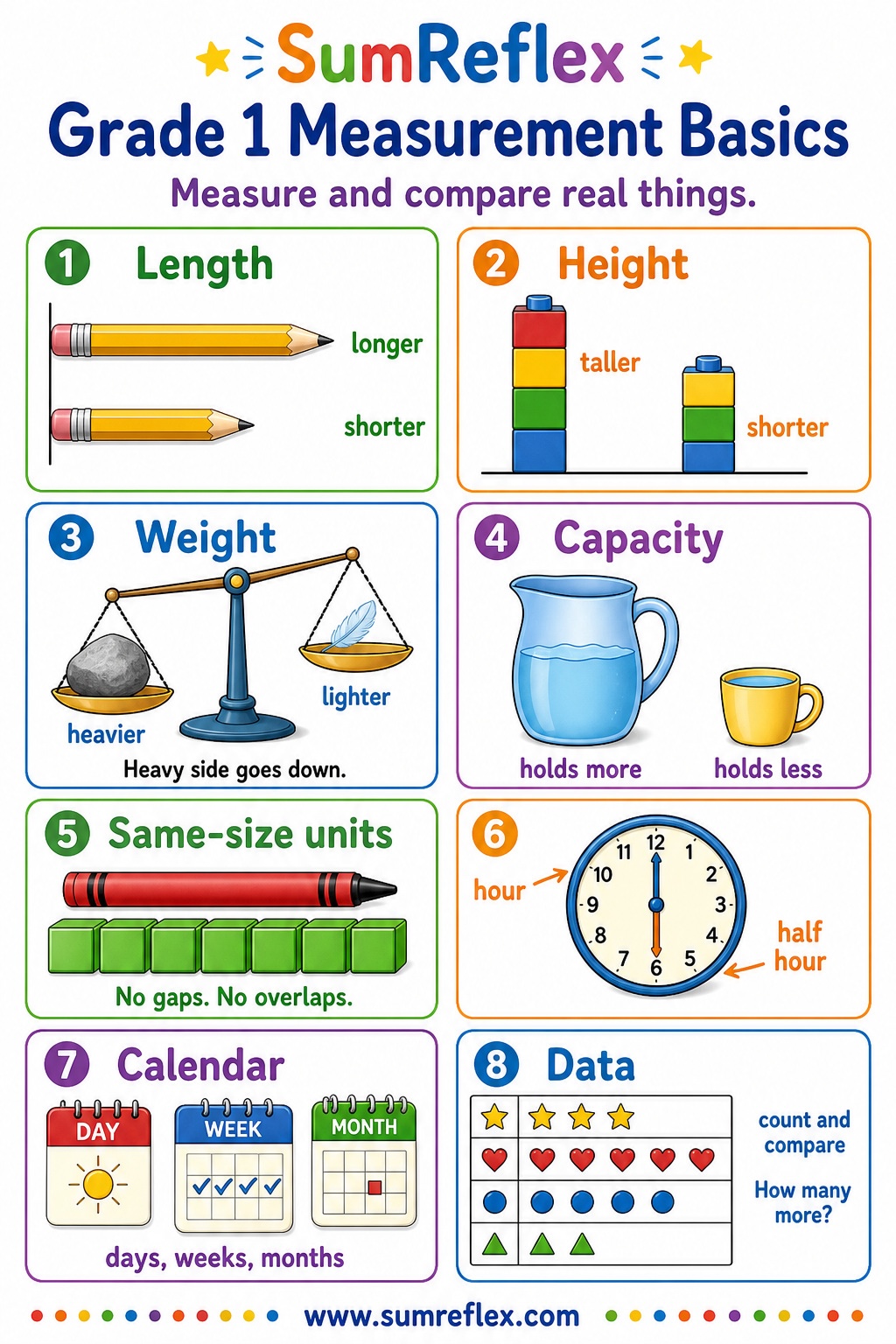
Compare length
Length tells how long something is from one end to the other.
Grade 1 students should compare objects with words like longer and shorter.
Example: A crayon may be shorter than a pencil.
Example: A ribbon may be longer than a paper clip.
When comparing length, line up the objects at the same starting point. If one object starts farther ahead, the comparison can be unfair.
Compare height
Height tells how tall something is.
Students compare height with words like taller and shorter.
Example: A bookshelf is taller than a chair.
Example: A small block tower is shorter than a tall block tower.
Height is usually measured from bottom to top.
Compare weight
Weight tells how heavy something is.
Grade 1 students often compare weight by holding objects or using a balance scale.
Use words like heavier and lighter.
Example: A book is heavier than a pencil.
Example: A feather is lighter than a toy car.
Compare capacity
Capacity tells how much a container can hold.
Students use words like holds more and holds less.
Example: A jug holds more water than a small cup.
Example: A spoon holds less liquid than a bowl.
Capacity is useful when talking about cups, bottles, bowls, buckets, and containers.
Measure with same-size units
Grade 1 students often measure with objects such as cubes, paper clips, counters, or blocks.
The units must be the same size. Do not mix big blocks and small blocks in the same measurement.
Start measuring at the same end of the object.
Put the units in a straight line with no gaps and no overlaps.
Example: If a pencil is 6 paper clips long, that means 6 same-size paper clips fit from one end of the pencil to the other.
Order objects by size
Students should be able to put objects in order by length or height.
Shortest to longest means the smallest length comes first and the biggest length comes last.
Tallest to shortest means the tallest object comes first and the shortest object comes last.
Example: Put a paper clip, crayon, and ruler in order from shortest to longest.
Ordering helps students compare more than two objects at once.
Read time to the hour and half hour
Grade 1 time usually focuses on the hour and half hour.
When the minute hand points to 12, the time is an hour time, such as 4:00.
When the minute hand points to 6, the time is a half hour time, such as 4:30.
Students should connect analog clocks and digital clocks.
Time is measurement because it tells how long we wait, study, sleep, play, or travel.
Use calendar words
Calendar measurement includes days, weeks, months, and years.
Grade 1 students should know that 7 days make 1 week.
They should learn the days of the week, the months of the year, and the days in each month.
Calendars help students read birthdays, school days, weekends, holidays, and schedules.
Read simple data
Grade 1 measurement also connects to data because students count and compare real groups.
A picture graph or tally chart can show how many students chose each item.
Students should answer questions such as How many?, How many more?, and How many fewer?
Example: If 6 students choose apples and 4 students choose bananas, 2 more students chose apples.
Common mistakes
Do not start two objects at different places when comparing length.
Do not measure with units that are different sizes.
Do not leave gaps between units when measuring.
Do not overlap units unless the lesson is about covering area. For length, units should touch end to end.
Do not mix up heavier and bigger. A small rock can be heavier than a large empty box.
Quick practice
1. Which word means more tall: taller.
2. Which word means less heavy: lighter.
3. What should you avoid when measuring with paper clips? Gaps and overlaps.
4. What does capacity tell? How much a container can hold.
5. How many days are in 1 week? 7 days.
6. What question compares two data groups: How many more? or How many fewer?
7. If a crayon is 5 cubes long, what did you count? 5 same-size cubes along the crayon.
The big idea
Grade 1 measurement is about making smart comparisons.
Students compare real objects, measure with equal units, read time and calendars, and use data to answer simple questions.
The goal is not only to name units, but to understand what is being measured and how to compare it fairly.