



Grade 1 measurement lesson
Days of the Week: Order, Weekdays, Weekend, Examples, and Chart
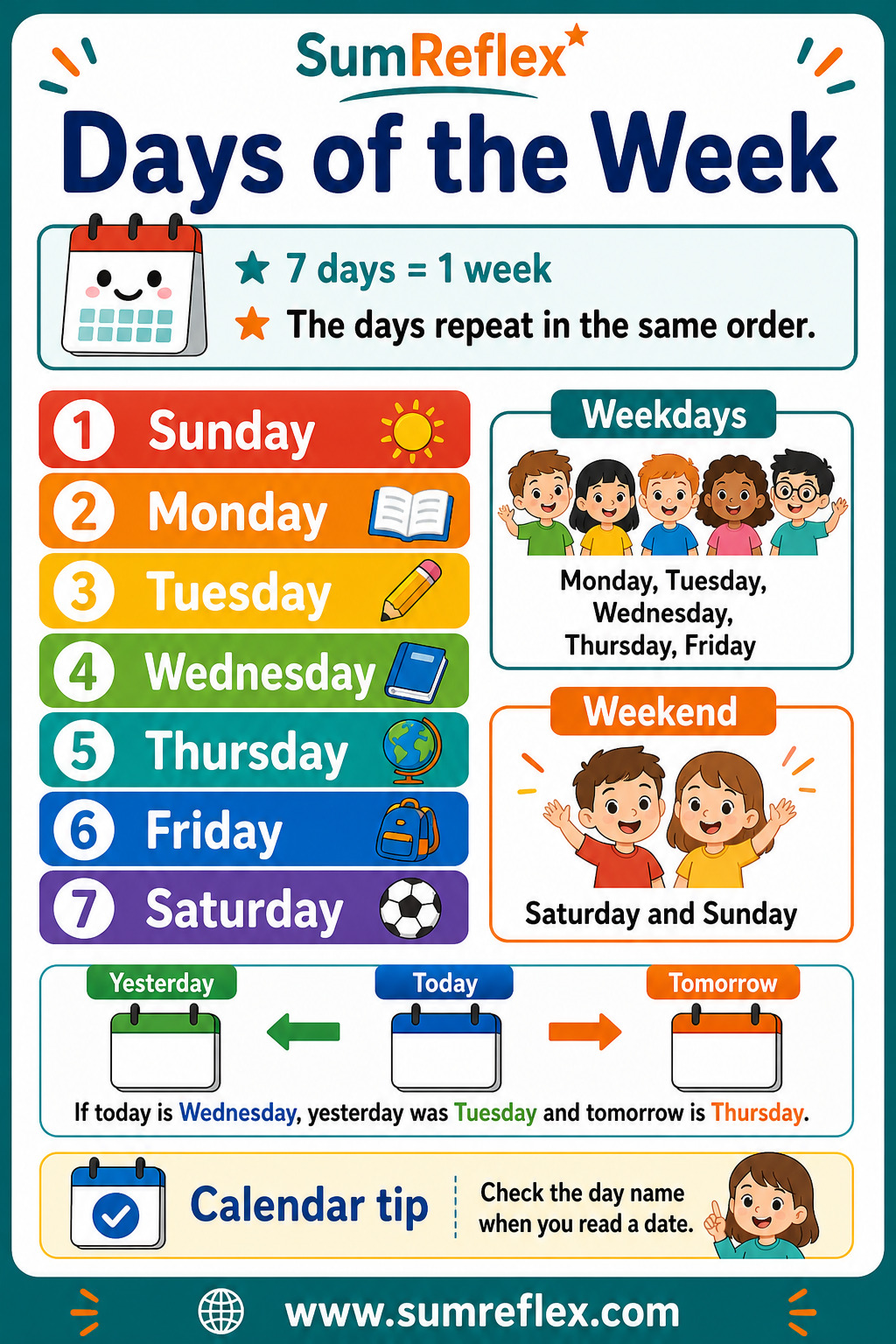
There are 7 days in a week. The days repeat in the same order: Sunday, Monday, Tuesday, Wednesday, Thursday, Friday, and Saturday.
What are the days of the week?
The days of the week are the 7 named days that make one week.
The days repeat in the same order again and again.
The 7 days are Sunday, Monday, Tuesday, Wednesday, Thursday, Friday, and Saturday.
Printable Days of the Week chart
Use this SumReflex chart as a quick reference for the day order, weekdays, weekend, and yesterday-today-tomorrow language.
The same chart is also listed in the Printable Measurement Unit Charts section with print and download buttons.
The days in order
The order of the days matters because calendars and schedules move forward one day at a time.
1st: Sunday.
2nd: Monday.
3rd: Tuesday.
4th: Wednesday.
5th: Thursday.
6th: Friday.
7th: Saturday.
After Saturday, the next day is Sunday again because a new week begins.
Weekdays and weekend
Many calendars group the days into weekdays and weekend days.
Weekdays are Monday, Tuesday, Wednesday, Thursday, and Friday.
Weekend days are Saturday and Sunday.
Many schools and workplaces use weekdays for regular schedules, and many families use the weekend for rest, activities, or special plans.
Yesterday, today, and tomorrow
Today means the day we are in right now.
Yesterday means the day before today.
Tomorrow means the day after today.
Example: If today is Wednesday, yesterday was Tuesday and tomorrow is Thursday.
Example: If today is Monday, yesterday was Sunday and tomorrow is Tuesday.
Reading a calendar
A calendar shows dates and day names together.
A date tells the month number or month name and the day number.
The day name tells where that date falls in the week.
For example, a calendar might show that June 14 is Sunday. That means the date is June 14 and the day of the week is Sunday.
Examples with before and after
What day comes after Monday? Tuesday comes after Monday.
What day comes before Friday? Thursday comes before Friday.
What day is two days after Wednesday? Thursday is one day after, and Friday is two days after Wednesday.
What day is three days before Sunday? Saturday is one day before, Friday is two days before, and Thursday is three days before Sunday.
What day comes after Saturday? Sunday comes after Saturday.
Simple word problems
Example 1: Ava has art class every Tuesday. What day is art class after Monday? Tuesday.
Example 2: A game is on Saturday. What day is the game after Friday? Saturday.
Example 3: If today is Thursday, what was yesterday? Wednesday.
Example 4: If today is Sunday, what is tomorrow? Monday.
Common mistakes
Do not forget that after Saturday, the week starts again with Sunday.
Do not mix up Tuesday and Thursday. They both begin with T, so read the whole word carefully.
Do not mix up Sunday and Saturday. They are both weekend days, but they are not the same day.
Do not forget that yesterday goes backward one day and tomorrow goes forward one day.
Quick practice
1. How many days are in 1 week? 7 days.
2. What day comes after Sunday? Monday.
3. What day comes before Wednesday? Tuesday.
4. Name the weekdays: Monday, Tuesday, Wednesday, Thursday, and Friday.
5. Name the weekend days: Saturday and Sunday.
6. If today is Friday, what is tomorrow? Saturday.
7. If today is Tuesday, what was yesterday? Monday.
8. What day comes after Saturday? Sunday.
The big idea
The days of the week help us read calendars and schedules.
There are 7 days in a week, and the days repeat in the same order.
When you know the order, words like yesterday, today, tomorrow, weekday, and weekend become much easier to understand.