



Grade 1 measurement lesson
Months of the Year: Order, Days, Abbreviations, Seasons, Examples, and Chart
A year has 12 months. Learning the month order, days in each month, abbreviations, and leap year rule makes calendars and dates easier to read.
What are the months of the year?
The months of the year are the 12 named parts of one year.
A year is a unit of time. It is longer than a day, week, or month. We use years to talk about birthdays, school grades, holidays, seasons, calendars, and age.
The 12 months are January, February, March, April, May, June, July, August, September, October, November, and December.
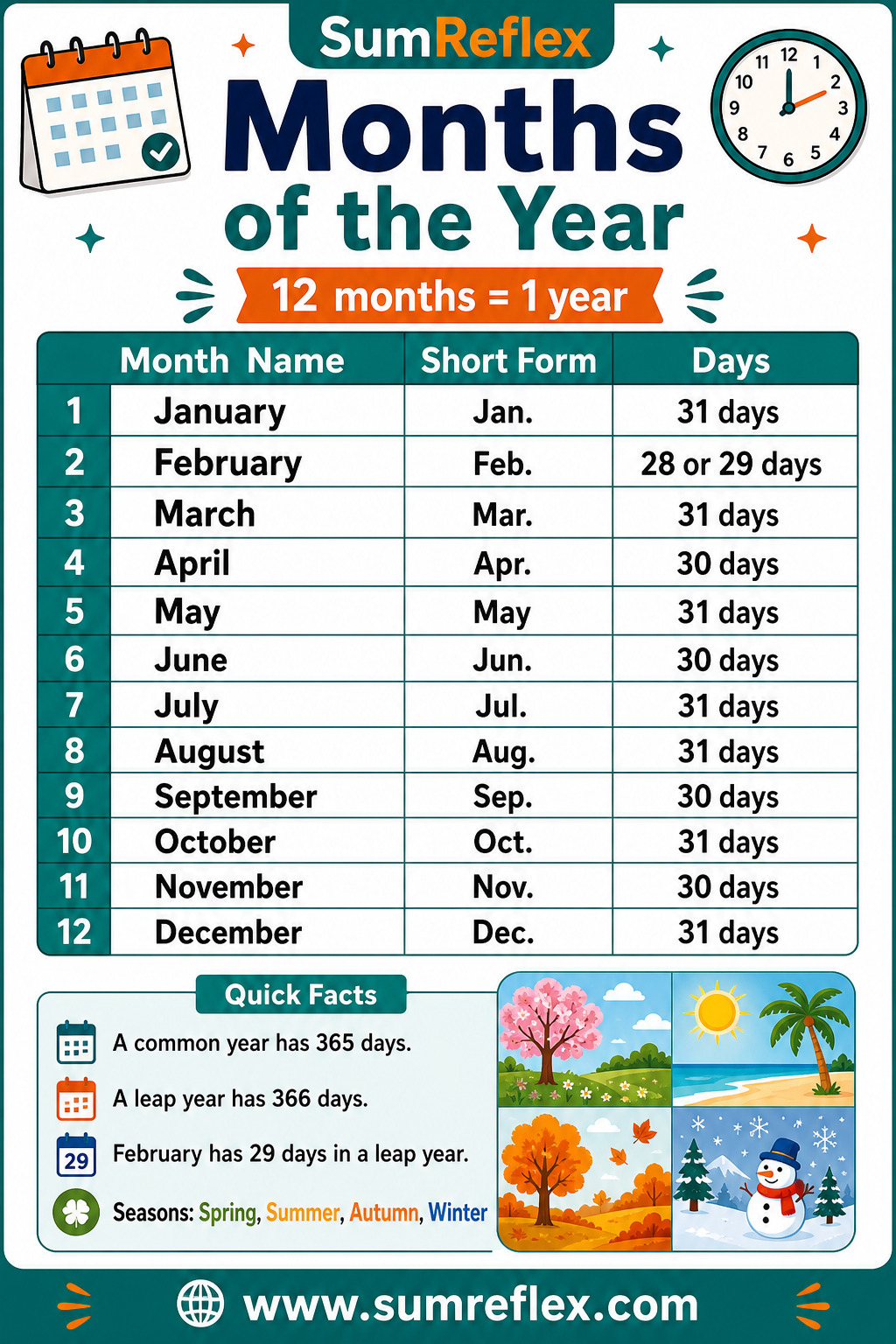
Printable Months of the Year chart
Use this SumReflex chart as a quick reference for month order, short forms, day counts, leap year facts, and seasons.
The same chart is also listed in the existing Printable Measurement Unit Charts section because months and years are units of time.
The months in order
The order of the months matters because calendars move forward in the same pattern every year.
1st: January. 2nd: February. 3rd: March. 4th: April.
5th: May. 6th: June. 7th: July. 8th: August.
9th: September. 10th: October. 11th: November. 12th: December.
After December, the next month is January again because a new year begins.
How many days are in each month?
Most months have either 30 or 31 days. February is the special month because it usually has 28 days, but it has 29 days in a leap year.
31-day months: January, March, May, July, August, October, and December.
30-day months: April, June, September, and November.
February: 28 days in a common year and 29 days in a leap year.
A common year has 365 days. A leap year has 366 days.
For a focused day-count reference, use the Days in Each Month lesson.
Short forms and abbreviations
A month abbreviation is a shorter way to write a month name.
January can be written as Jan., February as Feb., March as Mar., April as Apr., June as Jun., July as Jul., August as Aug., September as Sep., October as Oct., November as Nov., and December as Dec.
May is already short, so it is usually written as May with no period.
Abbreviations are common on calendars, forms, schedules, tickets, and labels where there is not much space.
Leap years and February
February usually has 28 days. In a leap year, February has 29 days.
That extra day is called leap day, and it is February 29.
A leap year has 366 days instead of 365 days.
A simple school rule is that leap years usually happen every 4 years, but calendar rules have a few exceptions for century years. For most everyday examples, remembering every 4 years is enough.
Example: If a calendar says February 2024 has 29 days, then 2024 is a leap year.
Months and seasons
Seasons are parts of the year connected to weather and sunlight. The four common season names are spring, summer, autumn or fall, and winter.
In many Northern Hemisphere school examples, spring is March, April, and May. Summer is June, July, and August. Autumn is September, October, and November. Winter is December, January, and February.
Seasons can be different depending on where you live. For example, when it is summer in the Northern Hemisphere, it is winter in the Southern Hemisphere.
So the month order stays the same everywhere, but the season connected to a month can depend on the place.
Months and quarters
A quarter of a year is 3 months because 12 months divided into 4 equal parts gives 3 months in each part.
Quarter 1: January, February, March.
Quarter 2: April, May, June.
Quarter 3: July, August, September.
Quarter 4: October, November, December.
Quarters are often used in school calendars, business reports, sports seasons, and planning charts.
Reading dates with months
A date usually tells the month, day, and year.
Example: March 14, 2026 means the month is March, the day is 14, and the year is 2026.
Example: 7/4/2026 in U.S. date format means July 4, 2026 because the month number comes first.
Example: 04 Aug. 2026 uses the abbreviation Aug. for August.
Date formats can change by country, so always check whether the month or day is written first.
Examples with before and after
What month comes after April? May comes after April.
What month comes before September? August comes before September.
What month is two months after June? July is one month after June, and August is two months after June.
What month is three months before December? November is one month before, October is two months before, and September is three months before December.
What month comes after December? January comes after December because the next year begins.
Examples with day counts
How many days are in October? October has 31 days.
How many days are in June? June has 30 days.
How many days are in February in a common year? February has 28 days.
How many days are in February in a leap year? February has 29 days.
Which months have 31 days? January, March, May, July, August, October, and December.
Examples with elapsed months
Elapsed months tell how many month steps pass from one month to another.
Example: From March to June is 3 month steps: March to April, April to May, and May to June.
Example: Six months after January is July if you count forward month by month.
Example: Four months after September is January of the next year: October, November, December, January.
Example: Two months before March is January.
Common mistakes
Do not forget that February is different from every other month.
Do not say all odd-numbered months have 31 days. September is the 9th month but has 30 days.
Do not forget that the year restarts after December. The month after December is January, not a 13th month.
Do not assume every country writes dates in the same order. In the United States, 3/5 often means March 5. In many other places, it can mean 3 May.
Do not treat seasons as exactly the same everywhere. The month order is fixed, but seasons depend on location and calendar system.
Quick practice
1. What is the 1st month? January.
2. What is the 6th month? June.
3. What is the 12th month? December.
4. What month comes after August? September.
5. What month comes before May? April.
6. How many months are in 1 year? 12 months.
7. Which month can have 28 or 29 days? February.
8. How many days are in a leap year? 366 days.
The big idea
The months of the year help us organize time.
When you know the order, short forms, day counts, and leap year rule, calendars become much easier to read.
The main facts to remember are simple: 12 months make 1 year, most months have 30 or 31 days, and February has 28 days or 29 days in a leap year.