



Grade 1 measurement lesson
Days in Each Month: 30 Days, 31 Days, February, Examples, and Chart
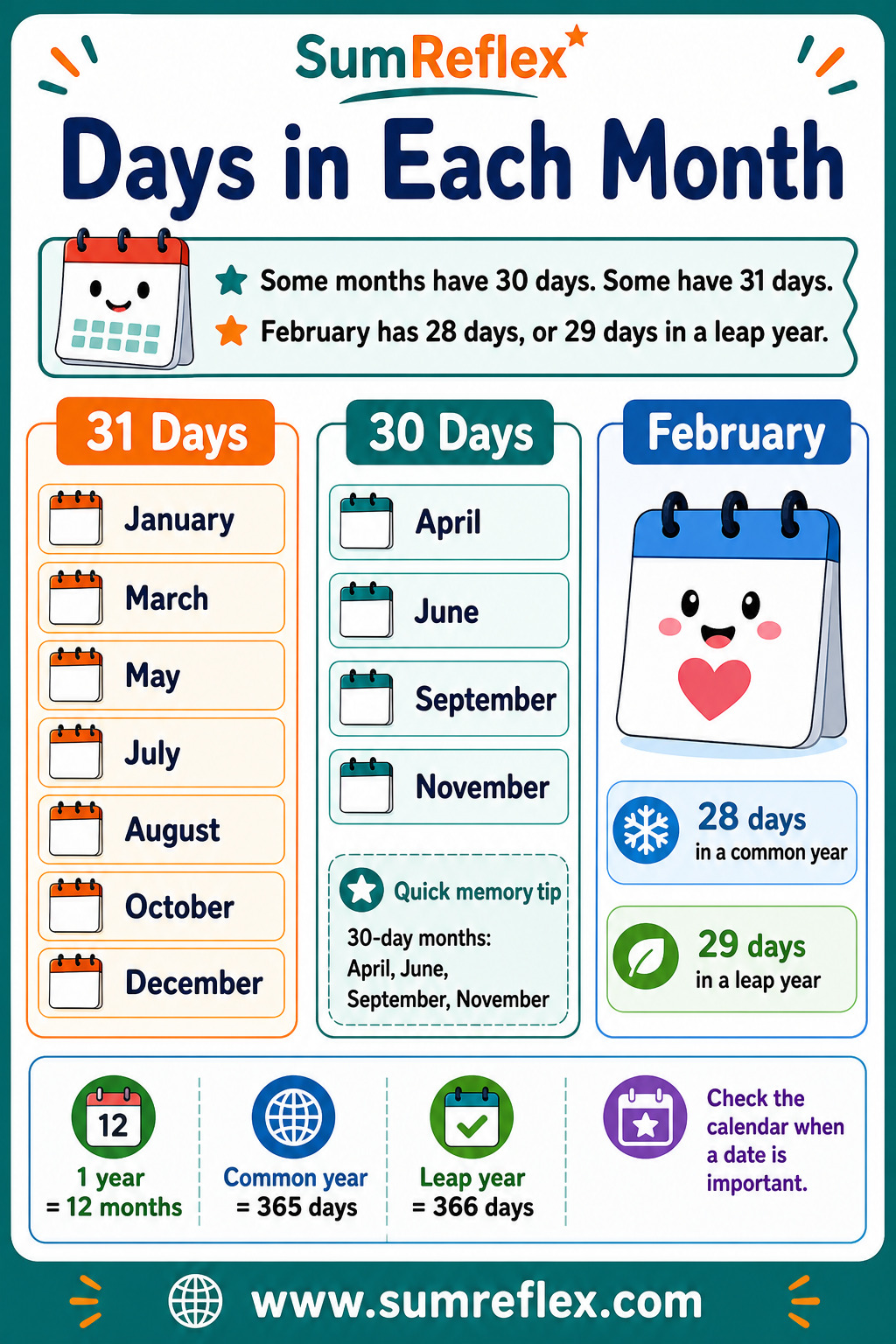
Most months have 30 or 31 days. February has 28 days in a common year and 29 days in a leap year.
How many days are in each month?
A month is a part of a year. Each month has a certain number of days.
Most months have either 30 days or 31 days.
February is the special month. It has 28 days in a common year and 29 days in a leap year.
Printable Days in Each Month chart
Use this SumReflex chart as a quick reference for 31-day months, 30-day months, February, common years, and leap years.
The same chart is also listed in the Printable Measurement Unit Charts section with print and download buttons.
Months with 31 days
There are 7 months with 31 days.
January has 31 days.
March has 31 days.
May has 31 days.
July has 31 days.
August has 31 days.
October has 31 days.
December has 31 days.
Months with 30 days
There are 4 months with 30 days.
April has 30 days.
June has 30 days.
September has 30 days.
November has 30 days.
A short memory tip is: April, June, September, and November have 30 days.
Why February is different
February is the only month that usually has 28 days.
In a leap year, February has 29 days. The extra day is called leap day.
Leap day is February 29.
A common year has 365 days. A leap year has 366 days.
Common year and leap year
A common year is a normal year with 365 days.
In a common year, February has 28 days.
A leap year has 366 days.
In a leap year, February has 29 days.
For early learners, a helpful school rule is that leap years usually happen every 4 years.
Examples with day counts
How many days are in January? January has 31 days.
How many days are in April? April has 30 days.
How many days are in February in a common year? February has 28 days.
How many days are in February in a leap year? February has 29 days.
Which months have 30 days? April, June, September, and November.
Which months have 31 days? January, March, May, July, August, October, and December.
Reading calendar dates
Knowing the number of days in a month helps you read calendars correctly.
For example, April has 30 days, so April 31 is not a real date.
October has 31 days, so October 31 is a real date.
February 29 is only on the calendar in a leap year.
When a date is important, always check a real calendar too.
Simple word problems
Example 1: Mia has a piano lesson on March 31. Is that a real date? Yes. March has 31 days.
Example 2: A party is planned for June 31. Is that a real date? No. June has 30 days.
Example 3: A calendar shows February 29. What kind of year is it? It is a leap year.
Example 4: Which month is longer, April or May? May is longer because May has 31 days and April has 30 days.
Common mistakes
Do not say every other month has 31 days. The pattern changes around July and August.
Do not forget that February is different from all other months.
Do not write dates such as April 31, June 31, September 31, or November 31.
Do not assume February always has 28 days. It has 29 days in a leap year.
Quick practice
1. How many days are in December? 31 days.
2. How many days are in September? 30 days.
3. Which month can have 28 or 29 days? February.
4. How many months have 30 days? 4 months.
5. How many months have 31 days? 7 months.
6. Is November 31 a real date? No.
7. Is July 31 a real date? Yes.
8. How many days are in a leap year? 366 days.
The big idea
Learning the days in each month makes calendars easier to read.
Remember the three groups: 31-day months, 30-day months, and February.
The most important special fact is that February has 28 days in a common year and 29 days in a leap year.