


Trigonometry formula notes
Using double-angle and half-angle formulas without mixing the signs
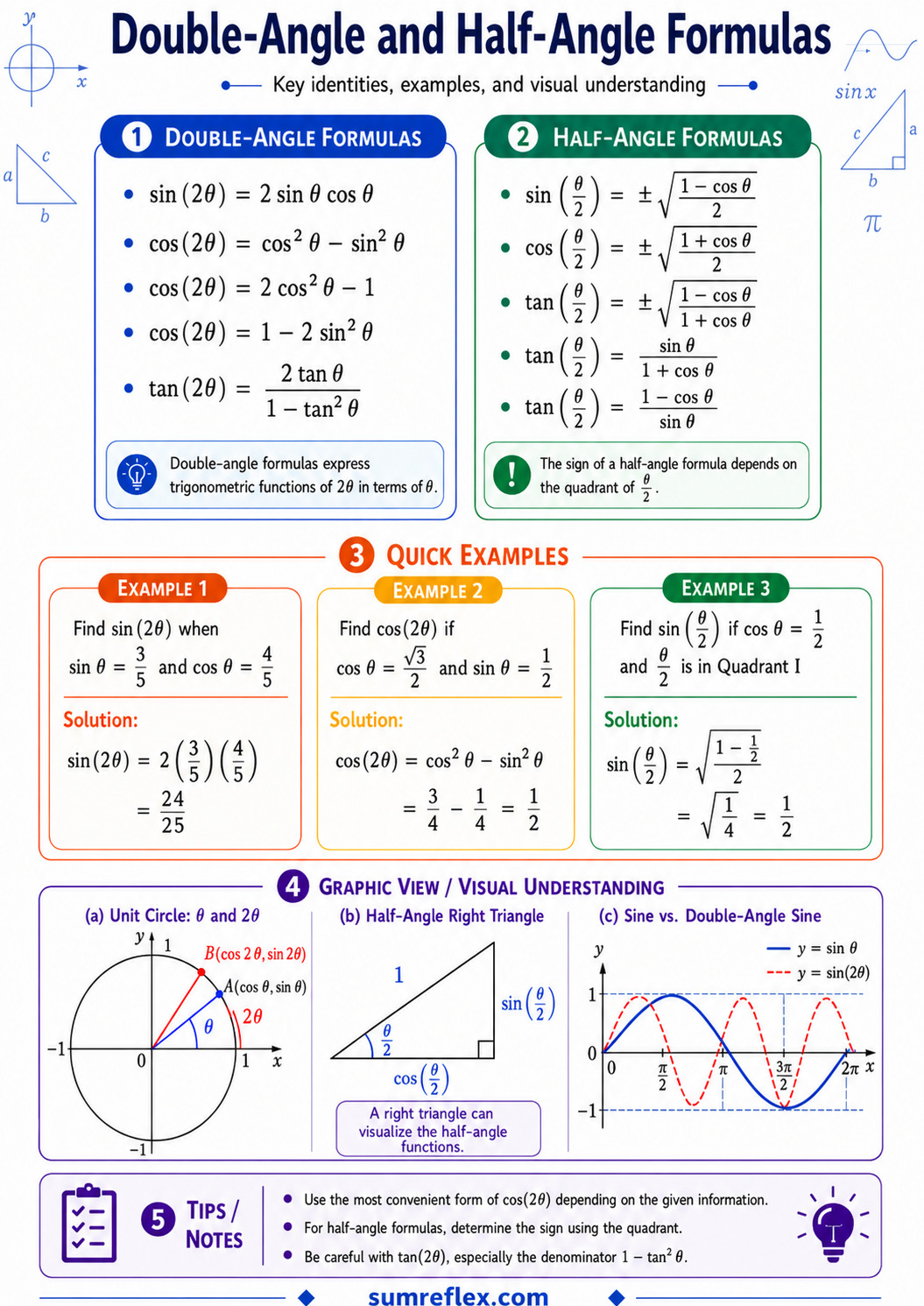
Use the chart to choose the formula first
Double-angle problems usually become easier when students choose the identity from the information given. If both sine and cosine are known, \(\sin(2\theta)=2\sin\theta\cos\theta\) is direct. If only sine is known, \(1-2\sin^2\theta\) may be the fastest cosine double-angle form. If only cosine is known, \(2\cos^2\theta-1\) may be cleaner.
The full lesson at Double-Angle and Half-Angle Formulas gives step-by-step examples and shows how to check each answer after using the chart.
Half-angle signs need a separate decision
The half-angle formulas include a plus-or-minus sign because a square root gives size before it gives direction. Students should decide the quadrant of \(\frac{\theta}{2}\), then choose the sign for sine, cosine, or tangent. This is the most common place where a numerically neat answer becomes wrong.
A good routine is to write the square-root value first, then add a short sign note such as "positive because \(\frac{\theta}{2}\) is in Quadrant I" or "negative because cosine is negative in Quadrant II."
Connect formulas to earlier trig work
Students who are still building exact values should keep the trigonometrical ratios table nearby. Double-angle and half-angle identities often use exact values such as \(\frac{1}{2}\), \(\frac{\sqrt3}{2}\), and \(\frac{\sqrt2}{2}\).
For broader identity proof work, pair this chart with the Trig Identities lesson. That lesson shows where these identities fit beside Pythagorean, quotient, reciprocal, sum, and difference identities.
Best ways to print and use it
Print this chart for Grade 11 trigonometry notebooks, tutoring folders, formula review, identity proofs, and exact-value practice. It works best when students mark which formula they used before substituting numbers.
For quick review, cover the formula side and ask students to rebuild one identity family from memory. Then uncover the chart and compare notation, signs, and denominator placement.