

Grade 11 trigonometry lesson
Double-Angle and Half-Angle Formulas: Identities, Examples, and Checks
Double-angle formulas rewrite trig functions of \(2\theta\). Half-angle formulas rewrite trig functions of \(\frac{\theta}{2}\) and require careful sign choice.
What are double-angle and half-angle formulas?
Double-angle and half-angle formulas are trigonometric identities that change the angle inside a trig function.
A double-angle formula rewrites a function of \(2\theta\) using functions of \(\theta\). For example, \(\sin(2\theta)\) can be rewritten as \(2\sin\theta\cos\theta\).
A half-angle formula rewrites a function of \(\frac{\theta}{2}\) using information about \(\theta\). These formulas are especially useful when the original angle has a known cosine value but the half angle is not one of the first values students memorize.
These identities sit inside the larger family of trigonometric identities, but they deserve their own careful lesson because the angle change is easy to misread.
Printable double-angle and half-angle formulas chart
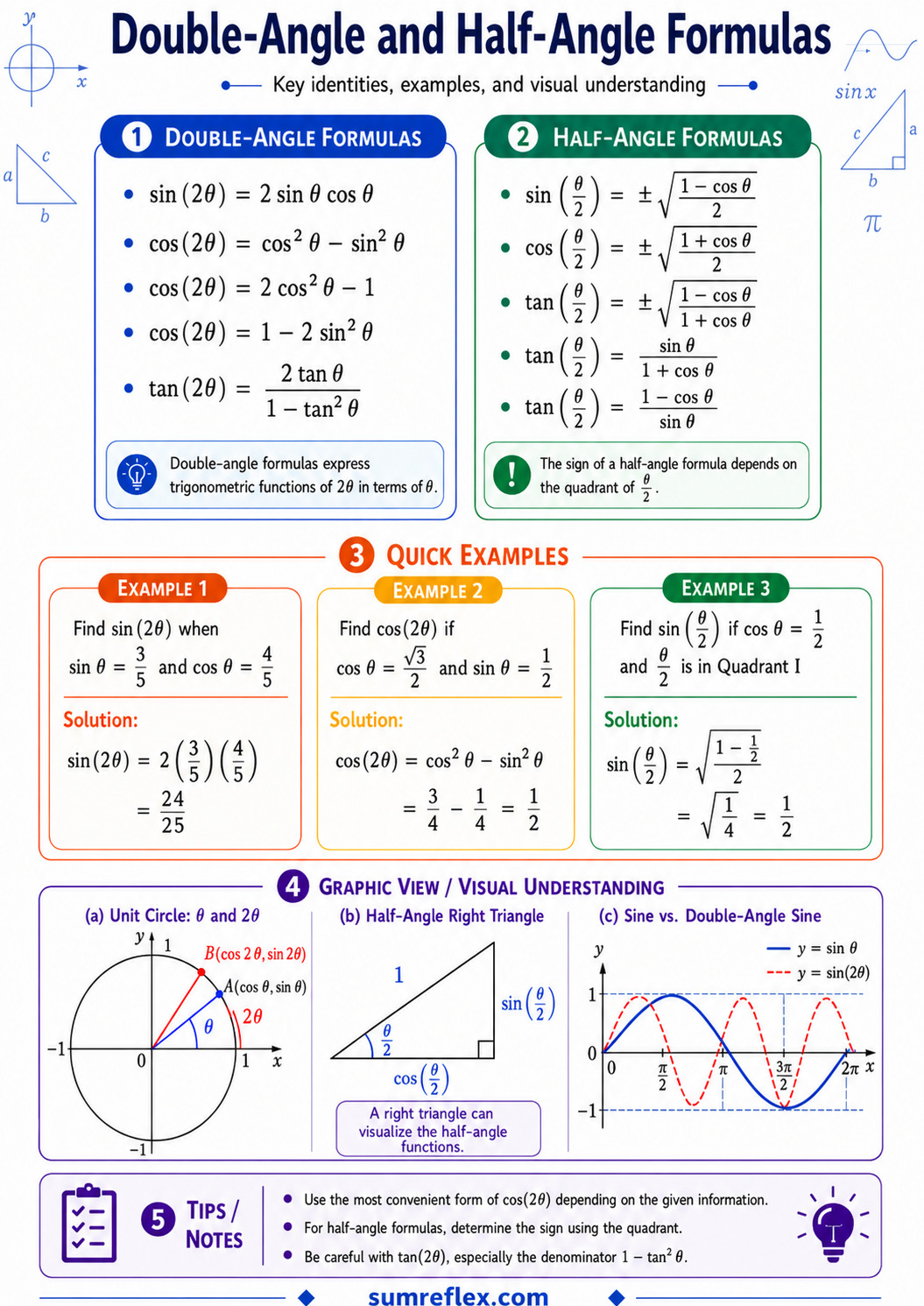
Use this SumReflex chart as a quick reference for the main formulas, sign reminder, worked examples, and visual meaning.
The same chart is also available in the Printable Trigonometry Charts section with print and download options.
Main double-angle formulas
The double-angle identities rewrite trig functions of \(2\theta\).
\[\sin(2\theta)=2\sin\theta\cos\theta\]
\[\cos(2\theta)=\cos^2\theta-\sin^2\theta\]
\[\cos(2\theta)=2\cos^2\theta-1\]
\[\cos(2\theta)=1-2\sin^2\theta\]
\[\tan(2\theta)=\frac{2\tan\theta}{1-\tan^2\theta}\]
Notice that cosine has three common forms. They are equivalent, but one form may be faster depending on what the problem gives you.
| Given information | Convenient formula | Why it helps |
|---|---|---|
| Both \(\sin\theta\) and \(\cos\theta\) | \(\sin(2\theta)=2\sin\theta\cos\theta\) | Uses both values directly. |
| Only \(\cos\theta\) | \(\cos(2\theta)=2\cos^2\theta-1\) | Avoids finding sine first. |
| Only \(\sin\theta\) | \(\cos(2\theta)=1-2\sin^2\theta\) | Avoids finding cosine first. |
| Only \(\tan\theta\) | \(\tan(2\theta)=\frac{2\tan\theta}{1-\tan^2\theta}\) | Works directly from tangent, when the denominator is not zero. |
Main half-angle formulas
Half-angle identities rewrite trig functions of \(\frac{\theta}{2}\). The sign depends on the quadrant of the half angle, not only on the quadrant of \(\theta\).
\[\sin\left(\frac{\theta}{2}\right)=\pm\sqrt{\frac{1-\cos\theta}{2}}\]
\[\cos\left(\frac{\theta}{2}\right)=\pm\sqrt{\frac{1+\cos\theta}{2}}\]
\[\tan\left(\frac{\theta}{2}\right)=\pm\sqrt{\frac{1-\cos\theta}{1+\cos\theta}}\]
\[\tan\left(\frac{\theta}{2}\right)=\frac{\sin\theta}{1+\cos\theta}\]
\[\tan\left(\frac{\theta}{2}\right)=\frac{1-\cos\theta}{\sin\theta}\]
The square-root forms need a plus or minus sign. The rational tangent forms carry the sign through the numerator and denominator, but they still require denominators that are not zero.
Where the formulas come from
The half-angle formulas are built from the cosine double-angle identities. Start with:
\[\cos(2x)=1-2\sin^2 x\]
Solve for \(\sin^2 x\):
\[2\sin^2 x=1-\cos(2x)\]
\[\sin^2 x=\frac{1-\cos(2x)}{2}\]
Now let \(x=\frac{\theta}{2}\). Then \(2x=\theta\), so:
\[\sin^2\left(\frac{\theta}{2}\right)=\frac{1-\cos\theta}{2}\]
Taking the square root gives the half-angle sine formula, with the sign chosen from the quadrant of \(\frac{\theta}{2}\).
Sign rule for half-angle formulas
The sign in a half-angle formula is not a decoration. It decides whether the final value is positive or negative.
Use the quadrant of \(\frac{\theta}{2}\). If \(\frac{\theta}{2}\) is in Quadrant I, sine, cosine, and tangent are positive. If it is in Quadrant II, sine is positive while cosine and tangent are negative. If it is in Quadrant III, tangent is positive while sine and cosine are negative. If it is in Quadrant IV, cosine is positive while sine and tangent are negative.
When the angle unit is part of the confusion, review degrees and radians first so the quadrant of the half angle is clear.
| Quadrant of \(\frac{\theta}{2}\) | \(\sin\left(\frac{\theta}{2}\right)\) | \(\cos\left(\frac{\theta}{2}\right)\) | \(\tan\left(\frac{\theta}{2}\right)\) |
|---|---|---|---|
| Quadrant I | Positive | Positive | Positive |
| Quadrant II | Positive | Negative | Negative |
| Quadrant III | Negative | Negative | Positive |
| Quadrant IV | Negative | Positive | Negative |
Example 1: find sin(2theta)
Find \(\sin(2\theta)\) when \(\sin\theta=\frac{3}{5}\) and \(\cos\theta=\frac{4}{5}\).
Step 1: Choose the double-angle identity for sine.
\[\sin(2\theta)=2\sin\theta\cos\theta\]
Step 2: Substitute the known values.
\[\sin(2\theta)=2\left(\frac{3}{5}\right)\left(\frac{4}{5}\right)\]
Step 3: Multiply.
\[\sin(2\theta)=\frac{24}{25}\]
So \(\sin(2\theta)=\frac{24}{25}\). This result is reasonable because sine values stay between \(-1\) and \(1\).
Example 2: choose the fastest cosine form
Find \(\cos(2\theta)\) if \(\sin\theta=\frac{5}{13}\).
Step 1: Since only sine is given, use the sine-only cosine form.
\[\cos(2\theta)=1-2\sin^2\theta\]
Step 2: Substitute \(\sin\theta=\frac{5}{13}\).
\[\cos(2\theta)=1-2\left(\frac{5}{13}\right)^2\]
Step 3: Square and simplify.
\[\cos(2\theta)=1-2\left(\frac{25}{169}\right)\]
\[\cos(2\theta)=1-\frac{50}{169}=\frac{119}{169}\]
So \(\cos(2\theta)=\frac{119}{169}\).
Example 3: find tan(2theta)
Find \(\tan(2\theta)\) when \(\tan\theta=\frac{2}{3}\).
Step 1: Use the tangent double-angle formula.
\[\tan(2\theta)=\frac{2\tan\theta}{1-\tan^2\theta}\]
Step 2: Substitute \(\tan\theta=\frac{2}{3}\).
\[\tan(2\theta)=\frac{2\left(\frac{2}{3}\right)}{1-\left(\frac{2}{3}\right)^2}\]
Step 3: Simplify the numerator and denominator.
\[\tan(2\theta)=\frac{\frac{4}{3}}{1-\frac{4}{9}}=\frac{\frac{4}{3}}{\frac{5}{9}}\]
Step 4: Divide by multiplying by the reciprocal.
\[\tan(2\theta)=\frac{4}{3}\cdot\frac{9}{5}=\frac{12}{5}\]
So \(\tan(2\theta)=\frac{12}{5}\).
Example 4: find a half-angle sine value
Find \(\sin\left(\frac{\theta}{2}\right)\) if \(\cos\theta=\frac{1}{2}\) and \(\frac{\theta}{2}\) is in Quadrant I.
Step 1: Use the half-angle sine formula.
\[\sin\left(\frac{\theta}{2}\right)=\pm\sqrt{\frac{1-\cos\theta}{2}}\]
Step 2: The half angle is in Quadrant I, so choose the positive sign.
\[\sin\left(\frac{\theta}{2}\right)=\sqrt{\frac{1-\frac{1}{2}}{2}}\]
Step 3: Simplify inside the square root.
\[\sin\left(\frac{\theta}{2}\right)=\sqrt{\frac{\frac{1}{2}}{2}}=\sqrt{\frac{1}{4}}=\frac{1}{2}\]
So \(\sin\left(\frac{\theta}{2}\right)=\frac{1}{2}\).
Example 5: half-angle cosine with a negative sign
Find \(\cos\left(\frac{\theta}{2}\right)\) if \(\cos\theta=-\frac{3}{5}\) and \(\frac{\theta}{2}\) is in Quadrant II.
Step 1: Use the half-angle cosine formula.
\[\cos\left(\frac{\theta}{2}\right)=\pm\sqrt{\frac{1+\cos\theta}{2}}\]
Step 2: The half angle is in Quadrant II, where cosine is negative. Choose the negative sign.
\[\cos\left(\frac{\theta}{2}\right)=-\sqrt{\frac{1-\frac{3}{5}}{2}}\]
Step 3: Simplify.
\[\cos\left(\frac{\theta}{2}\right)=-\sqrt{\frac{\frac{2}{5}}{2}}=-\sqrt{\frac{1}{5}}=-\frac{\sqrt5}{5}\]
So \(\cos\left(\frac{\theta}{2}\right)=-\frac{\sqrt5}{5}\).
Example 6: use a half-angle tangent form
Find \(\tan\left(\frac{\theta}{2}\right)\) if \(\sin\theta=\frac{4}{5}\) and \(\cos\theta=\frac{3}{5}\).
Use the rational form because both sine and cosine are known:
\[\tan\left(\frac{\theta}{2}\right)=\frac{\sin\theta}{1+\cos\theta}\]
Substitute:
\[\tan\left(\frac{\theta}{2}\right)=\frac{\frac{4}{5}}{1+\frac{3}{5}}\]
Simplify the denominator:
\[\tan\left(\frac{\theta}{2}\right)=\frac{\frac{4}{5}}{\frac{8}{5}}\]
Divide:
\[\tan\left(\frac{\theta}{2}\right)=\frac{4}{8}=\frac{1}{2}\]
How to check your answer
A good check starts with size and sign. Sine and cosine answers must stay between \(-1\) and \(1\). Tangent can be larger, but the sign should match the quadrant.
For double-angle answers, substitute your result back into a second equivalent identity when possible. For example, if you find \(\cos(2\theta)\) using \(1-2\sin^2\theta\), you can check with \(2\cos^2\theta-1\) if \(\cos\theta\) is known.
For half-angle answers, square your result and compare it with the squared half-angle formula. Then check the sign separately from the quadrant. This avoids the common mistake of getting the size right but the sign wrong.
For decimal confirmation after the exact work is done, the Scientific Calculator can help, but the identity setup should still be written by hand first.
Common mistakes to avoid
Mistake 1: Writing \(\sin(2\theta)=2\sin\theta\). The correct formula is \(\sin(2\theta)=2\sin\theta\cos\theta\).
Mistake 2: Forgetting the sign in a half-angle formula. The square root gives the size, but the quadrant gives the sign.
Mistake 3: Choosing the quadrant of \(\theta\) instead of the quadrant of \(\frac{\theta}{2}\). Half-angle sign depends on the half angle.
Mistake 4: Using the tangent double-angle formula when \(1-\tan^2\theta=0\). In that case the formula denominator is zero.
Mistake 5: Mixing degree and radian notation. The identity itself works in either unit, but the angle value must be interpreted consistently.
Practice questions
1. Find \(\sin(2\theta)\) if \(\sin\theta=\frac{5}{13}\) and \(\cos\theta=\frac{12}{13}\).
2. Find \(\cos(2\theta)\) if \(\cos\theta=\frac{3}{5}\).
3. Find \(\tan(2\theta)\) if \(\tan\theta=\frac{1}{4}\).
4. Find \(\sin\left(\frac{\theta}{2}\right)\) if \(\cos\theta=-\frac{1}{2}\) and \(\frac{\theta}{2}\) is in Quadrant II.
5. Find \(\cos\left(\frac{\theta}{2}\right)\) if \(\cos\theta=\frac{7}{9}\) and \(\frac{\theta}{2}\) is in Quadrant I.
6. Find \(\tan\left(\frac{\theta}{2}\right)\) if \(\sin\theta=\frac{8}{17}\) and \(\cos\theta=\frac{15}{17}\).
Practice answers
1. \(\sin(2\theta)=2\left(\frac{5}{13}\right)\left(\frac{12}{13}\right)=\frac{120}{169}\).
2. \(\cos(2\theta)=2\left(\frac{3}{5}\right)^2-1=\frac{18}{25}-1=-\frac{7}{25}\).
3. \(\tan(2\theta)=\frac{2\left(\frac{1}{4}\right)}{1-\left(\frac{1}{4}\right)^2}=\frac{\frac{1}{2}}{\frac{15}{16}}=\frac{8}{15}\).
4. \(\sin\left(\frac{\theta}{2}\right)=+\sqrt{\frac{1-\left(-\frac{1}{2}\right)}{2}}=\sqrt{\frac{3}{4}}=\frac{\sqrt3}{2}\).
5. \(\cos\left(\frac{\theta}{2}\right)=+\sqrt{\frac{1+\frac{7}{9}}{2}}=\sqrt{\frac{8}{9}}=\frac{2\sqrt2}{3}\).
6. \(\tan\left(\frac{\theta}{2}\right)=\frac{\frac{8}{17}}{1+\frac{15}{17}}=\frac{\frac{8}{17}}{\frac{32}{17}}=\frac{1}{4}\).
The big idea
Double-angle formulas turn \(2\theta\) into expressions using \(\theta\). Half-angle formulas turn \(\frac{\theta}{2}\) into expressions using \(\theta\).
The double-angle formulas are mostly about choosing the most convenient identity. The half-angle formulas are mostly about choosing the correct sign after finding the size.
Once those two habits are clear, these formulas become practical tools for exact values, proofs, graph work, and later trigonometric equations.