

Grade 11 trigonometry lesson
Trig Identities: Formula Chart, Rules, Proofs, and Examples
Trigonometric identities are formulas that let you rewrite trigonometric expressions without changing their value.
Trigonometric Functions and Identities
A trigonometric identity is a formula that stays true for every angle where both sides are defined.
That last part matters. An equation such as \( \sin \theta = \frac{1}{2} \) is only true for certain angles, but an identity such as \( \sin^2 \theta + \cos^2 \theta = 1 \) is true for every allowed value of \( \theta \).
Identities are the algebra tools of trigonometry. They help you simplify expressions, prove two forms are equal, rewrite a problem in sine and cosine, and prepare for equations, graphs, vectors, and calculus later on.
The main identity to know first
The identity that starts most trigonometry identity work is the Pythagorean identity:
\[ \sin^2 \theta + \cos^2 \theta = 1 \]
It comes from the unit circle idea that \( x^2 + y^2 = 1 \), where cosine acts like the x-coordinate and sine acts like the y-coordinate.
Once you know this formula, two more useful identities follow by dividing every term by \( \cos^2 \theta \) or by \( \sin^2 \theta \):
\[ 1 + \tan^2 \theta = \sec^2 \theta \]
\[ 1 + \cot^2 \theta = \csc^2 \theta \]
If the angle notation feels rusty, review degrees and radians before using identities with radian expressions.
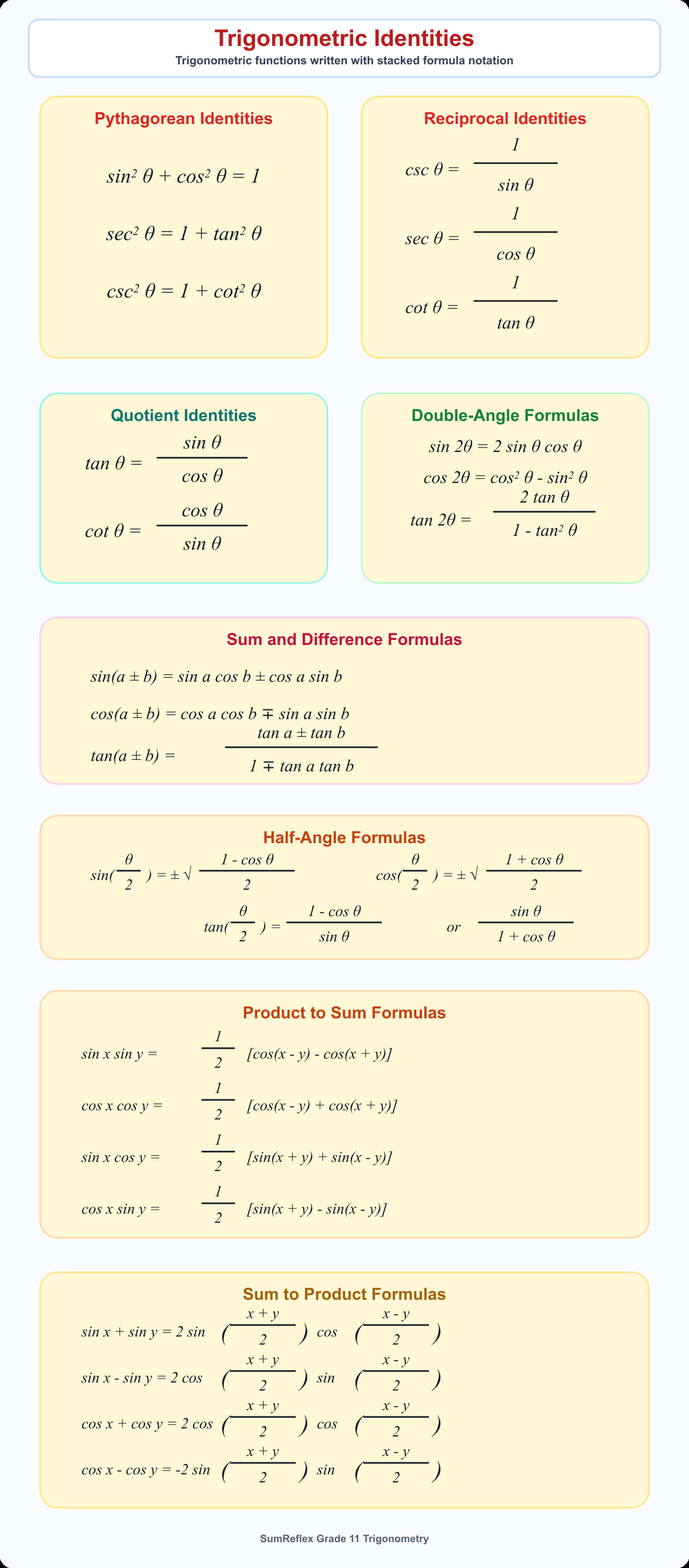
Trigonometric Functions Formula Chart
Use this chart as a working reference, not as a wall of formulas to memorize in one sitting.
Use it for Pythagorean, reciprocal, quotient, double-angle, sum and difference, half-angle, product-to-sum, and sum-to-product identities without reading cramped fractions.
Product and Sum Trigonometric Formulas
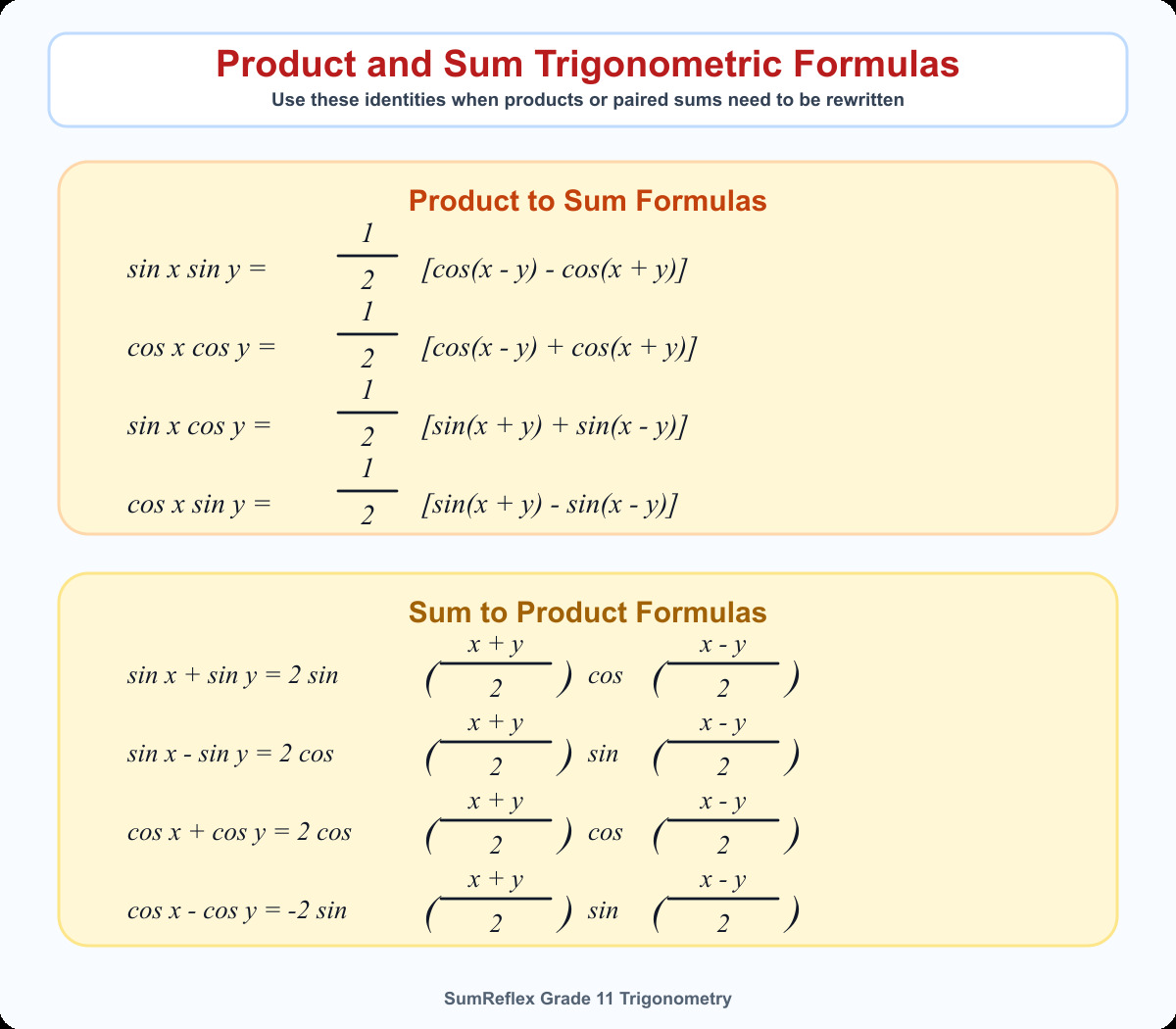
Product-to-sum and sum-to-product formulas are longer, so they are easier to read as a separate formula chart.
Use these identities when a product needs to become a sum, or when a paired sum needs to become a product before simplifying.
How the identity families connect
The quotient identities rewrite tangent and cotangent with sine and cosine. That is useful because many proofs become easier after every term uses only \( \sin \theta \) and \( \cos \theta \).
The reciprocal identities come from flipping a trigonometric ratio. For example, \( \sec \theta \) is the reciprocal of \( \cos \theta \), so \( \sec \theta = \frac{1}{\cos \theta} \) whenever \( \cos \theta \) is not zero.
Half-angle formulas rewrite expressions such as \( \sin\left(\frac{\theta}{2}\right) \), \( \cos\left(\frac{\theta}{2}\right) \), and \( \tan\left(\frac{\theta}{2}\right) \).
Product-to-sum and sum-to-product formulas change products into sums or sums into products. They become more useful after you are comfortable with the exact values in the trigonometrical ratios table.
Example 1: simplify with a Pythagorean identity
Simplify this expression:
\[ \frac{1 - \cos^2 \theta}{\sin \theta} \]
The numerator looks close to the Pythagorean identity. Since \( \sin^2 \theta + \cos^2 \theta = 1 \), subtract \( \cos^2 \theta \) from both sides:
\[ 1 - \cos^2 \theta = \sin^2 \theta \]
Now replace the numerator:
\[ \frac{1 - \cos^2 \theta}{\sin \theta} = \frac{\sin^2 \theta}{\sin \theta} \]
So the simplified expression is \( \sin \theta \), as long as \( \sin \theta \) is not zero in the original denominator.
Example 2: prove an identity without guessing
Prove this identity:
\[ \tan \theta + \cot \theta = \sec \theta \csc \theta \]
Start on the side with the sum, because adding two terms usually gives you something to combine.
\[ \tan \theta + \cot \theta = \frac{\sin \theta}{\cos \theta} + \frac{\cos \theta}{\sin \theta} \]
Use a common denominator:
\[ \frac{\sin^2 \theta + \cos^2 \theta}{\sin \theta \cos \theta} \]
The numerator is 1 by the Pythagorean identity, so the expression becomes:
\[ \frac{1}{\sin \theta \cos \theta} \]
Split the denominator into two reciprocal factors:
\[ \left(\frac{1}{\cos \theta}\right)\left(\frac{1}{\sin \theta}\right) = \sec \theta \csc \theta \]
That matches the right side, so the identity is proved for angles where the original terms are defined.
Example 3: use a double-angle identity
Suppose \( \sin \theta = \frac{3}{5} \) and \( \cos \theta = \frac{4}{5} \). Find \( \sin 2\theta \).
Use the double-angle identity:
\[ \sin 2\theta = 2\sin \theta \cos \theta \]
Substitute the given values:
\[ \sin 2\theta = 2\left(\frac{3}{5}\right)\left(\frac{4}{5}\right) \]
Multiply the numerator and denominator:
\[ \sin 2\theta = \frac{24}{25} \]
The identity saves time because you do not need to find the angle θ first.
How to choose the right identity
When you see \( \sin^2 \theta \) and \( \cos^2 \theta \) together, check whether the Pythagorean identity can turn them into 1.
When tangent, cotangent, secant, or csc creates clutter, rewrite everything with sine and cosine first.
When the problem uses \( 90^\circ - \theta \), think cofunction identities.
When the angle is written as \( a + b \), \( a - b \), or \( 2\theta \), look for sum, difference, or double-angle identities.
When proving an identity, usually change one side only. Pick the side that looks more complicated, then rewrite it step by step until it matches the other side.
Common mistakes
Do not cancel across addition. For example, \( \frac{\sin^2 \theta}{\sin \theta} \) simplifies, but \( \frac{1 + \sin \theta}{\sin \theta} \) does not become 1.
Do not forget restrictions. If the original expression has division by \( \sin \theta \), \( \cos \theta \), or \( \tan \theta \), those denominators cannot be zero.
Do not change an equation into an identity. An identity must be true for all allowed angles, not only for one answer angle.
Do not memorize formulas without knowing their job. Pythagorean identities handle squares, quotient identities handle tangent and cotangent, and reciprocal identities handle secant, cosecant, and cotangent.
Quick practice
1. Rewrite \( \tan \theta \) using sine and cosine. Answer: \( \frac{\sin \theta}{\cos \theta} \).
2. Rewrite \( \sec \theta \) using cosine. Answer: \( \frac{1}{\cos \theta} \).
3. Simplify \( 1 - \sin^2 \theta \). Answer: \( \cos^2 \theta \).
4. Simplify \( \sec^2 \theta - \tan^2 \theta \). Answer: \( 1 \).
5. Fill in the identity: \( \sin(90^\circ - \theta) = \) _____. Answer: \( \cos \theta \).
6. If \( \sin \theta = \frac{5}{13} \) and \( \cos \theta = \frac{12}{13} \), find \( \sin 2\theta \). Answer: \( \frac{120}{169} \).