


Grade 11 trigonometry lesson
Trigonometrical Ratios Table: All Systems, Exact Values, Charts, and Examples
A trigonometrical ratios table helps you quickly find exact sine, cosine, tangent, cotangent, secant, and cosecant values for common angles.
What is a trigonometrical ratios table?
A trigonometrical ratios table is a quick reference table for common angle values.
It tells you the exact value of sin, cos, tan, cot, sec, and cosec for standard angles such as 0°, 30°, 45°, 60°, and 90°.
These values appear again and again in trigonometry, coordinate geometry, physics, vectors, waves, circular motion, and calculus. Once you know the table, many problems become faster because you do not need a calculator for every common angle.
The same angle can be written in different systems. For example, 60° in the sexagesimal system is π/3 in the circular system. The angle is the same; only the unit changes.
Printable sexagesimal system chart
The sexagesimal system measures angles in degrees. It is the system most students learn first.
Use this chart when a question gives angles like 30°, 45°, 60°, or 90°.
The same chart is also listed in the Printable Geometry Charts section.
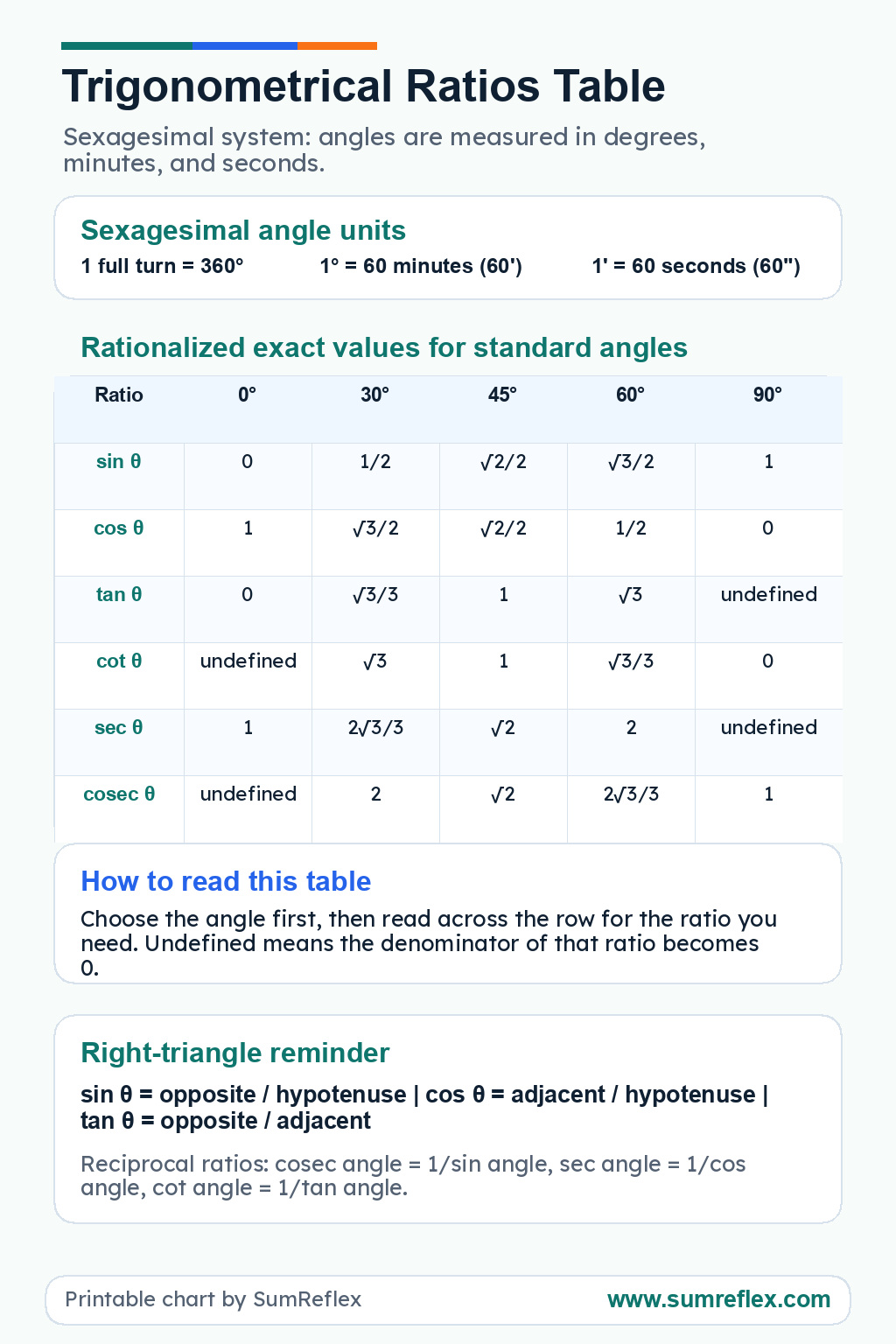
Printable non-rationalized values chart
Non-rationalized values are exact values that still have a square root in the denominator.
For example, tan 30° can be written as 1/√3. The rationalized form is √3/3. Both mean the same number.
Strictly speaking, non-rationalized form is not an angle measuring system. It is a way of writing exact trigonometric values. Students still see it in many textbooks, so it is useful to recognize.
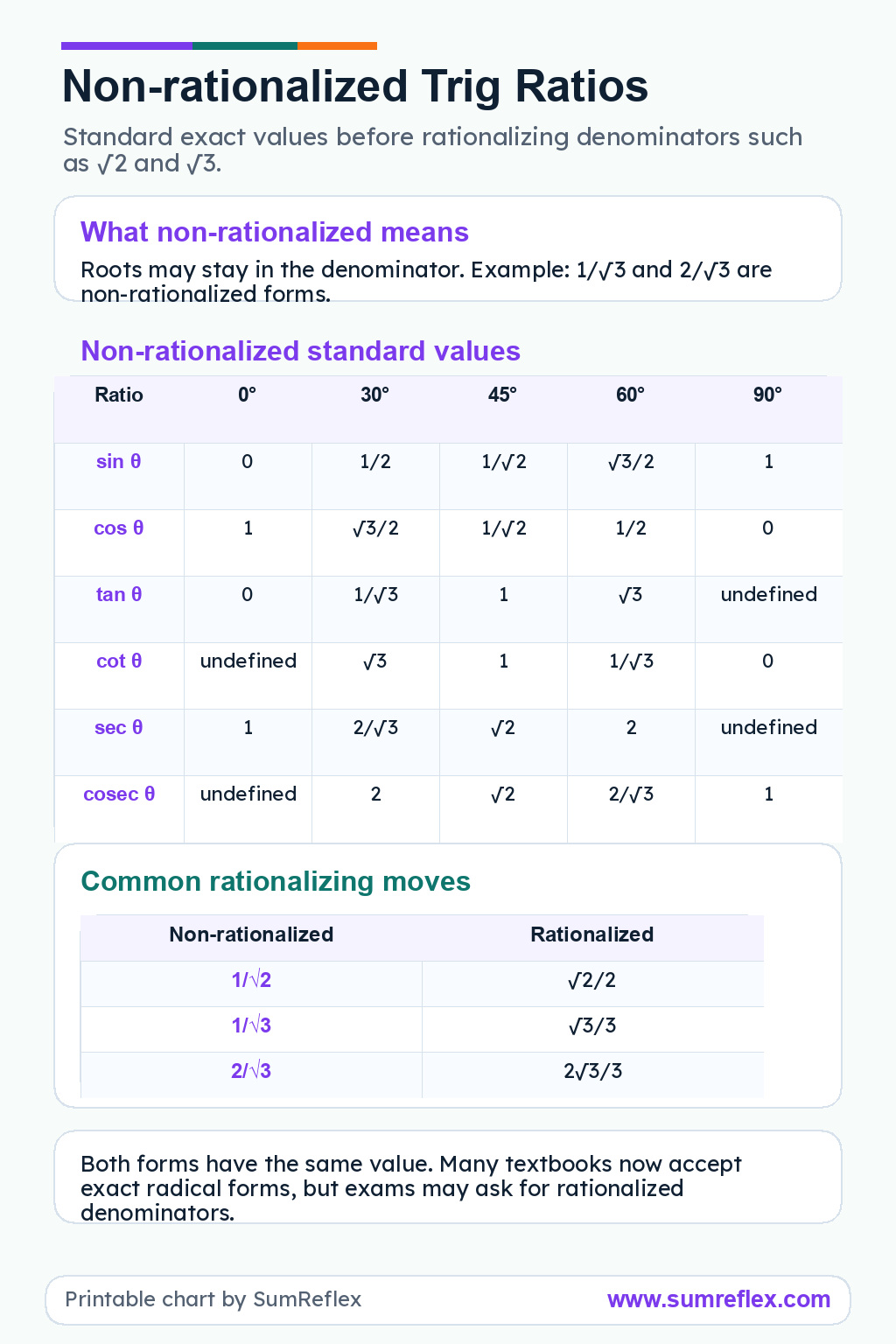
Printable circular system chart
The circular system measures angles in radians.
Radians are common in higher trigonometry because circles, arcs, graphs, and formulas work more naturally with radian measure.
Use this chart when a question gives angles like π/6, π/4, π/3, or π/2.
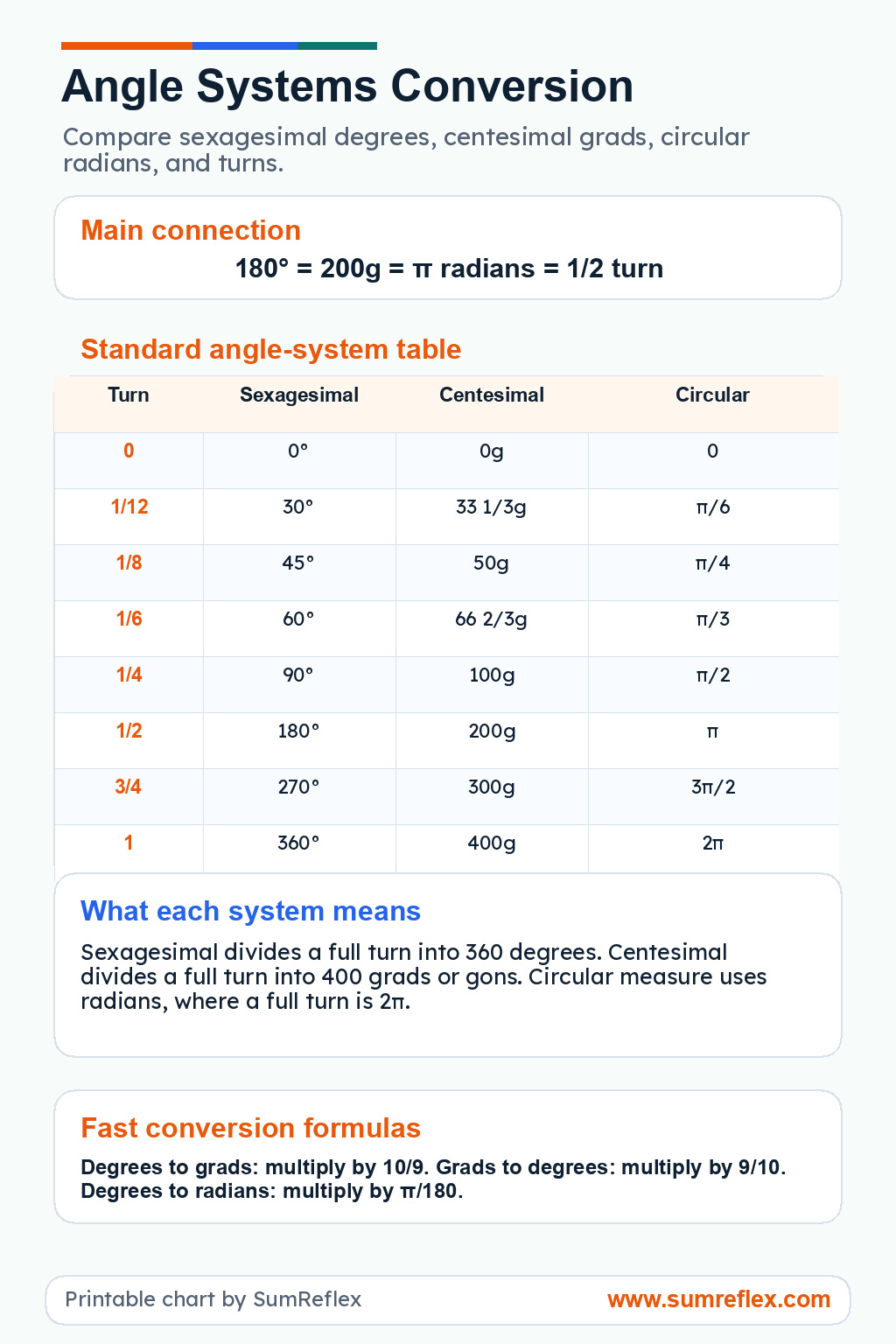
Printable angle systems conversion chart
Different books and subjects may write the same angle in different systems.
This chart compares sexagesimal degrees, circular radians, centesimal grads, turns, and decimal degrees.
If you are new to radian measure, review degrees and radians before using the circular-system table heavily.
The six trigonometrical ratios
In a right triangle, choose one acute angle first. The side across from that angle is the opposite side. The side beside that angle is the adjacent side. The longest side, across from the right angle, is the hypotenuse.
sin θ = opposite / hypotenuse. Sine compares the height-like side to the hypotenuse.
cos θ = adjacent / hypotenuse. Cosine compares the base-like side to the hypotenuse.
tan θ = opposite / adjacent. Tangent compares the opposite side to the adjacent side.
cot θ = adjacent / opposite. Cotangent is the reciprocal of tangent.
sec θ = hypotenuse / adjacent. Secant is the reciprocal of cosine.
cosec θ = hypotenuse / opposite. Cosecant, often written csc in some books, is the reciprocal of sine.
Sexagesimal system: degrees, minutes, and seconds
The sexagesimal system splits a full turn into 360 degrees.
One degree is written as 1°. One degree has 60 minutes, written 60′. One minute has 60 seconds, written 60″.
So 30° means 30 degrees, while 30° 15′ means 30 degrees and 15 minutes.
Most school trigonometry tables use the sexagesimal system because it is simple to read and common in geometry diagrams, navigation, maps, and angle measurement with a protractor.
The key standard angles in the basic table are 0°, 30°, 45°, 60°, and 90°. Later, the same values are reused around the full circle for 120°, 135°, 150°, and other related angles.
Circular system: radians
The circular system measures angle turn using radians.
The main conversion fact is 180° = π radians. A full turn is 360° = 2π radians.
The common standard angles match like this: 30° = π/6, 45° = π/4, 60° = π/3, and 90° = π/2.
Radians are especially important when working with the unit circle, trigonometric graphs, arc length, sector area, angular speed, and advanced formulas.
If an exam says to give the exact value of sin π/6, read it exactly the same way as sin 30°. The answer is 1/2.
Centesimal system: grads or gons
The centesimal system splits a full turn into 400 grads, also called gons.
A right angle is 100g, a straight angle is 200g, and a full turn is 400g.
This system is less common in school trigonometry, but it appears in surveying and some technical measurement settings.
The conversion from degrees to grads is grads = degrees × 10/9. For example, 90° × 10/9 = 100g.
The conversion from grads to degrees is degrees = grads × 9/10. For example, 50g × 9/10 = 45°.
Other angle formats
Turns measure a full rotation as 1 turn. So 1/2 turn = 180°, 1/4 turn = 90°, and 1/6 turn = 60°.
Decimal degrees write parts of a degree with decimals. For example, 30.5° means 30 degrees and half a degree. Since half a degree is 30 minutes, 30.5° = 30° 30′.
DMS notation means degrees, minutes, and seconds, such as 42° 18′ 30″. This is still part of the sexagesimal system.
Mil angle units are used in some technical and military settings. They are not usually needed for school trigonometrical ratio tables.
For regular school work, the most important systems are degrees and radians. Grads, turns, decimal degrees, and DMS help you understand how angle measurement can be written in different ways.
How to remember the standard values
For sine values from 0° to 90°, use this pattern: √0/2, √1/2, √2/2, √3/2, √4/2. This gives 0, 1/2, √2/2, √3/2, and 1.
For cosine, reverse the sine row. Cos 0° = 1, cos 30° = √3/2, cos 45° = √2/2, cos 60° = 1/2, and cos 90° = 0.
For tangent, use tan θ = sin θ / cos θ. That gives 0, √3/3, 1, √3, and undefined for 0°, 30°, 45°, 60°, and 90°.
The reciprocal ratios come from flipping the matching ratio: cosec is 1/sin, sec is 1/cos, and cot is 1/tan.
Do not try to memorize every row separately at first. Learn sine and cosine, then build tangent and the reciprocal ratios from them.
Example 1: find sin 30°
Problem: Find the exact value of sin 30°.
From the standard table, sin 30° = 1/2.
Answer: sin 30° = 1/2.
Example 2: find cos 60°
Problem: Find the exact value of cos 60°.
In the sexagesimal table, move to the 60° column and the cos row.
Answer: cos 60° = 1/2.
Example 3: find tan 45°
Problem: Find tan 45°.
At 45°, sine and cosine are equal: sin 45° = √2/2 and cos 45° = √2/2.
So tan 45° = sin 45° / cos 45° = 1.
Answer: tan 45° = 1.
Example 4: find sec 60°
Problem: Find sec 60°.
Secant is the reciprocal of cosine, so sec 60° = 1 / cos 60°.
Since cos 60° = 1/2, sec 60° = 1 ÷ 1/2 = 2.
Answer: sec 60° = 2.
Example 5: find cosec 30°
Problem: Find cosec 30°.
Cosecant is the reciprocal of sine, so cosec 30° = 1 / sin 30°.
Since sin 30° = 1/2, cosec 30° = 2.
Answer: cosec 30° = 2.
Example 6: find cot 60°
Problem: Find cot 60°.
Cotangent is the reciprocal of tangent.
Since tan 60° = √3, cot 60° = 1/√3.
If the answer must be rationalized, multiply top and bottom by √3: 1/√3 = √3/3.
Answer: cot 60° = 1/√3 or √3/3.
Example 7: convert 60° to radians
Problem: Convert 60° to radians.
Use degrees × π/180.
60° × π/180 = 60π/180 = π/3.
Answer: 60° = π/3 radians.
Example 8: convert π/4 to degrees
Problem: Convert π/4 radians to degrees.
Use radians × 180/π.
π/4 × 180/π = 180/4 = 45.
Answer: π/4 radians = 45°.
Example 9: find sin π/6
Problem: Find sin π/6.
First match the circular-system angle with its degree value. π/6 radians = 30°.
From the table, sin 30° = 1/2.
Answer: sin π/6 = 1/2.
Example 10: find cos π/3
Problem: Find cos π/3.
π/3 radians = 60°.
From the standard table, cos 60° = 1/2.
Answer: cos π/3 = 1/2.
Example 11: rationalize 1/√3
Problem: Write 1/√3 with a rationalized denominator.
Multiply numerator and denominator by √3.
1/√3 × √3/√3 = √3/3.
Answer: 1/√3 = √3/3.
Example 12: rationalize 2/√3
Problem: Write 2/√3 with a rationalized denominator.
Multiply numerator and denominator by √3.
2/√3 × √3/√3 = 2√3/3.
Answer: 2/√3 = 2√3/3.
Example 13: convert 45° to grads
Problem: Convert 45° into the centesimal system.
Use grads = degrees × 10/9.
45 × 10/9 = 50.
Answer: 45° = 50g.
Example 14: convert 0.25 turns to degrees
Problem: Convert 0.25 turns to degrees.
One full turn is 360°.
0.25 × 360° = 90°.
Answer: 0.25 turns = 90°.
Example 15: use a trig ratio in a triangle
Problem: A right triangle has hypotenuse 10 cm and an angle of 30°. Find the side opposite the 30° angle.
Use sin θ = opposite / hypotenuse.
sin 30° = opposite / 10. Since sin 30° = 1/2, we get 1/2 = opposite / 10.
Opposite = 10 × 1/2 = 5.
Answer: the opposite side is 5 cm.
Example 16: identify undefined values
Problem: Why are tan 90° and sec 90° undefined?
tan θ = sin θ / cos θ. At 90°, cos 90° = 0, so tan 90° would divide by 0.
sec θ = 1 / cos θ. At 90°, sec 90° = 1/0, which is also division by 0.
Answer: tan 90° and sec 90° are undefined because they require division by zero.
Common mistakes
Do not mix degree and radian labels. 60° and π/3 are the same angle, but 60 and π/3 are not the same written unit.
Do not write tan 90° = 0. It is undefined because cos 90° = 0.
Do not write cot 0° = 0. Cot 0° is undefined because tan 0° = 0 and cot is 1/tan.
Do not assume non-rationalized and rationalized answers are different values. 1/√3 and √3/3 are equal.
Do not forget that cosec and csc mean the same reciprocal ratio of sine.
Quick practice
1. Find sin 60°. Answer: √3/2.
2. Find cos 30°. Answer: √3/2.
3. Find tan 30°. Answer: 1/√3 or √3/3.
4. Find cot 45°. Answer: 1.
5. Find sec 0°. Answer: 1.
6. Find cosec 90°. Answer: 1.
7. Convert 90° to radians. Answer: π/2.
8. Convert π/6 to degrees. Answer: 30°.
9. Convert 100g to degrees. Answer: 90°.
10. Convert 1/2 turn to degrees. Answer: 180°.
11. Which values are undefined: tan 90°, cot 0°, sin 0°, or cos 90°? Answer: tan 90° and cot 0° are undefined. Sin 0° and cos 90° are both 0.