



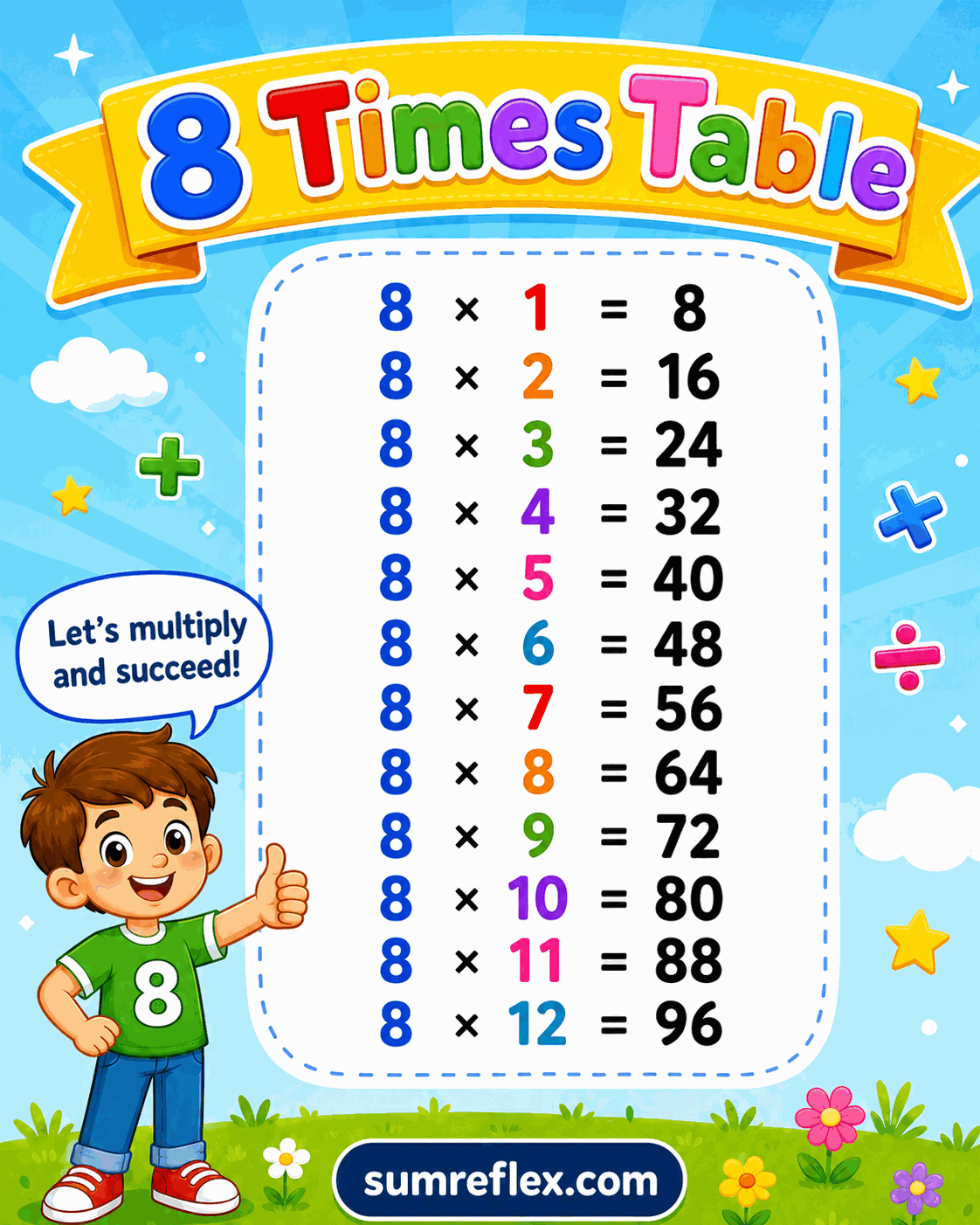
Eight table strategy guide
Using doubled fours and repeated doubling for the 8 table
Eight is double four
A practical way to learn the 8 table is to connect it to the 4 table. If 4 x 7 is 28, then 8 x 7 is double 28, which is 56. If 4 x 9 is 36, then 8 x 9 is double 36, which is 72. This relationship gives students a support row instead of asking them to memorize every product alone.
The 4 times table chart can sit beside this page during early practice. Students can compare the same factor in both rows and see the doubling clearly.
Repeated doubling builds the product
Eight is 2 x 2 x 2, so students can also double three times. For 8 x 6, start with 6, double to 12, double to 24, and double to 48. That method is dependable because each step is small even though the final product is larger.
Students should say the steps out loud at first. If they stop at 24, they have doubled only twice. The chart helps them see that one more doubling is needed.
Arrays keep the row grounded
Rows of eight can look long, but they are useful for showing the meaning of the fact. Eight rows of five, five rows of eight, or two blocks of four in each row can all represent the same product. The picture gives students a way to defend the answer.
For 8 x 8, the array is a square with 64 units. Calling attention to that square fact gives students a strong anchor inside the row.
Large products need reasonableness checks
The 8 table reaches products such as 56, 64, 72, 80, 88, and 96. Students should estimate before checking. Eight times 9 should be less than 10 x 9 and greater than 5 x 9. This range tells them that 72 is reasonable and that 27 is not.
Reasonableness checks are especially helpful before mixed multiplication practice, where students may confuse eights with sixes or sevens.
Where skip counting fits
The skip count by 8 chart helps students hear the product sequence. This times-table page ties those same numbers to facts. Use the skip-count page for movement and this page for factor-product recall.
A quick challenge for the 8 row
Ask students to solve one fact three ways: from the 4 table, through repeated doubling, and with an array. For 8 x 7, all three routes should reach 56. Multiple routes make the product easier to trust and easier to remember.
The 8 row also benefits from anchor facts. Eight times 5 is 40, eight times 10 is 80, and eight times 8 is 64. Students can count forward or backward from those anchors instead of starting at 8 every time.
For written work, have learners show the doubling path beside the chart. Eight times 9 can be written as 9, 18, 36, 72. The intermediate values reveal whether the student skipped a doubling step.
The divisible by 8 chart can be introduced later when students are checking larger numbers. This times-table page gives the early multiples that make the later rule less abstract.
For a stronger practice routine, choose one 8 fact and ask students to locate it between two easier products. Eight times 7 is between 8 x 5 = 40 and 8 x 10 = 80, so the answer should be somewhere in that range. Then they can use doubled fours or repeated doubling to land on 56.
Students can also compare 8 x 6 with 6 x 8 once the 6 table has been reviewed. The chart shows the same product, 48, while the story can be six groups of eight or eight groups of six. This reinforces the commutative property through a familiar fact.
Keep the 8 row practice short if students are working mentally. The products grow quickly, so two well-explained facts are often better than a long rushed drill.