



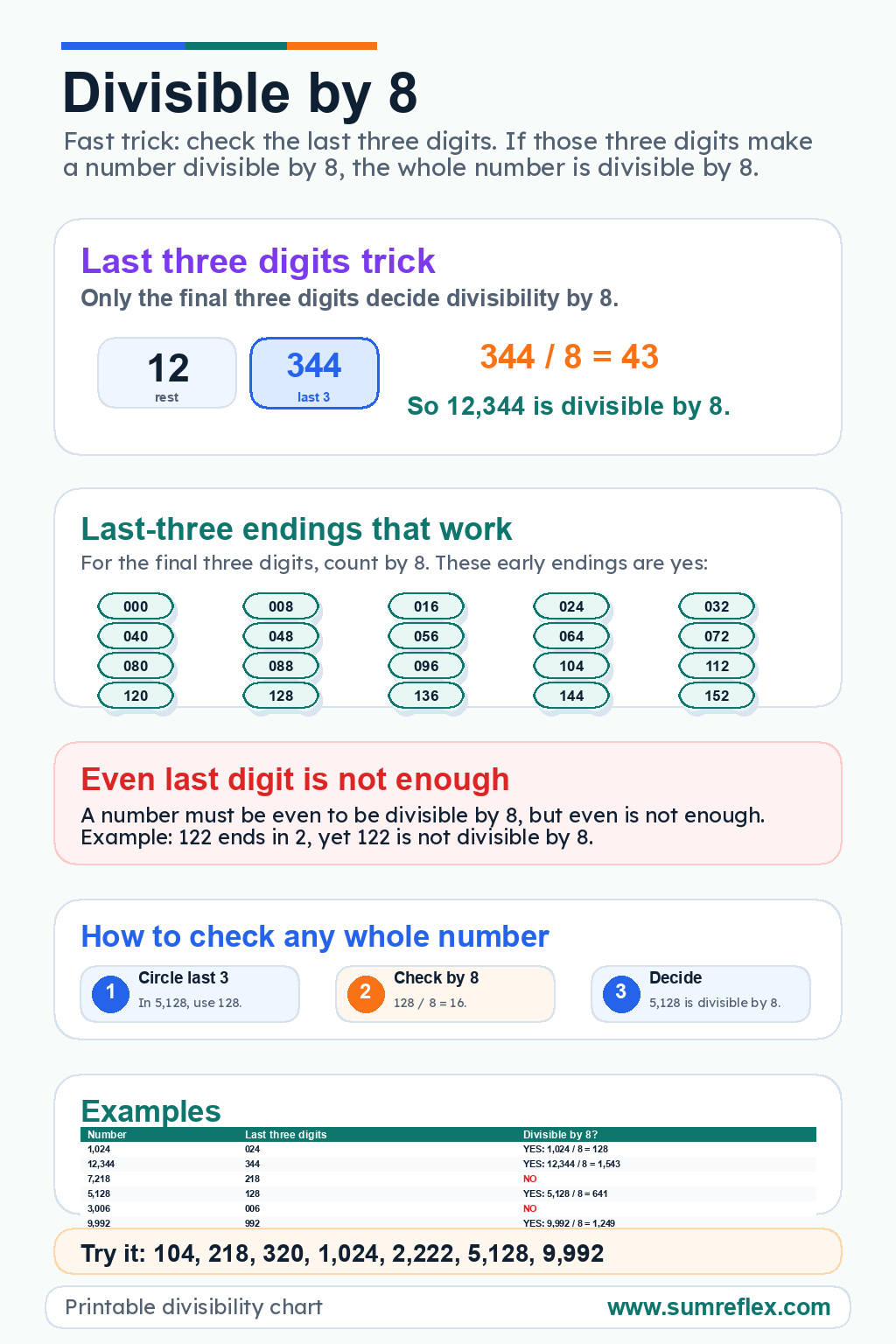
Divisibility by 8 explanation notes
Teaching the divisible by 8 chart through the final three digits
The final three digits as the real test area
The divisible by 8 chart extends a place-value idea students may already know from divisibility by 4. For 8, the final three digits decide the answer. In 42,136, the test number is 136. Since 136 divides evenly by 8, the whole number passes. The reason is that every thousand is divisible by 8, so the thousands and larger places do not change the remainder. Students should hear that explanation, because otherwise the rule can feel like a random demand to ignore most of the number.
This chart works well after learners understand the divisible by 4 chart. The new rule is not the same, but the thinking is related: isolate the ending block that matters, test that smaller block, and apply the result to the original number. The difference is that 8 needs three digits, not two.
Helping students break the rule into manageable pieces
The last-three-digits test can feel heavy when the ending is not familiar. A useful routine is to box the final three digits, rewrite them without the rest of the number, and then divide that smaller number by 8. If the boxed number is 000, the full number passes. If the boxed number is 024, students should read it as 24 and check whether 24 is divisible by 8. Leading zeros do not make the rule harder; they simply shrink the number being tested.
The divisible by 8 lesson can reinforce the method with step-by-step examples. During chart practice, ask students to write only the boxed ending and a short division fact, such as 136 = 8 x 17. That keeps the work compact while still proving the decision.
Why even endings are only the doorway
A number divisible by 8 must be even, so an odd last digit is a fast no. The problem is that many even endings still fail. Numbers ending in 014, 126, 222, or 390 are even, but the final three digits do not divide by 8. This is where the chart earns its place: it stops students from treating evenness as a complete answer.
To build that distinction, give students pairs with the same last digit but different final three-digit blocks. For example, 1,208 passes because 208 is divisible by 8, while 1,218 fails even though it also ends in 8. A few pairs like that teach more than a long list of successful examples. The learner sees that the whole final block matters, not just the final digit.
Ways to keep the 8 rule connected
The chart is useful in factor trees, powers-of-two discussions, measurement conversions, and mental checks before division. Since 8 is 2 x 2 x 2, students can connect the rule to repeated factors of 2 without losing the fast place-value shortcut. The Prime Factorization Calculator is a helpful follow-up when students need to see where the factor 8 sits inside a larger number breakdown.
For classroom review, use the printable after a short set of divisibility by 2 and 4 questions. Students can then explain why the 8 test is more demanding. The comparison makes the rule feel like part of a family rather than a standalone trick. When learners can say which ending block each rule checks, they are ready to choose the right chart during mixed number work.