



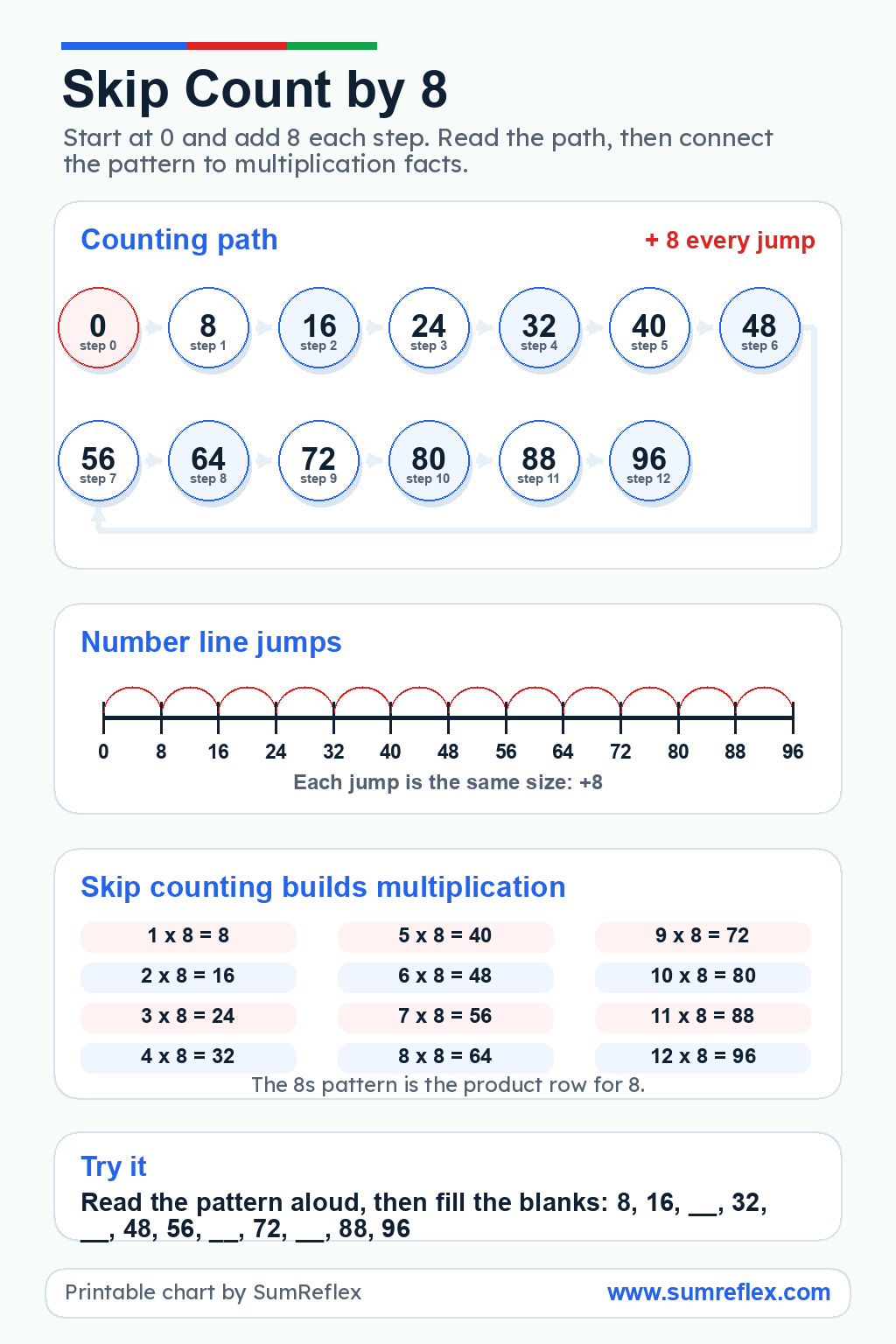
Eights counting guide
Using doubled fours to make the eights sequence easier
Eight can be built from a familiar row
The eights sequence can look heavy at first: 8, 16, 24, 32, 40, 48, and beyond. A helpful way to make it less heavy is to connect it to fours. Since 8 is double 4, every eight fact is double the matching four fact. Four groups of 8 are 32 because four groups of 4 are 16 and 16 doubled is 32.
This makes the skip count by 4 chart a useful stepping stone. Students can compare the same group count on both pages and see that the eights total is twice as large.
Arrays help students explain products
Rows of eight dots or tiles give students a way to prove the count. One row has 8, two rows have 16, and three rows have 24. If the row gets too long for a page, split each group of eight into two groups of four. The total stays the same, but the structure becomes easier to see.
This is especially helpful for facts such as 7 x 8 and 8 x 8. Students can use an array to reason toward 56 or 64 instead of guessing from memory.
Large jumps still have a constant size
The number line shows that the row is not speeding up or slowing down. The jump from 0 to 8 is the same size as the jump from 64 to 72. Students who see that regularity are less likely to treat the later products as a separate list.
A good check is to ask for one number before and one number after a given product. Around 48, the previous eights count is 40 and the next one is 56. That neighbor work builds a stronger mental map of the row.
Divisibility uses the same family of numbers
The skip-count chart gives the early list of multiples. The divisible by 8 chart later helps students test larger numbers by checking the final three digits. That rule can feel abstract unless students already know that 8, 16, 24, 32, and 40 are part of one repeated pattern.
Use the printable as a foundation page before moving to the divisibility shortcut. The chart answers, "What are the early multiples?" The later rule answers, "Does this larger number belong with them?"
Fact review after the count is understood
For direct multiplication review, open the 8 times table chart. Keep this skip-count page available for students who need to rebuild a product by jumps, doubles, or arrays. That support is especially useful before mixed multiplication practice.
A strong review routine is to ask students to solve one eights fact in two ways. For example, 6 x 8 can be counted as six jumps of 8 or found by doubling 6 x 4. Two methods give students a chance to catch errors and explain the structure of the answer.
For challenge work, ask students to compare 8 x 9 and 9 x 8 after they use the chart. The total is the same, but the story can be nine groups of eight or eight groups of nine. That comparison helps connect skip counting with the commutative property without needing a separate lecture.
Because the products grow quickly, students should also practice estimating whether an answer is reasonable. A claimed answer of 8 x 7 = 42 should feel too small when 6 x 8 is already 48.