



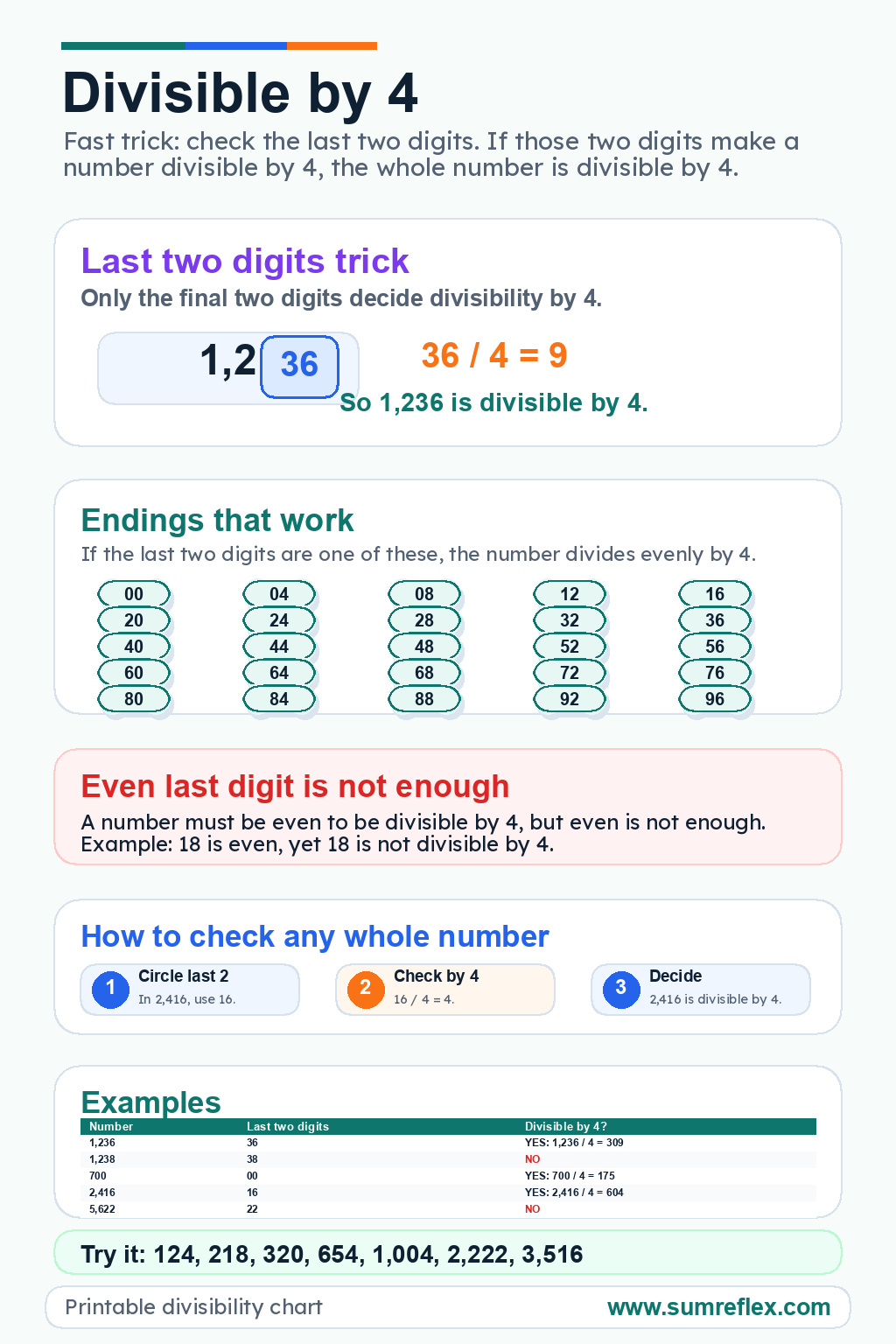
Divisibility by 4 reference notes
Teaching the divisible by 4 chart without reducing it to an even-number shortcut
Why only the final pair matters
The divisible by 4 chart gives students a useful upgrade from the simple even-ending test. Instead of checking one digit, they inspect the final two digits as a separate number. In 3,728, the decision comes from 28. Since 28 divides evenly by 4, the full number does too. The earlier digits do not need to be divided because every hundred is already divisible by 4. That place-value reason is worth saying aloud so the chart feels logical rather than magical.
This page is especially helpful after students know the divisible by 2 chart. Divisibility by 4 always produces an even number, but the reverse is not true. The chart shows the extra demand: the number must have a final two-digit ending that belongs to the 4 pattern. That distinction keeps learners from calling every even number divisible by 4.
Building the last-two-digits routine
A practical classroom routine starts with boxing the final two digits. Students should rewrite that pair on its own, then decide whether it is divisible by 4. For 6,316, the boxed ending is 16, so the number passes. For 6,318, the boxed ending is 18, so the number fails even though the last digit is even. The box-and-test habit prevents learners from looking at too much information or stopping too early.
When the page is used beside the divisible by 4 lesson, ask students to write a complete reason after each decision. A strong answer names the final two digits, not just the final digit. This is a small writing demand, but it reveals whether the rule was actually used. It also prepares students to explain factor checks during longer division or fraction work.
A quick way to catch false even answers
The chart is most valuable when students make near-miss errors. Numbers ending in 12, 24, 48, 76, and 00 pass easily, so learners may start to believe any even ending is enough. Put counterexamples near the chart: 22, 38, 54, 66, and 98 all end with even digits, but none divide evenly by 4. Seeing those failures next to the accepted endings builds a sharper mental filter.
It also helps to compare this rule with divisibility by 8. The 8 rule asks for three ending digits, which can feel like a larger version of this same idea. Students who can defend the last-two-digits test here will have an easier time with the divisible by 8 chart, because they already understand that place value can hide most of the number from the divisibility decision.
Connections after learners trust the rule
After students can use the chart accurately, the rule becomes a fast checkpoint for factors and multiples. It helps with identifying common factors, simplifying fractions, checking area dimensions, and spotting numbers that fit into groups of four. The Greatest Common Factor Calculator can support a full comparison after students try the mental test, but the printable keeps the first decision visible on paper.
For practice, mix numbers that end in the same final digit but have different final pairs. A set like 124, 134, 144, and 154 forces learners to inspect the pair instead of reacting to the 4. Another set such as 320, 420, 520, and 620 shows that ending in 20 always passes, even when the hundreds digit changes. That is the point of the chart: students learn which part of the number deserves attention.