



Groups of four guide
Using fours to connect pairs, arrays, and multiplication
Four is often two pairs
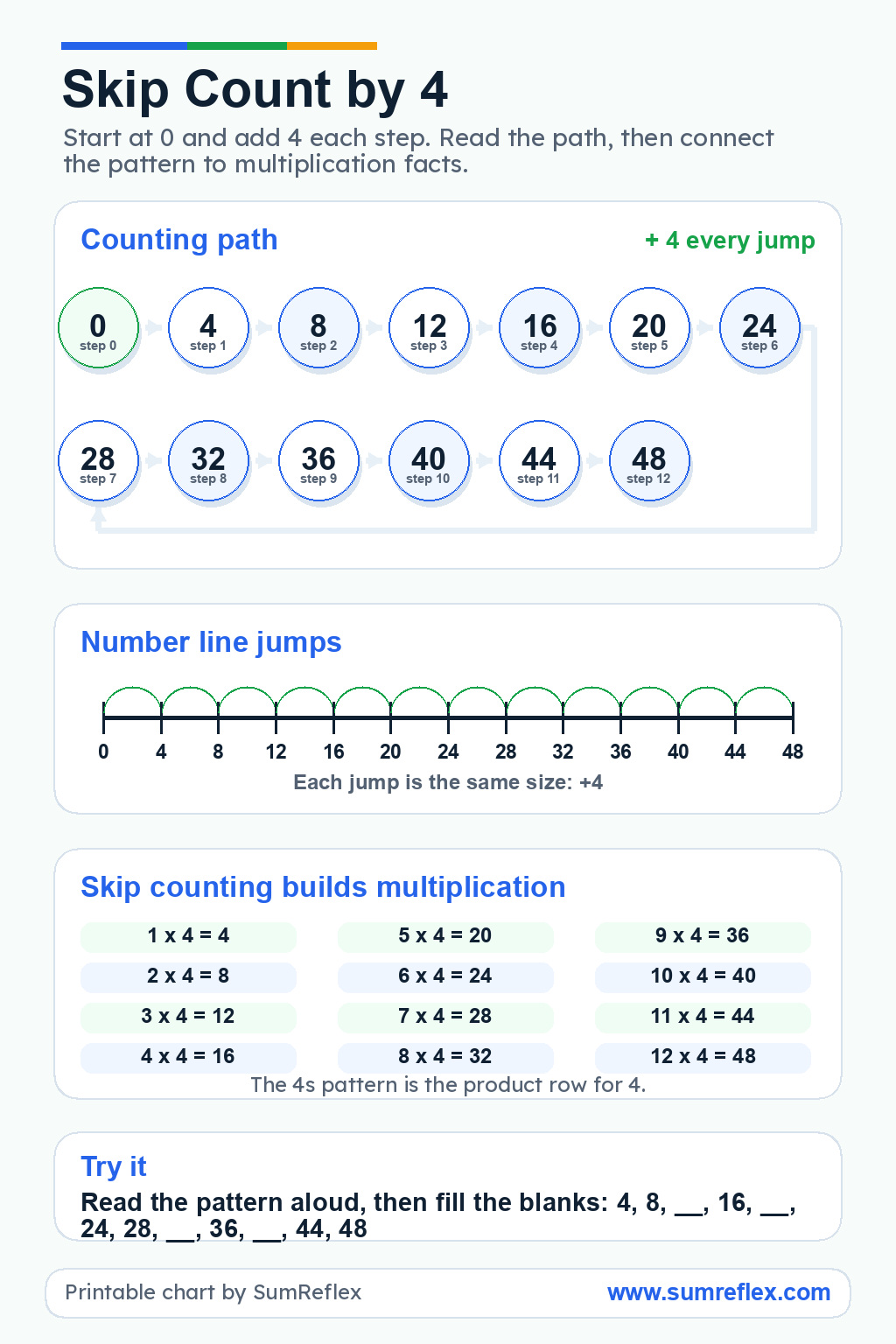
A strong way to introduce counting by 4 is to build each group as two pairs. Four wheels on a toy car, four legs on a chair, four corners on a paper, and four sides on many familiar shapes all give students a concrete group to count. The chart then records the totals: 4, 8, 12, 16, 20, and so on.
This pairing idea keeps the sequence connected to earlier twos work. If learners can count by 2, they can begin to see a four-count as every other landing in a twos pattern. The skip count by 2 chart is a useful companion when a student needs that intermediate step.
Arrays make the totals easier to defend
Students should not only say the fours sequence; they should be able to show it. Draw rows with four dots in each row, or use tiles to build groups of 4. After one row there are 4 dots. After two rows there are 8. After three rows there are 12. The chart gives students a place to check the running total.
This visual approach matters because 4 x 7 can be interpreted as seven groups of four rather than a fact floating by itself. If a student forgets 28, the array gives a way to rebuild the answer.
The pattern has several entrances
Some students remember 4, 8, 12, 16 by rhythm. Others prefer doubling. Since 4 is double 2, the fact 6 x 4 can be found by doubling 6 x 2. Twelve doubled is 24. Students who know their twos can use that relationship while the fours facts are still becoming automatic.
Another entrance is the square-number moment at 4 x 4 = 16. Calling attention to familiar facts inside the row gives students anchors. They can count forward or backward from an anchor instead of starting at 4 every time.
Equal jumps prevent counting-by-one drift
On the number line, every movement has the same size. That is the point to emphasize when students are tempted to count one by one under their breath. The chart shows that 16 to 20 is the same jump size as 32 to 36. The values are larger, but the movement is still plus 4.
Cover one landing point and ask students to use the point before and after it. If 24 and 32 are visible, the hidden value between them is 28 because it is four away from each neighbor.
From multiples to a divisibility check
Skip counting lists the multiples of 4. Later, students can test whether a larger whole number belongs to that list by using the divisible by 4 chart. That page looks at the last two digits, but the reason the test works is still tied to multiples of four.
For young learners, keep the language simple: if a number can be made from exact groups of 4, it is in the fours family. The chart gives the first visible stretch of that family.
Where the 4 times table fits
The 4 times table chart is the natural next reference when students are ready to read the row as multiplication facts. This skip-count chart is still helpful beside it because it lets students recover a forgotten product by moving through equal jumps.
A short routine for practice
Read the sequence forward once, then begin from 20 and continue to 48. After that, work backward from 48 to 24. Starting in the middle is harder than reciting from 0, and it reveals whether students understand the step size well enough to move flexibly.