



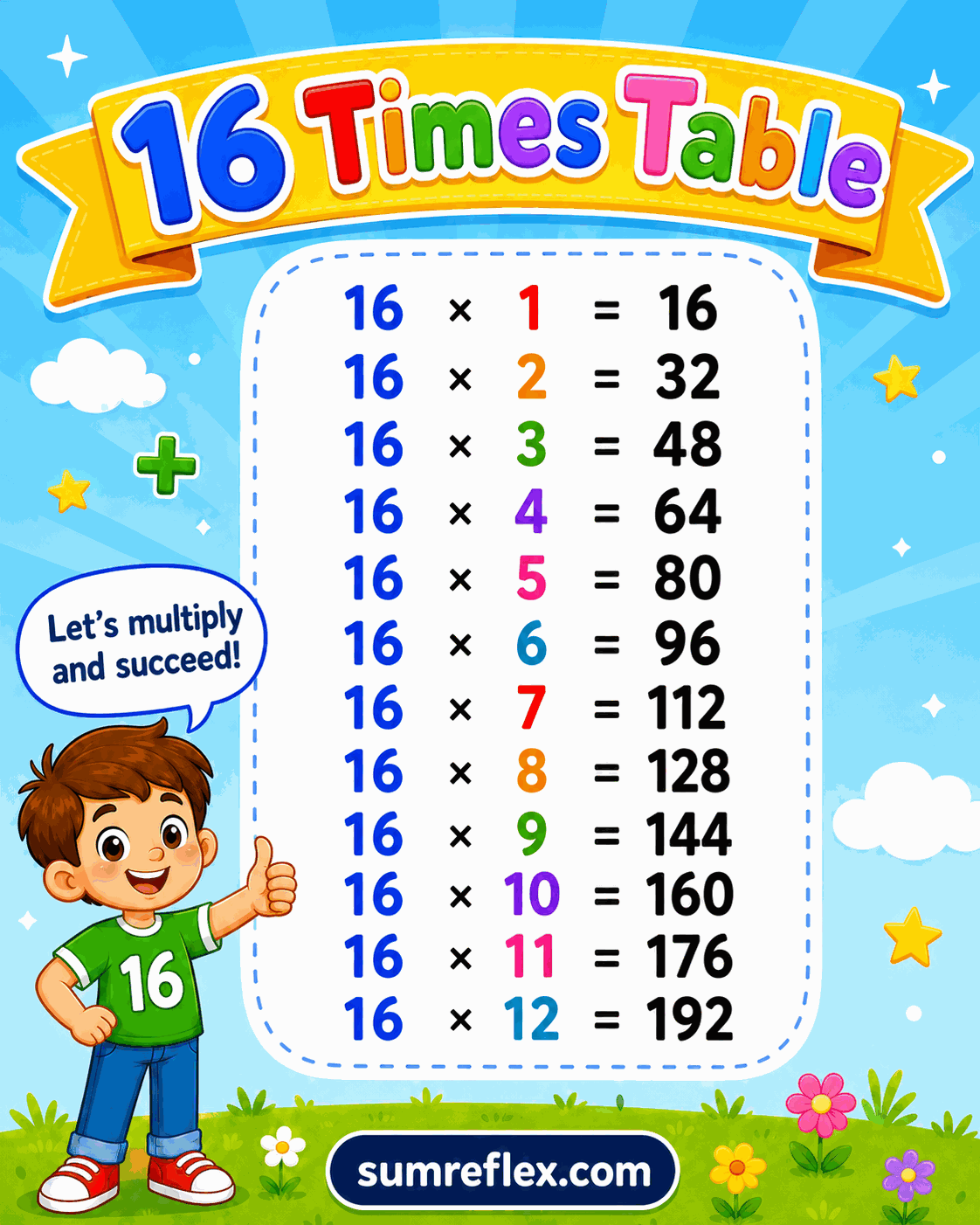
Sixteen table strategy guide
Using repeated doubling to understand the 16 table
Sixteen is four doublings of one group
The 16 table has a special structure because 16 equals 2 x 2 x 2 x 2. To find 16 x 5, a student can begin with 5, double to 10, double to 20, double to 40, and double one more time to reach 80. That sequence may sound longer than a memorized fact, but every step is simple and defensible.
This repeated-doubling route is especially helpful for students who like patterns but do not yet remember the larger row. The chart gives the final values, while the doubling steps explain how those values can be rebuilt.
The 8 table is the closest stepping stone
Another practical route is to use the 8 table and double once. If 8 x 9 is 72, then 16 x 9 is 144. If 8 x 12 is 96, then 16 x 12 is 192. This approach cuts the number of steps and connects the row to a table many students have already practiced.
The 8 times table chart can sit beside this page during early review. Students can read a product from the 8 row, double it, and then verify it on the 16 row.
Place value matters once products pass 100
The 16 row moves into three-digit products quickly. That makes it useful for teaching careful place-value checks. Sixteen times 7 is 112, not 102 or 172. Students should estimate before checking: the answer must be greater than 10 x 7 and less than 20 x 7.
Have learners write a rough range before they use the chart. For 16 x 11, the answer should be between 110 and 220. The exact value, 176, fits that range. This habit catches many unrealistic answers before the chart is consulted.
A power-of-two conversation for older students
Sixteen is also connected to powers of two, area models, computer memory language, and repeated halving. Students do not need all of that context at once, but the row is a useful doorway into the idea that some numbers have deep doubling structure.
For divisibility work, the divisible by 8 chart provides a related check for a smaller power of two. The 16 table itself shows multiples built by multiplication, while divisibility pages ask whether a number belongs to a related multiple family.
How to practice this chart
Use three columns: factor, doubling path, final product. For factor 6, students write 6, 12, 24, 48, 96, then check 16 x 6 = 96. For factor 10, they write 10, 20, 40, 80, 160. The visible path slows the work enough to prevent random guessing.
Once the row is familiar, students can use the 1 to 20 times table chart for mixed review. This single-page chart stays useful when the goal is to understand why the 16 products grow the way they do.
For a quick oral check, ask students to move backward from a product. If 16 x 8 is 128, half of 128 is 64, half of 64 is 32, half of 32 is 16, and half of 16 is 8. The reverse path confirms the original factor and makes the doubling structure visible from both directions.
Why this row builds mental endurance
The 16 table asks students to hold several steps without losing the original factor. That makes it good mental-math training. Keep the sessions short and precise: one or two facts with full explanation are more valuable than a rushed row of copied products.
Accuracy comes first.