



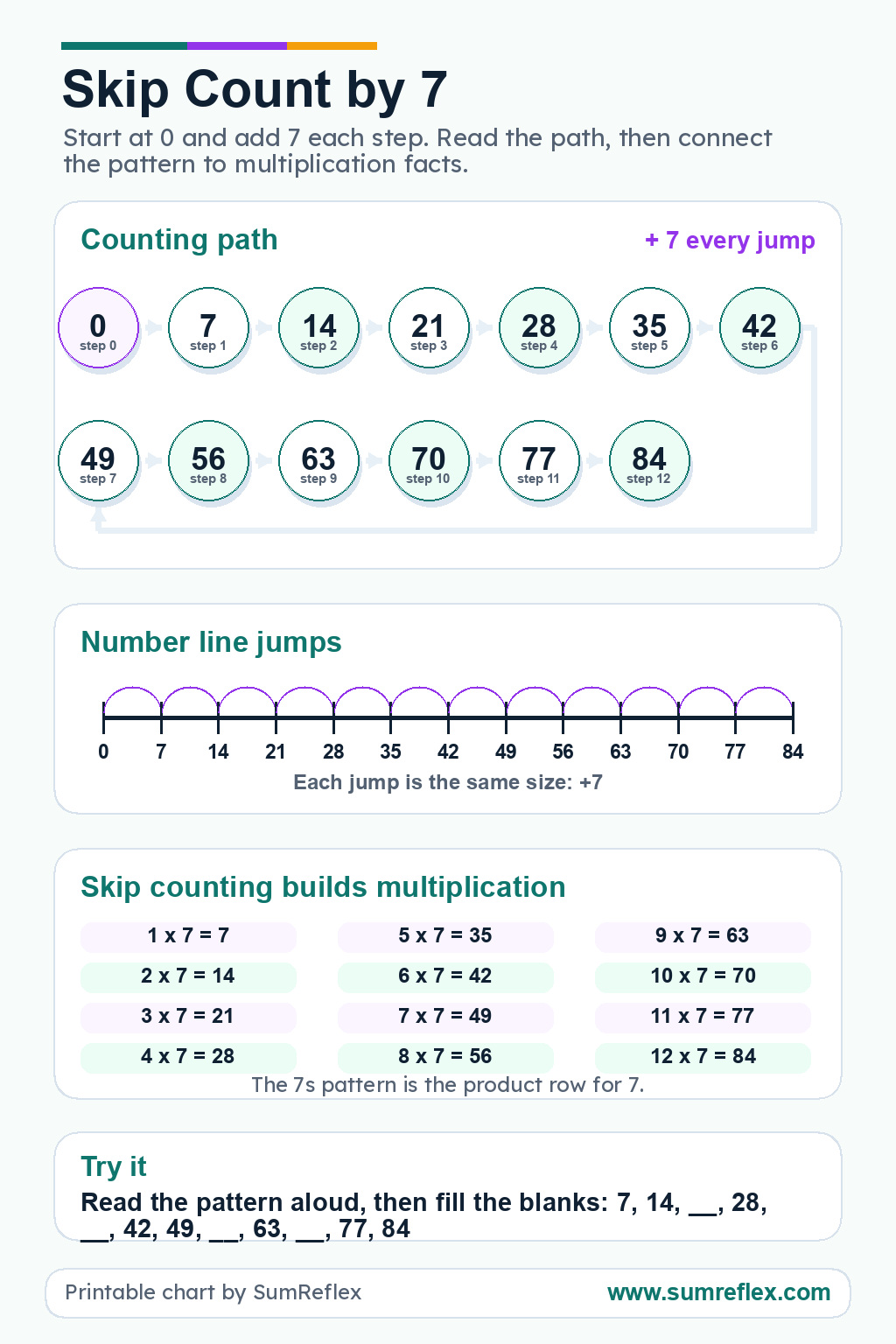
Sevens counting guide
Learning the sevens pattern through weeks and equal jumps
A week gives seven a real anchor
Seven is not as visually simple as two shoes, five fingers, or ten fingers, so students benefit from a familiar context. Weeks are the best starting point: 1 week is 7 days, 2 weeks are 14 days, 3 weeks are 21 days, and 4 weeks are 28 days. The chart turns that calendar idea into a number pattern.
If students need the weekly order itself, the days of the week chart can support the calendar side. This sevens chart focuses on total days when equal groups of seven are counted.
Calendar questions also make the count feel useful. Ask how many days are in 6 weeks, how many days are in 9 weeks, or how many days pass during 12 full weeks. Students can point through the chart while still understanding that each landing represents another complete week.
The row needs deliberate landmarks
The sevens pattern often needs more intentional practice than the twos, fives, or tens. Pick a few landmarks and build from them. Seven times five is 35 because five weeks have 35 days. Seven times ten is 70 because ten groups of seven make 70. Seven times seven is 49, a square fact that many students eventually remember as its own anchor.
Once those landmarks are secure, students can count forward or backward from them. If 7 x 5 is 35, then 7 x 6 is 42. If 7 x 10 is 70, then 7 x 9 is 63. This is more flexible than always starting at 7.
Equal jumps stop the row from feeling random
Because the ending digits do not form a simple classroom-friendly pattern, students may think the sevens sequence is a list to memorize. The number line helps counter that. Every landing point is exactly seven more than the one before it. The jump from 21 to 28 has the same size as the jump from 56 to 63.
Have students trace the jumps and say the addition sentence underneath: 28 plus 7 is 35, 35 plus 7 is 42, 42 plus 7 is 49. This keeps the structure visible even when the facts feel hard.
Connecting to facts and factor checks
When students are ready for fact notation, the 7 times table chart gives a direct multiplication layout. For older learners checking whether a number belongs to the sevens family, the divisible by 7 chart gives a different kind of reference.
Use this skip-count printable before both of those pages. It gives the first working list of multiples and helps students hear the count as repeated addition, not an isolated row of products.
A short independent routine is to choose three sevens facts that are often confused, such as 6 x 7, 7 x 7, and 8 x 7. Students can mark 42, 49, and 56 on the chart, then write a sentence explaining how the values are related. The goal is to create nearby landmarks instead of treating every fact as a separate memory task.
For oral practice, ask students to answer in both directions: seven groups make 49, and 49 can be separated into seven groups of seven. That reverse language prepares them for later division without adding a new chart.
The same back-and-forth can be repeated with 28, 35, and 63, giving students several familiar stopping points inside a row that often feels difficult.