



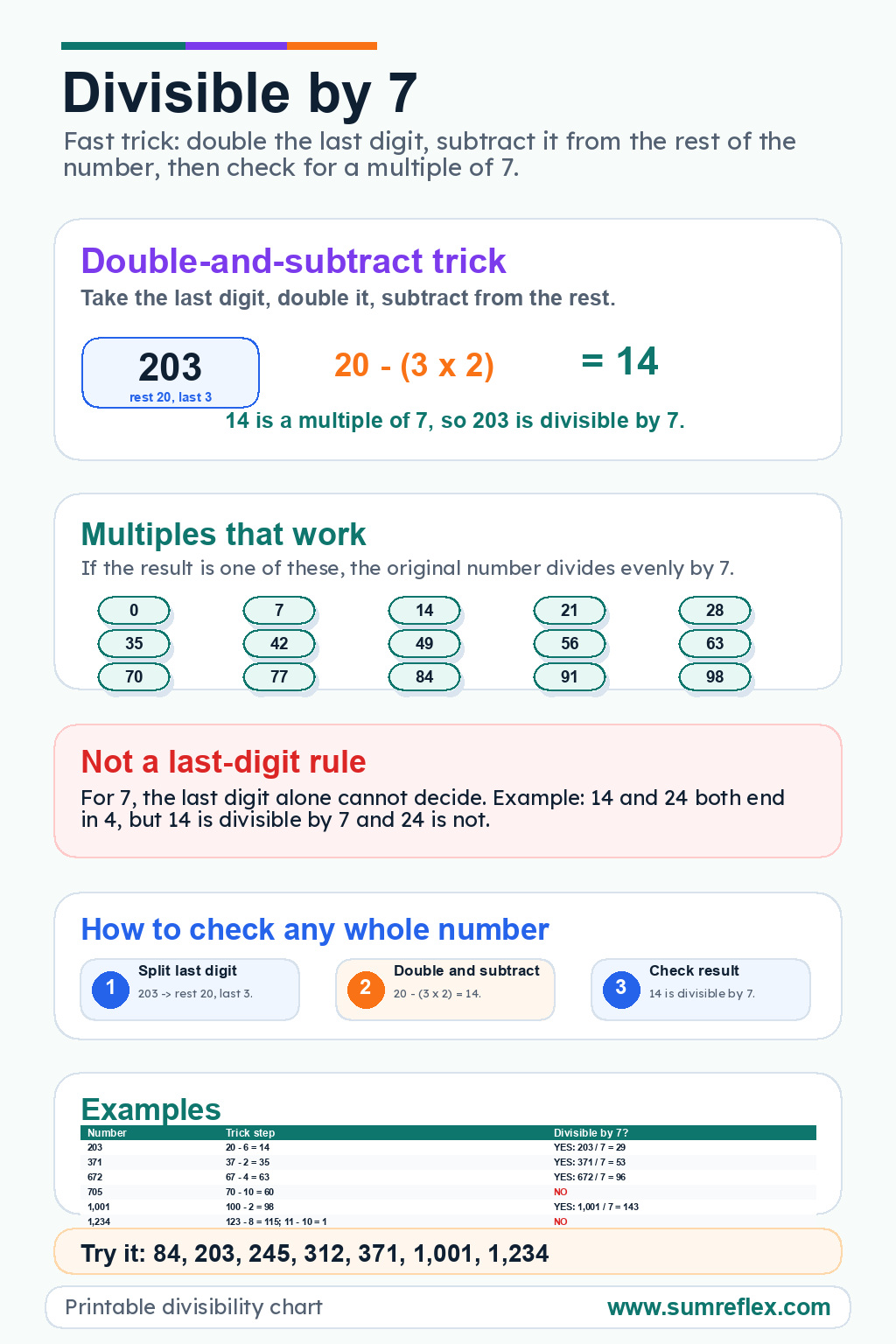
Divisibility by 7 practice guide
Making the divisible by 7 chart usable for students who dislike tricks
Why this rule feels different from the others
The divisible by 7 chart asks for more patience than most divisibility references. Students cannot decide from the last digit, and the digit sum does not solve the problem. The double-and-subtract rule gives a workable path: remove the last digit, double that removed digit, subtract the result from the remaining number, and then check whether the new number is divisible by 7. For 203, remove 3, double it to 6, and subtract from 20 to get 14. Since 14 is divisible by 7, 203 is divisible by 7.
That sequence is why the chart should be treated like a worked procedure rather than a flashcard. Some learners will prefer direct division for small numbers, and that is fine. The printable is most useful when the original number is large enough that reducing it makes the decision easier.
Making double-and-subtract less intimidating
Students need room to write the steps. Have them draw a slash before the final digit, double the final digit underneath, and write the subtraction line beside the original number. For 532, the work becomes 53 - 4 = 49, and 49 is a known multiple of 7. The visual spacing matters because the rule has more moving parts than the rules for 2, 5, or 10.
The divisible by 7 lesson can give extra examples, but the chart is the quick reference students need during mixed practice. If the first reduced result is still large, the same process can be repeated. The goal is not to make students perform a magic trick quickly; it is to give them a reliable reduction they can explain.
How to verify the result without memorizing every multiple
A weak spot in the 7 rule is the final check. After reducing a number, students still need to know whether the result is a multiple of 7. They do not need a huge memorized list, but they should know the common products from 7 x 1 through 7 x 12 and be comfortable extending by adding 7. The chart can be used with skip counting or a multiplication table when that memory is still developing.
For deeper checking, pair this printable with the prime and composite numbers chart. Seven is prime, so when a whole number is divisible by 7, that factor can become a meaningful part of a factor tree. The Factor Calculator can confirm the complete factor list after students use the chart to make the first decision.
Natural uses for the seven test
This chart fits best in mixed divisibility practice, factor trees, enrichment groups, and number theory review. It is not usually the first rule students master, but it becomes valuable when they need a method that is more interesting than trial division. Use examples such as 196, 343, 483, and 1,029 to show that the process can handle both familiar and less familiar numbers.
A good exit question asks students to compare two methods. They can divide the number directly, then use double-and-subtract and see whether both routes agree. That comparison helps the rule feel trustworthy. Once students realize the chart is a checking method they can defend, they are more willing to use it inside larger problems instead of skipping every number that involves a factor of 7.