



Sixes counting guide
Making the sixes pattern less intimidating
Six is a compound group
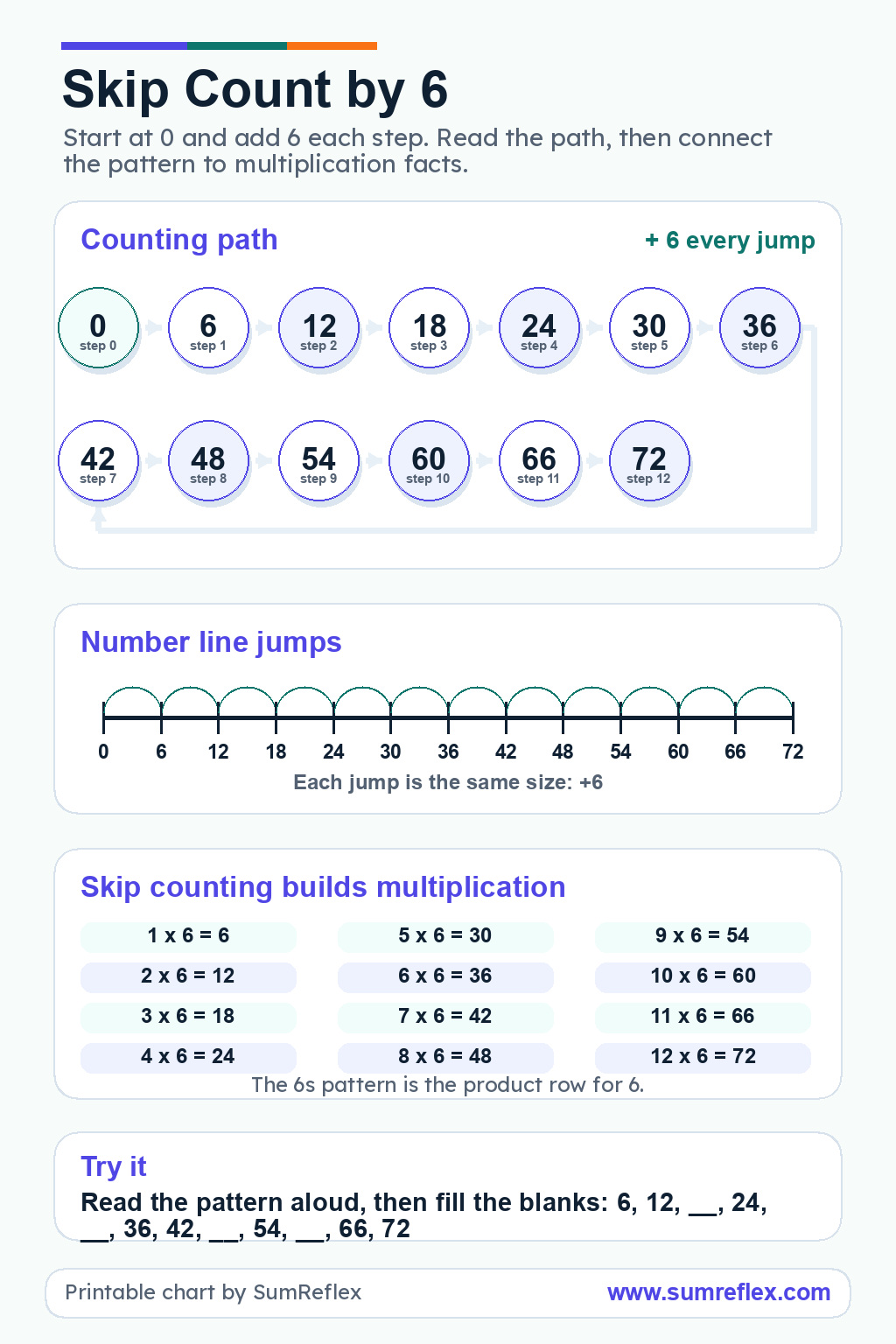
A group of six can feel large to students who are still new to skip counting. It becomes easier when they see six as two groups of three or as five with one more. The chart shows the final totals, but classroom practice should let students build those totals with counters, dice patterns, egg-carton rows, or dot arrays.
The count moves 6, 12, 18, 24, 30, and 36 because each new group adds the same amount. Students who can explain that repeated addition are in a stronger position than students who only recite the row.
Doubled threes are a useful support
One practical strategy is to build the sixes from threes. If a student knows 7 x 3 = 21, then 7 x 6 is double that amount, which gives 42. This does not replace learning the sixes pattern, but it gives students a reliable way to recover a fact when recall is slow.
The skip count by 3 chart can support that bridge. Put the threes page beside this one and let students compare the seventh, eighth, and ninth landings in both sequences.
The number line shows a bigger stride
The number line portion is important because a jump of 6 covers more space than earlier skip-count patterns. Students can see that 18 to 24 and 48 to 54 are the same size jump even though the numbers are in different ranges. That visual equality is the heart of skip counting.
For practice, ask students to start from 24 and count three more jumps. They should land on 30, 36, and 42. Beginning in the middle prevents the chart from being used only as a memorized song.
A later divisibility test uses two ideas
When students reach divisibility, 6 has a special rule: a number must be divisible by both 2 and 3. The divisible by 6 chart explains that test. This skip-count page prepares the ground by showing the multiples first.
It can be useful to circle 6, 12, 18, 24, and 30, then ask what they have in common. Students may notice they are even, and some will notice the connection to threes. Those observations are the beginning of the later rule.
From sequence to multiplication row
The 6 times table chart gives a cleaner fact layout after students understand the count. Use this page when they need to rebuild products through equal jumps, and use the times-table page when they are ready to review fact pairs quickly.
Good uses for the printable
This chart works well in Grade 3 multiplication folders, tutoring sessions, small-group intervention, and mixed-fact review. It is especially useful for students who can count by twos, threes, fives, and tens but hesitate when the sequence requires a larger step.
For written work, choose one landing point and ask students to explain two ways to reach it. The number 48, for example, can be eight jumps of 6, double eight jumps of 3, or five groups of 8 plus one more group of 8 if students are comparing related facts. Multiple explanations help keep the sixes row from becoming a brittle memorized list.
If a learner loses the sequence after 36, have them return to an anchor they know rather than restart at 6. Anchors such as 30, 36, and 60 make the row easier to navigate.