



Groups of three reference
Seeing threes as repeated groups instead of a memorized chant
Three objects at a time creates the count
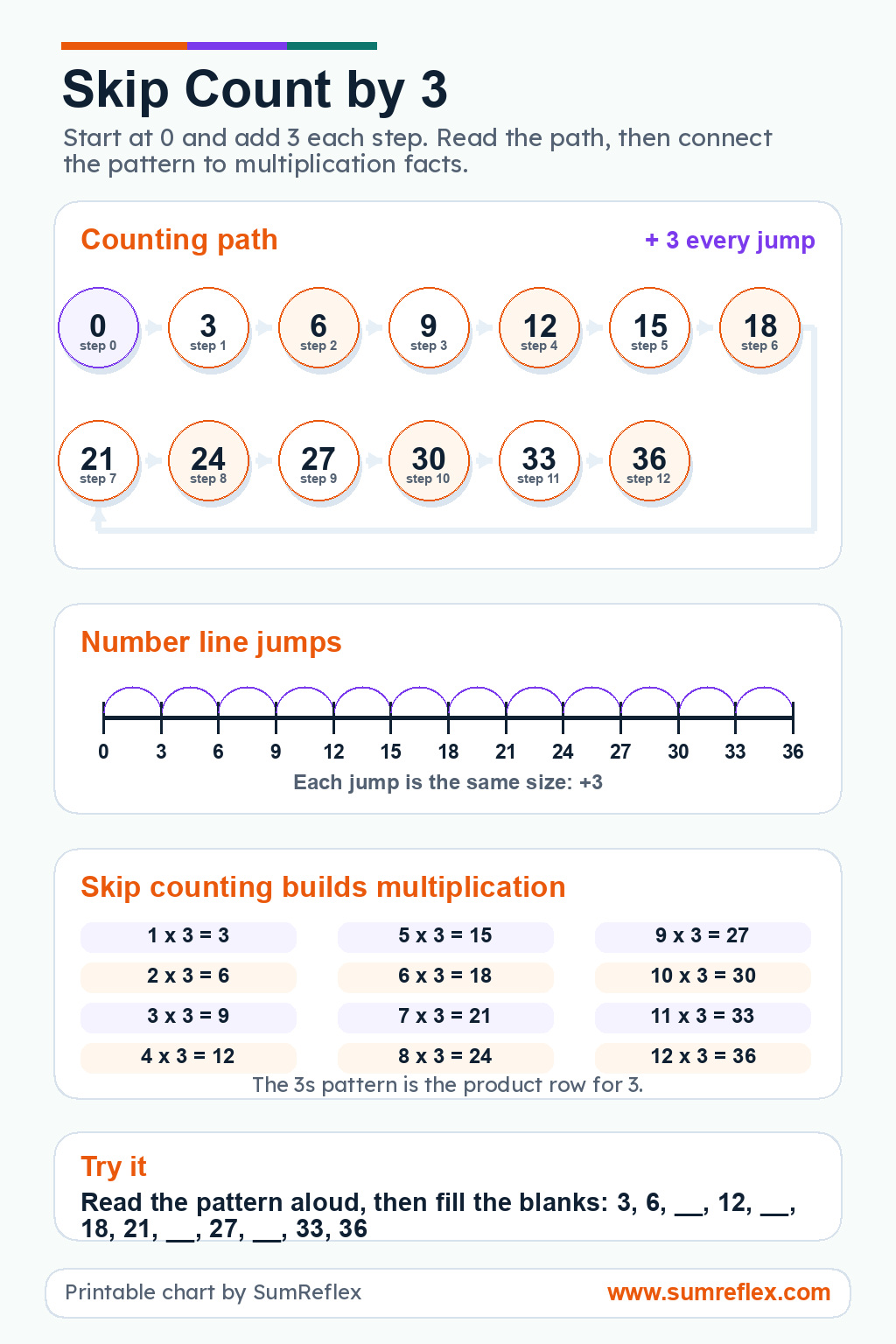
The threes sequence is easiest to understand when it begins with objects: three crayons in each cup, three counters in each row, three sides on each triangle, or three points earned each turn. Students can count each group as one unit and then record the running total. The chart gives that running total a clean visual home.
Unlike counting by 2 or 5, the threes pattern does not always give students an instant ending-digit clue. That is why the grouped meaning is important. The count is not random. It is 3 added again and again: 3, 6, 9, 12, 15, 18, and onward.
Rhythm helps, but reasoning should stay visible
Many students learn the sound of 3, 6, 9, 12 before they understand why those numbers belong together. Saying the sequence aloud is still useful, especially if students tap once for each group rather than tapping every single object. The tap marks the group; the spoken number names the total.
After the rhythm is familiar, ask questions that interrupt the chant. What comes before 24? What is three more than 27? Which count is the sixth landing point? These questions make students use the chart as a reference rather than recite from memory every time.
The digit-sum rule arrives later
Students may eventually learn that many multiples of 3 can be checked by adding digits. That belongs with the divisible by 3 chart. This skip-count chart comes first because it shows where the multiples come from before a shortcut is introduced.
A helpful classroom sequence is to build the list with groups, mark the values on this chart, and only later test larger numbers with the digit-sum rule. That order keeps the shortcut from feeling like a trick.
Moving into multiplication facts
The 3 times table asks students to name the total for a given number of groups. The skip-count chart lets them walk there. If the question is 7 x 3, a learner can count seven landings: 3, 6, 9, 12, 15, 18, 21. That method should become faster with practice, but it gives students a dependable bridge while facts are still developing.
When fact notation becomes the focus, use the 3 times table chart beside this page. The threes count is the movement; the times-table page is the fact record.
Middle-start practice prevents fragile recall
A student who can recite from 3 to 36 may still struggle when asked to begin at 18. Use the chart to practice from different starting points: start at 15 and count forward three steps, or start at 30 and count backward two steps. This turns the sequence into a flexible number pattern rather than a memorized line that only works from the beginning.
Another useful prompt is to place a blank between two known counts. If the chart shows 18, blank, 24, the missing value must be 21 because it is three more than 18 and three less than 24. These neighbor checks help students use the step size from both directions, which is exactly what they need when threes appear inside mixed multiplication and division work.
For quick review, ask students to name a real group of three before they solve. Three wheels on tricycles, three vertices on triangles, or three points in a game gives the sequence a reason to exist.